XRP Price Prediction: Ripple Achieves 40 Billion Valuation With Strong Institutional Outlook

Last Updated 2026-03-25 21:51:08
Reading Time: 1m
In 2025, XRP overcame regulatory challenges to achieve a $40 billion market capitalization, strengthening its cross-border payment capabilities through acquisitions and global expansion. This article examines Ripple’s practical strategies, prospects for stablecoins and institutional adoption, and provides an outlook on potential developments for XRP in 2026.

Preface

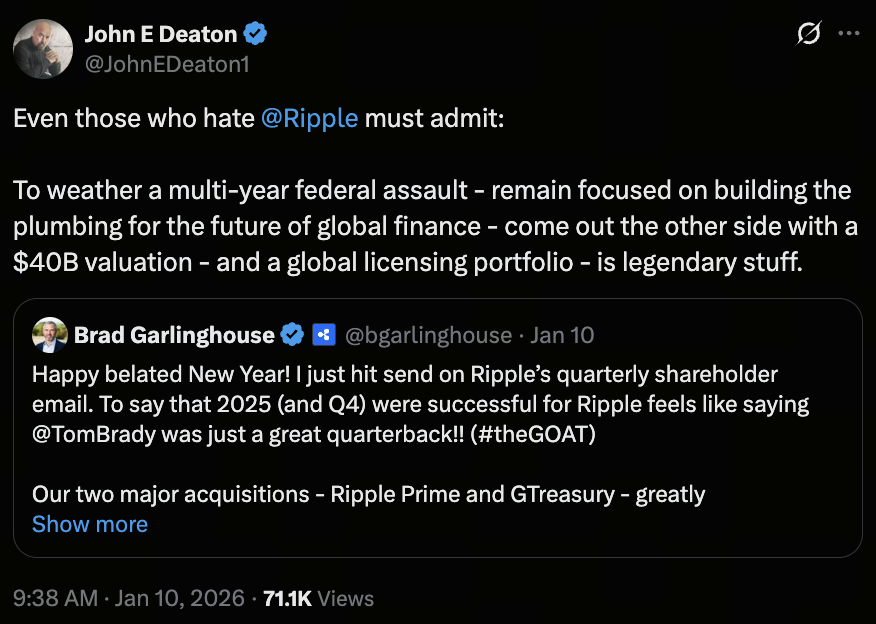
After five years of regulatory headwinds, Ripple has continued to show exceptional resilience and a clear long-term strategy. John Deaton, legal counsel for XRP holders, expressed strong admiration for Ripple’s achievements in 2025, noting that even critics must recognize the company’s outstanding results amid challenging circumstances.

Behind the $40 Billion Market Cap Surge

In 2025, Ripple completed several strategic acquisitions, including Ripple Prime and GTreasury. The GTreasury deal, valued at $1 billion, was aimed at enhancing cross-border payment liquidity, settlement speed, and transaction costs. These moves, together with Ripple’s global business expansion, drove its market capitalization past the $40 billion mark.

Ripple also resolved its five-year lawsuit with the U.S. Securities and Exchange Commission (SEC) in 2025, agreeing to a $125 million penalty. The court simultaneously ruled that XRP does not qualify as a security. This milestone not only provided Ripple with a solid legal foundation but also reinforced its standing in the digital asset market.

XRP and Institutional Adoption Strategy

Ripple CEO Brad Garlinghouse emphasized that the company will prioritize the real-world utility of XRP and its stablecoin, Ripple USD (RLUSD), instead of pursuing short-term market trends. The recent approval of a UK electronic money license has further strengthened Ripple’s global compliance framework for 2026, enabling it to provide regulated crypto infrastructure to institutional clients.

(Source: JohnEDeaton1)

Ripple executive Reece Merrick forecasts that with accelerated legislation and policy initiatives like the GENIUS Act, crypto assets will increasingly become part of institutional portfolios. He identifies 2026 as a pivotal year for XRP’s institutional adoption.

Looking Ahead

As regulatory pressures stabilize and global expansion continues, Ripple’s long-term strategy and focus on utility position it as an ideal choice for institutional adoption. Investors should monitor XRP’s development in global payment infrastructure and the stablecoin sector, as these factors will directly influence its future price and market impact.

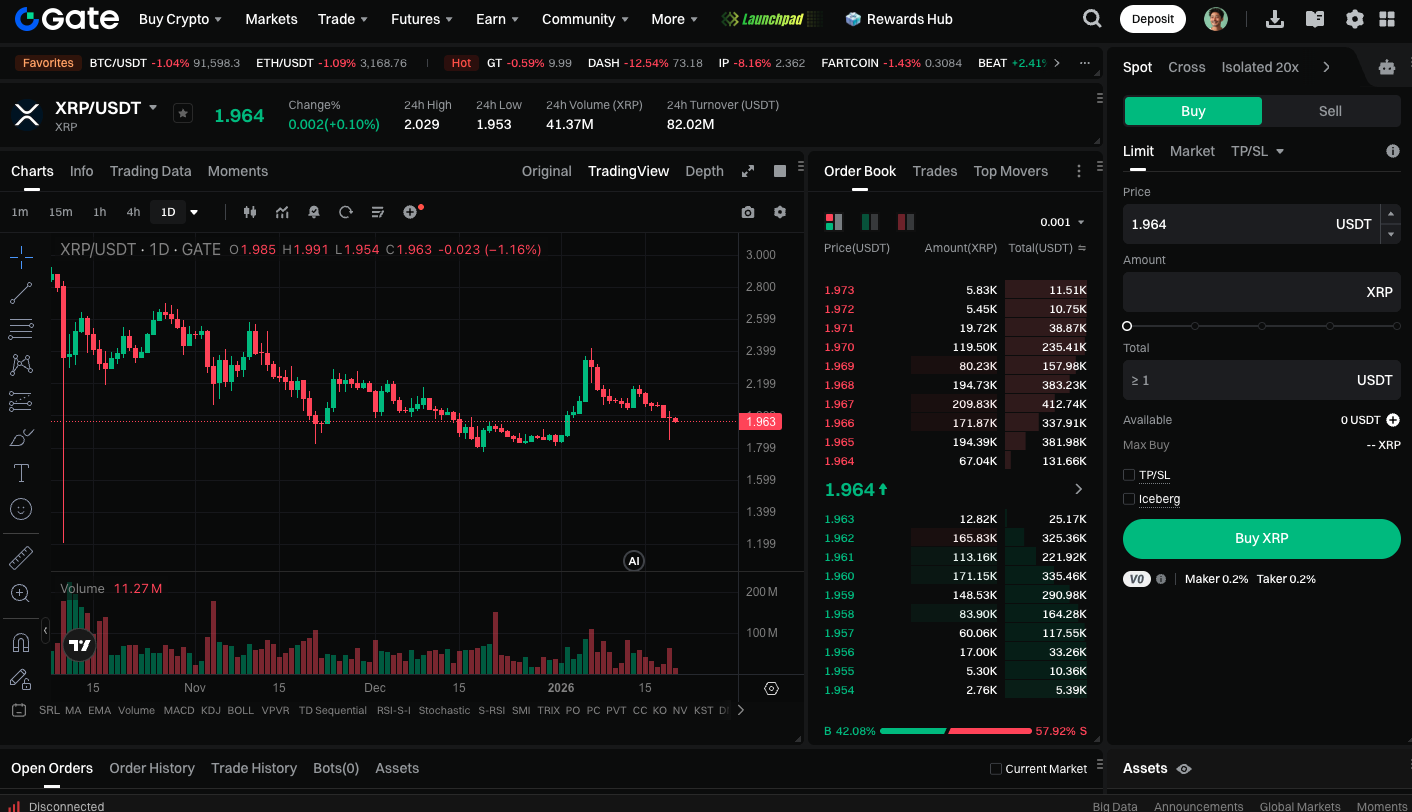
Begin trading XRP spot now: https://www.gate.com/trade/XRP_USDT
Conclusion

Having overcome prolonged regulatory challenges, Ripple has driven its market capitalization to $40 billion and enhanced its cross-border payment capabilities through acquisitions and global expansion. XRP’s utility-focused strategy and robust compliance framework provide a clear advantage for institutional adoption. With growing policy support and market demand, 2026 could mark a major inflection point for XRP’s long-term value.

Author: Allen
Disclaimer
* The information is not intended to be and does not constitute financial advice or any other recommendation of any sort offered or endorsed by Gate.
* This article may not be reproduced, transmitted or copied without referencing Gate. Contravention is an infringement of Copyright Act and may be subject to legal action.

Related Articles

AI-Native Settlement Layers: How United Stables Is Building the Next Financial Rail
Beginner

AI-Native Settlement Layers: How United Stables Is Building the Next Financial Rail

Stablecoins were originally designed as dollar substitutes within exchanges, primarily used for asset pricing and trade settlement. As on-chain financial ecosystems have matured, their role has expanded beyond simple payments to include collateral assets, cross-chain liquidity mediums, and unified settlement units. In particular, as AI systems and automated agents begin to participate directly in economic activity, demand has risen sharply for programmable value units capable of instant settlement. This shift is pushing stablecoins toward the role of foundational financial infrastructure.
2026-03-25 03:16:17
The ve(3,3) Flywheel Explained: How AERO Tokenomics Powers Aerodrome’s DeFi Economy
Beginner

The ve(3,3) Flywheel Explained: How AERO Tokenomics Powers Aerodrome’s DeFi Economy

In the competition for DeFi liquidity, high-inflation mining alone is no longer enough to build lasting advantages. Aerodrome applies the ve(3,3) economic model to redesign token emissions, voting mechanisms, and revenue distribution, creating a liquidity flywheel centered on governance and cash flow. This article examines AERO tokenomics, the veAERO locking mechanism, and protocol revenue models to explain how Aerodrome builds a sustainable DeFi economic system.
2026-03-25 06:41:58
Aerodrome Tokenomics: How ve(3,3) Powers Base's Most Profitable DEX
Beginner

Aerodrome Tokenomics: How ve(3,3) Powers Base's Most Profitable DEX

AERO is the native token of Aerodrome Finance, a core decentralized exchange and liquidity protocol in the Base ecosystem. It is primarily used for liquidity incentives and ecosystem operations. veAERO is a governance NFT that users receive by locking AERO, representing both voting power and the right to share protocol revenue. Through a dual track structure of AERO as a utility token and veAERO as a governance credential, Aerodrome separates liquidity usage value from long term governance power, allowing participants to act as liquidity providers, governance decision makers, and revenue sharers within the same system.
2026-03-25 06:40:31
How Does PAXG Work? In-Depth Overview of the Physical Gold Tokenization Mechanism
Beginner

How Does PAXG Work? In-Depth Overview of the Physical Gold Tokenization Mechanism

PAXG (Pax Gold) is a tokenized asset backed by physical gold, issued by the fintech company Paxos and traded on the Ethereum blockchain as an ERC-20 token. The core concept is to tokenize physical gold on-chain, with each PAXG token representing ownership of a certain amount of gold. This structure enables investors to hold and trade gold in the form of a digital asset.
2026-03-24 19:12:51
How is the price of PAXG determined? Pegging mechanism, trading depth, and influencing factors
Beginner

How is the price of PAXG determined? Pegging mechanism, trading depth, and influencing factors

PAXG (Pax Gold) is a tokenized asset backed by physical gold reserves, launched by fintech firm Paxos and issued as an ERC-20 token on the Ethereum blockchain. The core concept is to digitally represent real-world gold assets, allowing investors to hold and trade gold via the blockchain network. Because each PAXG token corresponds to a specific quantity of physical gold, its price is theoretically expected to closely track the global gold market.
2026-03-24 19:11:40
DePIN Identity Network and Real World Applications: How Humanity Protocol Brings on-chain Identity Into the Physical World
Beginner

DePIN Identity Network and Real World Applications: How Humanity Protocol Brings on-chain Identity Into the Physical World

Most Web3 identity systems remain confined to on-chain environments and struggle to achieve meaningful adoption in real world settings. Through a DePIN architecture and physical verification hardware, Humanity Protocol aims to bring decentralized identity into access control systems, hospitality, public services, and offline events, allowing on-chain identity to function not just as a digital credential, but as foundational infrastructure for real world access.
2026-03-25 07:40:53





