As consumers shift from prioritizing brands to seeking the best combination of price and value, discount retail is emerging as a vital growth engine in the global retail sector. Amid inflation, evolving consumption patterns, and rising economic uncertainty, shoppers are increasingly drawn to high-value products, fueling sustained interest in Off-Price Retail.
From a retail business model perspective, TJX exemplifies a supply chain-driven approach to value creation. Through opportunity buying, rapid inventory turnover, and data-driven operations, TJX has carved out a competitive edge distinct from traditional department stores and general retailers, steadily expanding its global influence in the discount retail market.
What Is Discount Retail (Off-Price Retail)
Discount retail (Off-Price Retail) is a business model where branded inventory, seasonal merchandise, and surplus goods from various channels are sourced and sold to consumers at prices below those of traditional retailers. Unlike conventional retailers who purchase goods based on fixed schedules, Off-Price Retail emphasizes flexible sourcing, fast turnover, and capturing supply chain market opportunities.
TJX Companies (TJX) is a leading example of this model. Its portfolio—including TJ Maxx, Marshalls, and HomeGoods—continuously seeks out discounted branded merchandise, offering consumers apparel, footwear, home goods, and lifestyle products.
Traditional retail relies on forecasting consumer demand and purchasing goods according to quarterly or annual plans. While this approach maintains product stability, it often results in inventory buildup. When market trends shift, retailers may need to clear excess stock through promotions, impacting profitability.
Off-Price Retail operates under a fundamentally different logic. Rather than pre-selecting all products, companies continually seek supply chain opportunities. Brands may clear old inventory to launch new products, manufacturers may produce surplus goods due to changing orders, or retail channels may need to rebalance inventory. While such goods can be burdensome for traditional retailers, they represent attractive sourcing opportunities for discount retailers.
The core value of discount retail lies in connecting the needs of brands, retailers, and consumers. Brands clear inventory through discount channels, retailers benefit from cost advantages, and consumers access branded products at lower prices.
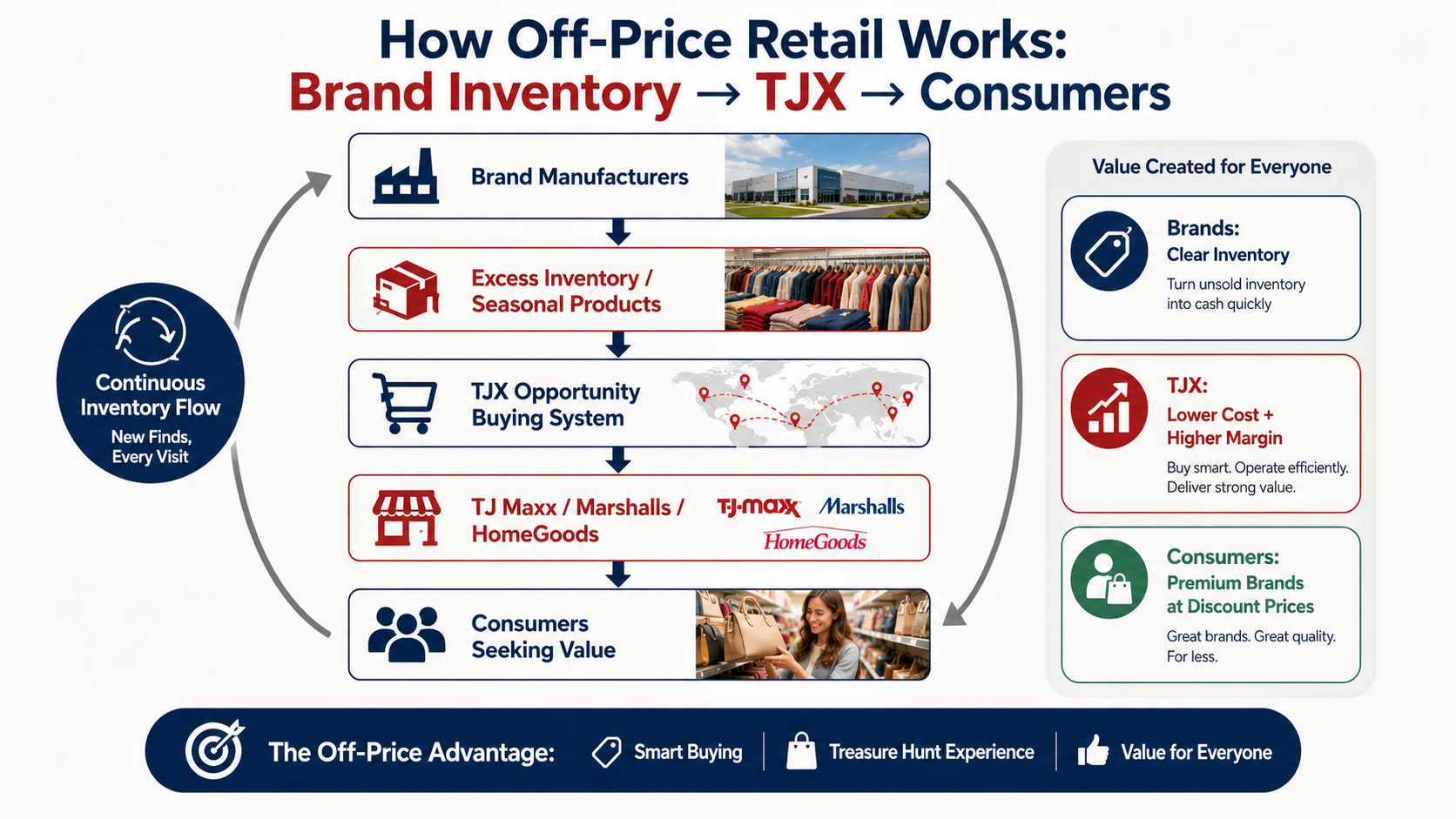
In recent years, as value-for-money becomes a greater priority for consumers, this model has gained widespread acceptance. Especially during economic shifts, consumers do not stop spending but instead seek "higher value" purchasing options, further accelerating the growth of Off-Price Retail.
Why TJX Remains Competitive Over the Long Term
TJX's leadership in the discount retail sector is not solely built on low prices, but on a comprehensive competitive system centered around procurement, supply chain management, and consumer experience.
First, TJX boasts a robust global sourcing network. Long-standing partnerships with brands, manufacturers, and suppliers enable the company to consistently access high-quality merchandise.
For discount retailers, sourcing capability determines the ceiling of the business model. Low prices are achieved not by simply cutting selling prices, but by acquiring desirable products at lower costs. TJX's extensive supply chain relationships allow it to identify opportunities worldwide—a distinct advantage that is difficult for competitors to replicate quickly.
Second, TJX has developed a highly efficient inventory management system. With constantly changing product sources, the company must rapidly distribute and sell merchandise. TJX leverages its store network, data analytics, and logistics infrastructure to ensure products reach the market quickly and are sold efficiently.
Third, TJX delivers a unique shopping experience. Unlike traditional retailers with fixed product assortments, TJX stores frequently update their offerings, allowing shoppers to discover new brands and categories on each visit. This "treasure hunt" experience increases store visits and builds strong customer loyalty.
This business model positions TJX not merely as a platform for discounted goods, but as a key channel for consumers seeking value.
How TJX Sources Branded Discount Merchandise
TJX's procurement system lies at the heart of its business model. The company employs an opportunity buying strategy, seeking branded products with favorable pricing in the global marketplace.
Opportunity buying is not simply about purchasing cheap surplus inventory—it involves identifying commercially valuable products as supply chain dynamics shift. Examples include:
- Surplus inventory generated after brands adjust product lines;
- Out-of-season merchandise following seasonal changes;
- Excess stock resulting from manufacturers' production plan adjustments;
- Products that other retail channels need to clear quickly.
These goods typically do not reflect quality issues, but are more often the result of supply chain cycle adjustments.
TJX's advantage is its scale, allowing it to quickly absorb these resources. With numerous TJ Maxx, Marshalls, and HomeGoods stores, the company can match different products to distinct consumer markets.
For example, a batch of sportswear may be best suited to certain regional markets, while home goods may be distributed through HomeGoods. This flexible allocation boosts the efficiency of product value realization.
Moreover, TJX's procurement team leverages years of industry experience to assess sales potential. By combining expertise with data-driven insights, the company continuously uncovers opportunities in complex market environments.
Unlike traditional retailers, TJX does not depend on a few best-selling products, but on a multitude of opportunities that drive overall growth. This model reduces the risk associated with relying on single products.
Why Discount Retail Is Resilient Across Economic Cycles
A key strength of discount retail is its resilience during economic fluctuations.
When the economy is strong, consumers are willing to buy more branded products, and TJX's discounted offerings meet their desire for quality and value.
During economic downturns, consumers typically scale back high-priced purchases and focus on price advantages. Discount retail channels then attract shoppers who previously bought mid-to-high-end products.
This shift, known as "trade down," sees consumers move from premium channels to those offering better value. TJX's strength is its appeal across multiple consumer segments—not just low-income shoppers. For many, shopping at TJ Maxx or Marshalls is about both saving money and enjoying the discovery of branded products.
As a result, TJX's business model combines price advantages with an engaging shopping experience.
How TJX Achieves High Inventory Turnover
Inventory management is a key reason TJX sustains its competitive edge. For retailers, inventory represents both assets and capital risk. Unsold stock often requires clearance through discounts, impacting profitability.
TJX's Off-Price Retail model naturally emphasizes rapid turnover. Its flexible sourcing avoids the inventory buildup risks faced by traditional retailers who pre-purchase large volumes of fixed products.
TJX's inventory management relies on a cycle of "fast sourcing, fast sales, and continuous adjustment." When procurement teams identify opportunities, TJX quickly acquires merchandise and leverages its logistics and store network to reach consumers. If a product sells well, TJX seeks similar items; if demand lags, it quickly adjusts its assortment.
This flexibility sharply contrasts with traditional retail. Conventional retailers must plan quarterly assortments in advance, and misjudging demand can lead to unsold inventory. TJX sources products dynamically, with inventory structure constantly evolving.
Additionally, TJX optimizes inventory allocation through data analysis. Consumer preferences vary by region—some markets favor sportswear, others focus on home goods. By analyzing sales data, TJX matches products to markets, maximizing inventory utilization.
The store network is fundamental to TJX's inventory turnover. Numerous physical stores provide sales channels and serve as key nodes for product flow. When regional inventory needs adjustment, TJX redistributes merchandise through its supply chain system, enhancing operational efficiency.
This high-turnover model means TJX does not rely on large-scale promotions to clear stock, but sustains profitability through rapid product movement—a major factor behind its consistently high operational efficiency.
How TJX Differs From Ross Stores and Burlington
Within the Off-Price Retail market, TJX faces competition from Ross Stores and Burlington. While all three employ discount retail models, they differ in brand portfolio, supply chain capability, and consumer positioning.
Ross Stores is another major US discount retailer, with brands like Ross Dress for Less and dd’s DISCOUNTS. Ross's strength lies in its low-price strategy, attracting shoppers through large-scale procurement.
TJX, in contrast, offers a more diverse brand mix. In addition to TJ Maxx and Marshalls, it owns HomeGoods and other home-focused brands, covering more consumer scenarios beyond apparel. This enables TJX to serve both individual and household shopping needs.
Burlington also specializes in discount apparel, with a model similar to TJX. Recent store expansion and brand optimization have bolstered its competitiveness, but TJX continues to hold a strong market position thanks to its global procurement network and scale.
Compared to traditional retail giants like Walmart and Costco, TJX's competitive logic is distinct.
Walmart's strength is its massive supply chain, offering everyday low prices through bulk purchasing and efficient logistics. Shoppers visit Walmart for staple items like groceries, household goods, and daily necessities.
Costco relies on a membership model, reducing costs with curated products, high-volume purchasing, and strong member loyalty. Its supply chain focuses on fewer SKUs and maximizing single-product sales efficiency.
TJX excels at discovering value products. Rather than pursuing stable supply for all items, it flexibly sources opportunity merchandise and attracts consumers through its unique shopping experience.
Thus, these three represent different retail competition models:
- Walmart emphasizes scale efficiency;
- Costco emphasizes member value and curated products;
- TJX emphasizes supply chain flexibility and value discovery.
Challenges Facing Discount Retail
Despite its steady growth, Off-Price Retail faces several challenges.
Competition is intensifying. As value-for-money becomes a priority, more retailers are adopting discount strategies. Department stores, e-commerce platforms, and large general retailers are all offering more attractive prices, increasing market pressure.
Supply chain complexity is rising. TJX's model depends on a global sourcing network, so changes in trade policy, rising logistics costs, and supply chain disruptions can impact procurement efficiency. Recent global supply chain adjustments require companies to diversify suppliers and build resilience.
Consumer shopping habits are evolving. While physical stores remain TJX's core strength, online shopping is reshaping the retail landscape.
For discount retailers, moving online is not as straightforward as selling standardized products. TJX's offerings are random and fast-changing, making it challenging to replicate the offline "treasure hunt" experience digitally.
Additionally, younger consumers demand greater brand value, sustainability, and enhanced shopping experiences. Retailers must deliver not only price advantages but also richer brand connections.
Future Trends in Off-Price Retail
Looking ahead, Off-Price Retail has significant growth potential.
Consumers' focus on value will persist. Regardless of economic conditions, shoppers want higher-value products. Increasingly, consumers seek a balance between price and quality, creating ongoing growth opportunities for TJX and its peers.
Supply chain digitization will drive industry advancement. AI, big data analytics, and automated logistics will enable retailers to manage procurement and inventory with greater precision. For TJX, technology enhances, rather than replaces, the opportunity buying model—empowering teams to identify market opportunities. By analyzing consumer behavior, sales trends, and inventory data, TJX can allocate resources more efficiently.
Global sourcing remains a key competitive factor. Companies with broader supplier networks can secure better-priced merchandise.
In the future, leading Off-Price Retailers will need three core capabilities:
- Global product acquisition;
- Rapid inventory management;
- Digital consumer engagement.
TJX's current advantage is built on these strengths.
Conclusion
The sustained growth of discount retail (Off-Price Retail) is driven by evolving consumer values and improved supply chain efficiency. Compared to traditional retail, TJX leverages opportunity buying, a global supply network, and high inventory turnover to transform supply chain complexity into competitive advantage.
TJX's success is not just about low prices—it is built on a business system that consistently uncovers product value. Through brands like TJ Maxx, Marshalls, and HomeGoods, TJX serves multiple consumer scenarios and adapts to market changes with flexible operations.
As consumers continue to prioritize value, digital technology enhances retail efficiency, and global supply chains are optimized, Off-Price Retail is poised for continued growth. As an industry leader, TJX exemplifies how modern retailers can create lasting competitive advantages through supply chain excellence.