As social media enters a zero-sum game, relying solely on user growth has lost its edge. AI is now the key to boosting average revenue per user (ARPU). Recommendation engines use deep learning to fine-tune content rankings, keeping people glued to apps like Facebook and Instagram for longer stretches.
Meanwhile, generative AI is reshaping content production. Platforms are evolving from passive content distributors into integrated content generators and distributors, further elevating AI’s strategic role.
Meta is rolling out next-generation data centers globally, purpose-built for AI training and inference. These aren’t just cloud computing hubs—they’re high-performance systems optimized for large model training. Key features: high-density GPU clusters, low-latency interconnects, and storage architectures designed for AI workloads. These systems handle parallel training across tens of thousands of GPUs to meet the exponential hashrate demands of large models.
Meta is also fine-tuning its data scheduler to dynamically share compute power across ad recommendations, content moderation, and AI training—boosting overall efficiency and resource utilization.
To cut its reliance on external GPU suppliers, Meta Platforms created its own AI chip: MTIA (Meta Training and Inference Accelerator). MTIA isn’t built for general training—it’s focused on high-frequency inference tasks like ad recommendation ranking and content filtering. This gives it an advantage in unit power consumption and cost control.
Strategically, a custom chip means "compute autonomy." Meta reduces dependence on outside hardware vendors, lowers marginal compute costs over time, and sharpens the overall economics of its AI systems.
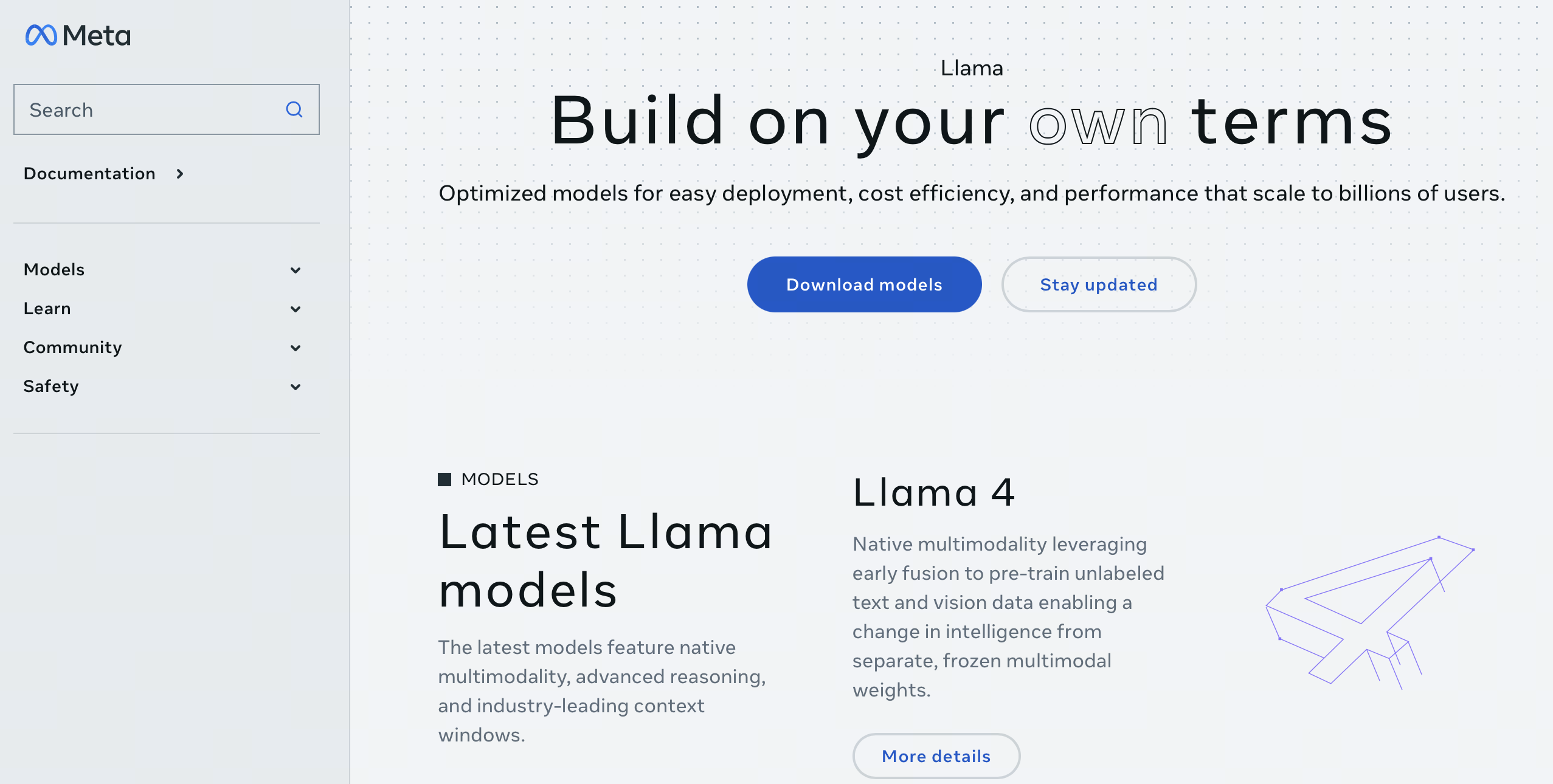
At the heart of Meta’s AI ecosystem is the open-source model Llama. Unlike closed systems, Llama’s open approach lets developers freely deploy, fine-tune, and build apps. This yields two big outcomes: faster technology spread and a rapidly growing developer community, plus stronger influence for Meta’s AI technical standards.
On the product side, Llama is deeply woven into Meta’s AI assistant ecosystem—covering WhatsApp, Instagram, and Messenger—creating a fast loop from model capability to user-facing apps.
AI infrastructure is shifting from a cost sink to a strategic asset. For Meta, this system drives three key levers: ad efficiency, content distribution, and model iteration speed. Better recommendations lift ad conversion rates, and ad revenue is Meta’s cash cow. So, AI infrastructure and revenue are tightly linked.
Scale also cuts unit compute costs, creating economies of scale that give Meta a stronger cost structure in the long game.
Compared to NVIDIA, Microsoft, and Google, Meta’s AI infrastructure strategy is more "application-driven."
| Company |
Core Positioning |
AI Infrastructure Model |
Technology/Resource Core |
Strategic Focus |
Ecosystem Strategy |
| NVIDIA |
Bottom-level compute & chip supplier |
"Shovel seller" infrastructure provider |
GPUs (H100, Blackwell), CUDA ecosystem |
Provide general-purpose AI compute |
Strong platform lock-in (CUDA locks developers) |
| Microsoft |
Cloud computing + enterprise AI platform |
Cloud AI infrastructure (IaaS + PaaS) |
Azure, OpenAI partnership, enterprise AI toolchain |
Embed AI into productivity & cloud services |
Enterprise ecosystem closed but broad |
| Google |
Vertically integrated AI + Search + Cloud |
Custom chips + proprietary product loop |
TPU, Gemini, Search/YouTube data |
Reinforce search & ad core |
Highly integrated closed loop |
| Meta |
Social + ad-driven AI application company |
Application-driven infrastructure |
Llama (open-source), custom training/inference clusters |
Optimize social ads & content distribution |
"Internal optimization + open-source diffusion" dual path |
Meta’s hallmark: its infrastructure serves only its own apps (social, ads, content), and it extends external influence through open-sourcing Llama. It’s a hybrid of "internal efficiency first + external ecosystem diffusion."
What Challenges Does Massive AI CapEx Face?
Building AI infrastructure demands sustained heavy spending, putting long-term pressure on Meta.
First, hardware costs keep rising—GPUs and data centers need continuous investment. Second, energy consumption is a beast—training big models guzzles power and requires serious cooling.
Third, the payback cycle is long—infrastructure costs are recouped gradually via ad efficiency gains over years. Fourth, tech iteration risk looms—new model architectures can quickly obsolete older hardware.
Global stock investing is evolving. New entry points—like digital asset platforms such as Gate—are emerging. Some now let you trade US stocks, including Meta, directly with stablecoins like USDT—no traditional brokerage needed.
The big shift: "account and asset integration." Users manage crypto and stocks on one platform, lowering cross-border barriers and improving capital mobility.
Some platforms also offer extended or near-24-hour trading, letting investors ride US stock volatility more flexibly. For high-beta tech stocks like Meta, this boosts accessibility and liquidity management.
Note: These platforms change only the entry and settlement method, not Meta’s risk profile. Its price still depends on ad cycles, AI investment pace, and macro conditions.
Meta’s AI infrastructure will evolve in three directions:
- Compute autonomy: Cut GPU dependence further via MTIA and custom chips.
- Multimodal expansion: Let AI handle text, images, and video together for deeper understanding.
- Edge AI & edge computing: Push AI to smart glasses, phones, and other devices for real-time interaction.
Summary
Meta Platforms is building a complete AI infrastructure stack—data centers, the custom MTIA chip, and the open-source Llama model. This stack powers its ad and social businesses and is becoming the engine of future growth.
As AI takes center stage in global tech competition, Meta’s playbook is shifting from "traffic platform" to "compute and model platform." AI infrastructure is redefining its long-term growth trajectory and cementing its position in the global digital economy.