
The retail industry has long been shaped by shifts in consumer behavior, the rise of online shopping, and technological innovation. Walmart’s significance lies not only in its massive sales volume, but also in its leadership in the digital transformation of traditional retail. Facing competition from internet retail platforms like Amazon, Walmart has evolved from a purely brick-and-mortar enterprise into an omnichannel commercial ecosystem that integrates online and offline resources.
From an industry perspective, Walmart’s growth demonstrates the global retail shift from “store competition” to competition centered around supply chain, data, and technology. By investing continuously in AI, automation systems, and digital infrastructure, Walmart is working to build a smarter, more efficient retail network.
Walmart’s Core Business Structure
Walmart’s business consists of three major segments: Walmart U.S., Walmart International, and Sam’s Club.
Walmart U.S. is the company’s core operation and largest revenue contributor, covering Supercenters, Neighborhood Markets, online retail, and delivery services across the United States. This segment offers food, fresh produce, daily necessities, electronics, apparel, and home goods—forming the foundation for Walmart’s “one-stop shopping” model.
Walmart International manages operations in multiple countries and regions, including Mexico, China, Canada, and India. Unlike the mature retail environment in the U.S., the international segment prioritizes localized operations, building competitive advantages by adapting to diverse consumer needs.
Sam’s Club is Walmart’s warehouse retail brand targeting the membership market. Similar to the Costco Wholesale model, Sam’s Club attracts consumers through membership fees, bulk purchasing, and high-value products. In recent years, Sam’s Club has strengthened its digital experience with mobile payments, online orders, and smart delivery services.
Beyond traditional retail, Walmart has actively expanded into advertising, financial services, and data services, aiming to leverage its extensive consumer traffic to generate new revenue streams.
How Walmart Builds a Leading Global Retail Ecosystem
Walmart’s enduring competitive advantage is driven by three core factors: scale, supply chain capability, and consumer data accumulation.
Procurement scale is one of Walmart’s most important competitive barriers. With a vast global network of stores and consumer demand, Walmart can source products at lower costs and attract customers with price advantages—helping establish strong brand influence in the mass market.
Supply chain systems are fundamental to Walmart’s operational efficiency. The company invests heavily in logistics centers, inventory management systems, and delivery networks, optimizing product flow through data analysis. By monitoring sales data in real time, Walmart can adjust inventory levels to minimize stockouts and excess inventory.
Digital capability is becoming the new core of Walmart’s ecosystem. Consumers now shop not only in physical stores, but also via the Walmart app, online marketplace, and delivery services. By integrating online orders, membership data, and consumer behavior, Walmart delivers a more personalized shopping experience.
This omnichannel model positions Walmart not just as a retailer, but as a platform connecting consumers, suppliers, logistics networks, and digital services.
In recent years, AI and automation have become key drivers of operational efficiency at Walmart.
Within the supply chain, Walmart uses AI to forecast consumer demand, analyzing historical sales data, seasonal trends, and regional consumption patterns to improve inventory management accuracy. For example, before holidays or special consumption cycles, AI systems help the company adjust product supply in advance, boosting operational efficiency.
In warehousing, Walmart continues to build automated distribution centers, deploying robotic systems for product sorting, transportation, and packaging—accelerating logistics and reducing labor costs. Automation helps address the long-term labor cost pressures in retail.
For store operations, Walmart applies AI to optimize shelf management, product replenishment, and customer service. Computer vision technology, for instance, can monitor inventory status, reducing manual inspection costs and improving supply stability.
The advancement of generative AI is also driving Walmart to explore new consumer interaction methods, such as smart shopping assistants, personalized recommendations, and internal employee AI tools. In the future, AI will impact not only Walmart’s back-end operations, but may also transform the consumer shopping experience.
Walmart’s Strategy in E-Commerce, Membership Services, and Advertising
As online retail competition intensifies, Walmart continues to strengthen its e-commerce capabilities.
Walmart’s e-commerce strategy does not simply replicate Amazon’s model, but leverages its physical store network to build unique advantages. Its extensive store footprint serves as distribution nodes, enabling Walmart to offer faster local delivery.
Recently, Walmart launched the Walmart+ membership program, enhancing customer retention through member benefits. Walmart+ offers delivery discounts, fuel savings, mobile payments, and other perks designed to increase repeat purchases.
Advertising has become a major growth area for Walmart. Walmart Connect, the company’s retail media platform, enables brands to conduct targeted marketing using consumer shopping data. Unlike traditional advertising, retail ads directly connect with purchase behavior, making them a key profit driver for large retailers.
As competition among e-commerce platforms intensifies, advertising is also a critical battleground between Walmart and Amazon. In the future, consumer data may become the central asset for retail enterprises.
How Walmart Differs from Amazon, Costco, and Target
Walmart, Amazon, Costco, and Target are all major players in the U.S. retail market, but their business models are distinct.
Amazon’s core strengths are e-commerce infrastructure, cloud computing, and a global logistics network, with a focus on online shopping and digital services.
E-Commerce Capability
Walmart’s advantages stem from its physical retail network, supply chain scale, and integrated online-offline capabilities. Unlike Amazon, Walmart’s numerous stores provide direct access to consumers and serve as distribution nodes.
Costco’s core model is membership-based warehouse retail, built on low SKU count, high volume, and membership fee revenue. Compared to Costco, Walmart offers a broader product selection, catering to a wider range of consumer needs.
Target focuses on brand experience, design, and mid-to-high-end consumers, differentiating itself from Walmart’s low-price, mass-market positioning.
Walmart’s competitive strategy is not simply to become the largest online retailer, but to build differentiated advantages through its physical network, digital technology, and supply chain strength.
How to Trade WMT Stock on Gate
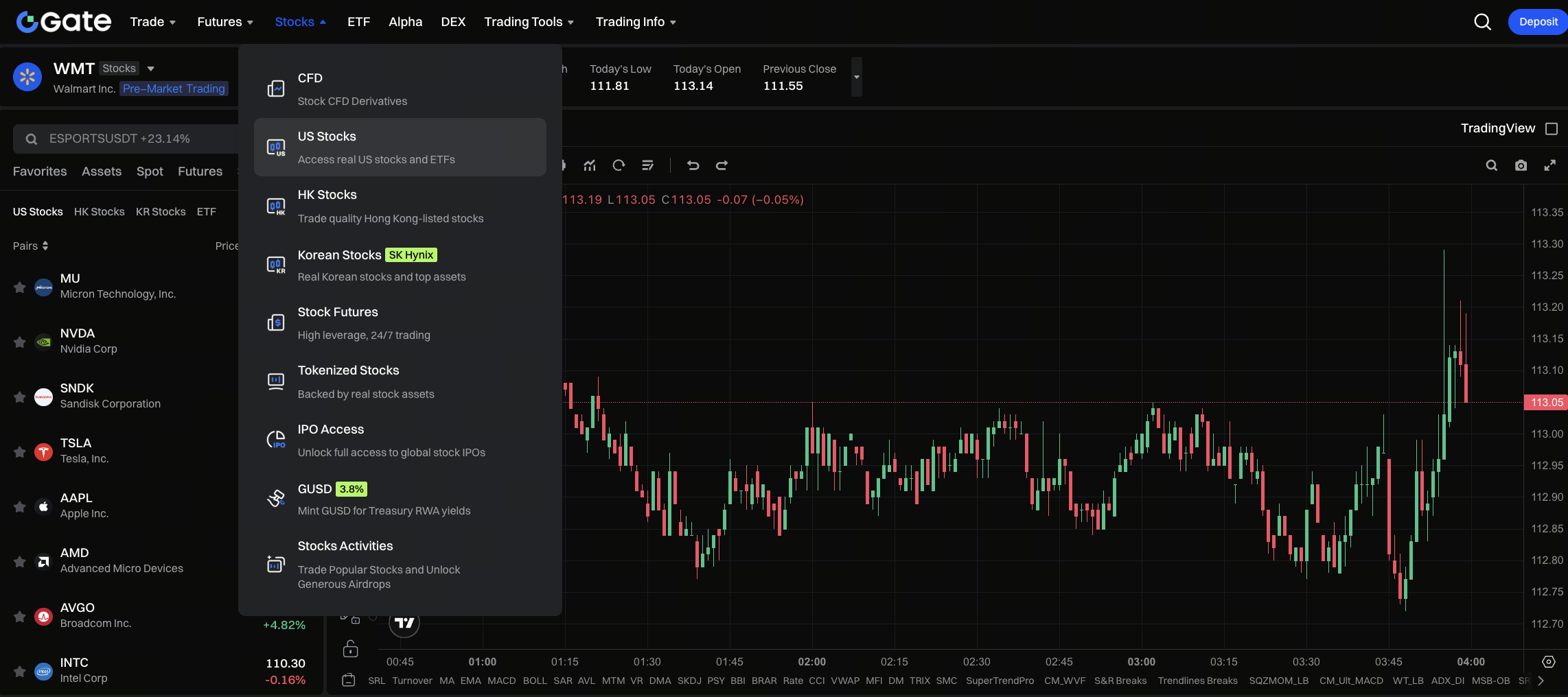
As global investors increasingly focus on U.S. equities, traditional stock assets are entering the ecosystem of digital asset trading platforms. Gate offers stock-related products and trading services, providing users with convenient market access and insights into the performance of global corporate assets, including Walmart (WMT).
As a leader in global retail, Walmart stock price is influenced by consumer trends, retail data, earnings reports, AI investments, and macroeconomic factors. Through Gate’s trading channels, users can monitor WMT market activity and conduct research based on corporate fundamentals, industry trends, and market information.
Compared to traditional stock trading, digital platforms deliver a more flexible asset management experience. Users can view market prices, access company information, and select trading methods according to their risk preferences. Investors should be aware that stock markets are affected by company performance, economic cycles, policy changes, and other factors—so it’s essential to understand the associated risks.
For users interested in the convergence of global corporate assets and digital financial services, Walmart (WMT) exemplifies digital transformation in traditional retail, while Gate offers a digital platform connecting global asset information and trading services.
Key Risks to Consider When Investing in WMT Stock
As a global retail leader, Walmart has a stable business foundation, but investing in WMT stock still involves several risk factors.
-
The retail industry remains fiercely competitive. Amazon, Costco, Target, and emerging e-commerce platforms are continually strengthening their market position, which may impact Walmart’s market share and profitability.
-
Margin pressure is a longstanding challenge for traditional retailers. Walmart’s commitment to low prices requires ongoing efficiency improvements to offset rising labor, logistics, and supply chain costs.
-
International operations carry market risks. Consumer preferences, regulatory environments, and economic cycles vary by country, so global expansion may face operational challenges.
-
Large-scale investments in AI, automation, and digital infrastructure can enhance long-term competitiveness, but may increase short-term capital expenditure.
Walmart’s Future Direction and Long-Term Growth Potential
Looking ahead, Walmart’s growth will focus on three key areas.
Advancing smart retail. As AI technology matures, Walmart can further optimize supply chain, inventory management, and customer service, boosting overall operational efficiency.
Expanding digital business revenue. E-commerce, membership services, and advertising will become important growth drivers beyond traditional product sales.
Strengthening the omnichannel ecosystem. Compared to purely online platforms, Walmart’s greatest advantage lies in its global physical network. In the future, the company may continue leveraging its stores, logistics, and data capabilities to achieve seamless online-offline integration.
Long-term, retail competition is shifting from price to efficiency. Companies with supply chain, data, and technology strengths are better positioned to maintain an edge in the evolving market.
Summary
Walmart (WMT) has grown from a U.S. discount retailer into a global retail powerhouse, built on procurement scale, supply chain management, and consumer trust.
In response to the rise of e-commerce and changing consumption patterns, Walmart is achieving digital transformation through AI, automation, e-commerce platforms, membership services, and advertising. Moving forward, Walmart’s core competitiveness will come not only from product sales, but also from data, technology, and omnichannel ecosystem development.
For market participants monitoring global business models and retail industry trends, Walmart is a prime example of how traditional enterprises achieve long-term growth through digital transformation.
FAQs
What Is Walmart (WMT)?
Walmart (WMT) is one of the world’s largest retail companies, with main businesses including physical retail, e-commerce, membership warehousing, advertising services, and supply chain management.
Why Does Walmart Maintain a Long-Term Competitive Advantage?
Walmart’s advantages stem from global procurement scale, supply chain efficiency, low-price strategy, and a vast consumer network.
Is Walmart an E-Commerce Company?
Walmart is not a pure e-commerce company; it builds an omnichannel retail model through online marketplaces, mobile apps, and a physical store delivery network.
What Are Walmart’s AI Strategies?
Walmart uses AI for demand forecasting, inventory management, logistics optimization, smart recommendations, and internal operational automation.
What Should You Consider When Investing in WMT Stock?
Investors should monitor retail competition, margin changes, international market performance, and the cost pressures from AI and digital investments.