As cross-chain protocols become essential blockchain infrastructure, security has emerged as a top priority for both users and developers. Cross-chain asset transfers and inter-chain message communication involve multiple blockchain networks; if the verification mechanism fails, it can lead to asset loss or incorrect state. As a result, building a reliable security layer has become a core requirement for cross-chain protocol development.
In the Celer Network architecture, the SGN functions as a "cross-chain coordination center." Whether it's asset bridging through cBridge or message transmission via Inter-chain Messaging, both depend on the SGN for state verification and execution coordination.

What Is the Core Role of SGN?
The SGN's primary responsibility is to maintain state consistency across cross-chain systems.
When a user initiates a cross-chain transfer, the transaction state on the source chain must be accurately recorded and relayed to the destination chain. The SGN validates whether the relevant events actually occurred and coordinates the subsequent execution.
For cross-chain message protocols, the SGN also handles message routing and execution confirmation. Only verified messages can be received and executed by the destination chain application.
In essence, the SGN does not store user assets directly. Instead, it ensures that cross-chain operations are completed as intended through verification and coordination mechanisms.
What Are the Components of SGN Architecture?
The SGN consists of three main components: Validators, Delegators, and the Staking system.
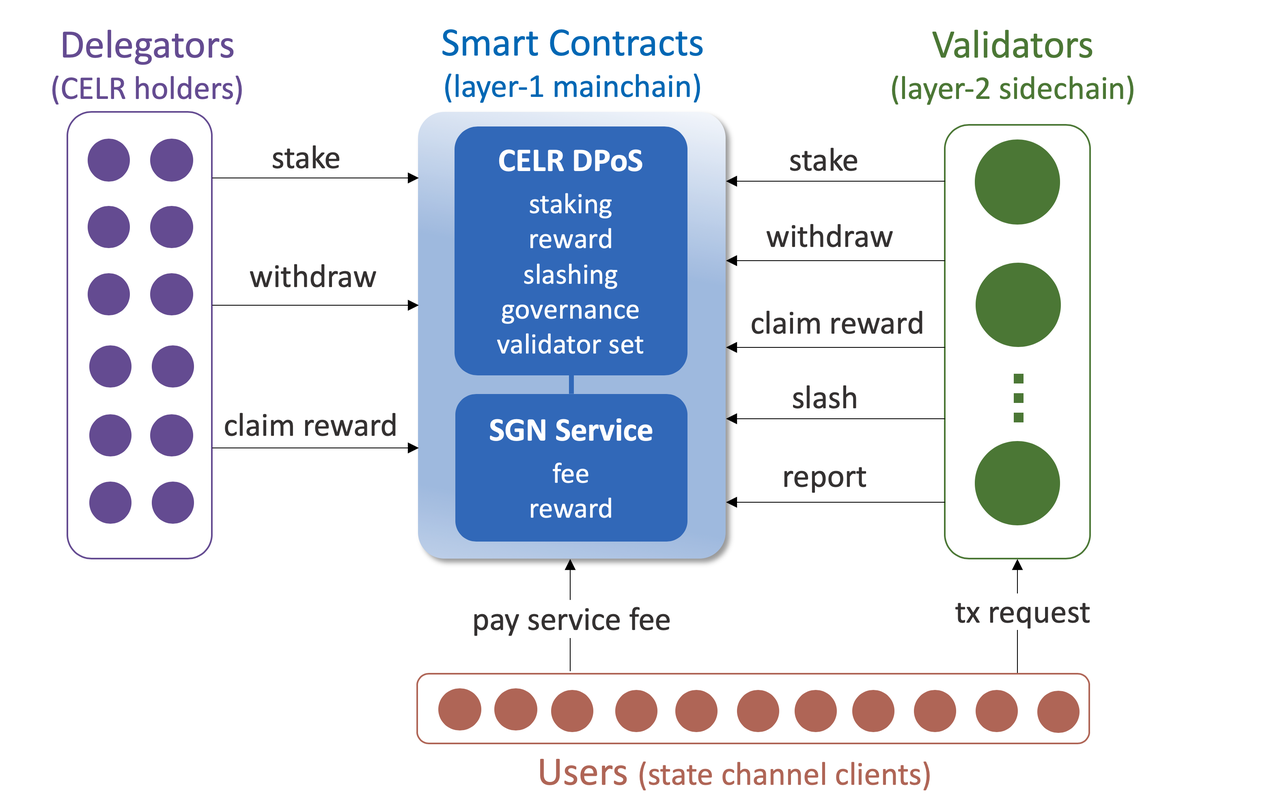
Validators run nodes, verify cross-chain states, and participate in network consensus. All critical messages and state updates in the network require validator confirmation.
Delegators support validators by staking CELR. While delegators do not directly participate in verification, their staked assets help enhance network security.
The staking system manages CELR lock-ups, reward distribution, and slashing mechanisms, forming the foundation of the entire economic security model.
How Does the SGN Verify Cross-Chain State?
One of the biggest challenges for cross-chain protocols is ensuring information consistency across different blockchains.
When a user initiates a cross-chain operation via cBridge, the source chain generates corresponding event records. SGN nodes continuously monitor these events and collect relevant proof information.
Once validators confirm the event is valid, the state information is synchronized across the network. After consensus is reached, the operation on the destination chain is executed.
This process allows the cross-chain system to confirm that assets have been locked, burned, or transferred, thereby preventing double-spending and state conflicts.
How Does the SGN Support Inter-chain Messaging?
Inter-chain Messaging (IM) is Celer's cross-chain message protocol, which relies on the SGN for message coordination.
When a source chain application sends a cross-chain request, the message first enters the Message Bus system.
The SGN verifies the message's authenticity and ensures it is delivered to the destination chain according to predefined rules.
After receiving the message, the destination chain application can execute corresponding smart contract logic, such as updating state, completing governance votes, or triggering DeFi operations.
This mechanism enables applications on different blockchains to collaborate, going beyond simple asset transfers.
How Does the CELR Staking Mechanism Work?
CELR is the core economic security tool of the SGN.
Validators must stake a certain amount of CELR to participate in network operation. A larger stake typically increases the chances of obtaining verification eligibility and earning rewards.
Ordinary holders can stake CELR to validator nodes through the delegation mechanism, thereby sharing in network incentives.
This model allows more users to participate in network security while strengthening the overall economic security of the verification network.
What Are the Reward and Penalty Mechanisms of the SGN?
The SGN employs a typical PoS incentive model.
Validators earn rewards by completing state verification, message coordination, and network maintenance. Rewards usually come from protocol service fees and ecosystem incentive programs.
If a validator goes offline, acts maliciously, or violates protocol rules, their staked assets may be slashed.
This reward and penalty mechanism encourages honest behavior and improves the overall security level of the network.
What Is the Difference Between SGN and Traditional Cross-Chain Bridge Verification Models?
Many early cross-chain bridges relied on multi-signature wallets for asset management.
In that model, a small group of validator nodes held critical permissions. If those nodes were attacked or colluded, the entire system's security could be compromised.
The SGN, in contrast, uses an open PoS verification network, enhancing security through economic incentives and distributed nodes.
From a design standpoint, the SGN is closer to the decentralized governance model of a blockchain network itself, rather than a traditional custodial verification architecture.
Summary
The State Guardian Network, serving as Celer Network's decentralized security layer, uses a proof-of-stake mechanism to ensure the trustworthy execution of cross-chain messages and state data.
As the core infrastructure connecting cBridge and Inter-chain Messaging, the SGN handles cross-chain state verification, message coordination, and network security maintenance, providing a unified trust layer for Celer's cross-chain ecosystem.
FAQs
What Is the Relationship Between SGN and cBridge?
cBridge is Celer's cross-chain bridge product, while the SGN verifies state changes and transaction events during cBridge's cross-chain process, ensuring assets are correctly transferred across chains.
What Consensus Mechanism Does SGN Use?
The SGN uses a Proof of Stake (PoS) mechanism. Validators participate in network verification by staking CELR and receive corresponding rewards.
Why Is CELR Needed for SGN Staking?
CELR is the economic security foundation of the SGN. Validators and delegators participate in network operation by staking CELR, while the reward and slashing mechanisms help maintain system security.
Does the SGN Custody User Assets?
The SGN itself does not directly custody user assets. Its main job is to verify cross-chain states and coordinate message execution, not to act as an asset custodian.







