Bitcoin has long been regarded as the most secure and decentralized blockchain network. However, because its native scripting capabilities are limited, the Bitcoin ecosystem has developed more slowly in areas such as DeFi, stablecoins, and on-chain finance. As Ethereum Layer2 and Rollup technologies have gradually matured, the market has started exploring how to give BTC stronger programmability while still inheriting Bitcoin’s security.
Against this backdrop, the concepts of Bitcoin Layer2 and BTCFi have started to gain momentum. As one of the more representative Bitcoin ZK Rollup projects in this space, Citrea aims to use zkEVM, BitVM, and zero knowledge proofs to allow BTC to serve not only as a store of value asset, but also as an asset that can participate in lending, stablecoins, DEXs, on-chain yield markets, and other financial scenarios.
What Is Citrea?
As a ZK Rollup network built on Bitcoin, Citrea’s core goal is to provide BTC with smart contract and decentralized finance capabilities while inheriting Bitcoin’s security.
Citrea uses a Type 2 zkEVM as its execution environment, allowing Ethereum developers to migrate Solidity contracts and DeFi applications at relatively low cost. At the same time, Citrea uses Bitcoin as both its data availability layer, or Data Availability, and its final settlement layer, or Settlement Layer, compressing on-chain states through zero knowledge proofs.
Unlike traditional Bitcoin sidechains, Citrea places greater emphasis on a “Bitcoin native” scaling logic, aiming to reduce reliance on custodial bridges, multisig validators, and external security networks.
Why Does Bitcoin Need ZK Rollups?
Bitcoin has the largest on-chain asset scale in the world, but it has long lacked a mature smart contract ecosystem. A large amount of BTC remains passively held and cannot participate in on-chain financial scenarios such as lending, DEXs, stablecoins, and yield protocols in the same way ETH can.
Bitcoin Rollups emerged to improve BTC’s on-chain programmability while avoiding direct changes to Bitcoin’s mainnet rules. Citrea chooses the ZK Rollup approach because zero knowledge proofs can increase transaction throughput while preserving Bitcoin’s security model as much as possible.
Compared with independent sidechains, Rollups place greater emphasis on “bringing final state security back to the main chain.” This is also an important difference between Citrea and some traditional Bitcoin scaling solutions.
| Need |
Citrea’s Solution |
| Improve scalability |
Executes transactions off chain |
| Reduce mainnet burden |
Compresses data with ZK Proofs |
| Inherit Bitcoin security |
Bitcoin Settlement |
| Support smart contracts |
Type 2 zkEVM |
| Expand BTCFi |
Native BTC asset ecosystem |
How Does Citrea’s Technical Architecture Work?
Citrea’s architecture mainly consists of zkEVM, ZK Proof, BitVM, and Bitcoin Settlement.
User transactions first enter Citrea’s zkEVM execution layer. Smart contracts and DeFi operations are completed on Layer2 rather than executed directly on the Bitcoin mainnet. The system then compresses a large number of transactions into zero knowledge proofs, or ZK Proofs, and submits the state data to Bitcoin.
In this process, Bitcoin is responsible for data storage and final settlement, while BitVM verifies the correctness of Rollup states. This structure allows Citrea to increase throughput while binding security as closely as possible to the Bitcoin mainnet.
| Module |
Function |
| zkEVM |
Executes smart contracts |
| Sequencer |
Batches transactions |
| Prover |
Generates ZK Proofs |
| Bitcoin DA |
Stores state data |
| BitVM |
Verifies state correctness |
| Settlement Layer |
Final settlement |
What Role Does BitVM Play in Citrea?
BitVM is one of the important scaling directions in the Bitcoin ecosystem. Its goal is to enable more complex off chain computation verification without modifying Bitcoin’s consensus rules.
Citrea uses BitVM to verify Rollup state proofs. Put simply, Citrea executes transactions off chain, the Prover generates ZK Proofs, and BitVM verifies whether those proofs are correct within the Bitcoin environment. Bitcoin then completes final state confirmation.
This approach is clearly different from traditional multisig bridges. Many sidechains usually rely on federated validators or custodial bridges, while Citrea places greater emphasis on allowing Bitcoin itself to participate in the verification logic, thereby reducing additional trust assumptions.
However, BitVM is still a relatively new technical direction. Its long term efficiency, verification cost, and practical scalability remain under continued market observation.
How Does Citrea Build the BTCFi Ecosystem?
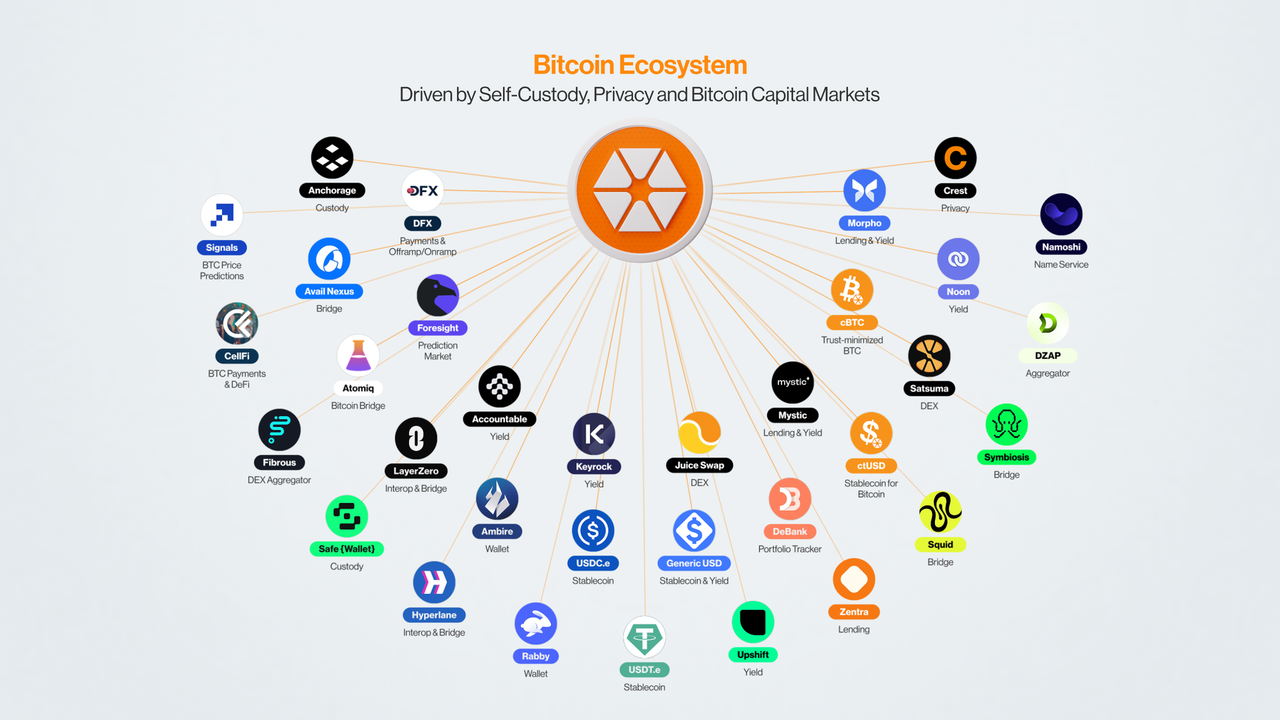
BTCFi, or Bitcoin Finance, refers to the on-chain financial ecosystem built around BTC. Citrea is not only a Rollup network, but also aims to become infrastructure for BTCFi.
The current Citrea ecosystem includes components such as the native stablecoin ctUSD, BTC collateralized lending protocols, structured yield products, DEX infrastructure, and Clementine Bridge. Among them, ctUSD is viewed as an important liquidity medium within the ecosystem, supporting trading and capital circulation in the BTCFi market.
Through BTCFi, Citrea aims to help BTC move beyond being a “passive store of value asset” and participate further in financial scenarios such as on-chain lending, yield generation, liquidity provision, and stablecoin collateralization.
As the BTCFi concept develops, the Bitcoin ecosystem is also gradually evolving toward an “on-chain capital market,” and Citrea is attempting to become an infrastructure layer within this trend.
What Is the Role of the CTR Token?
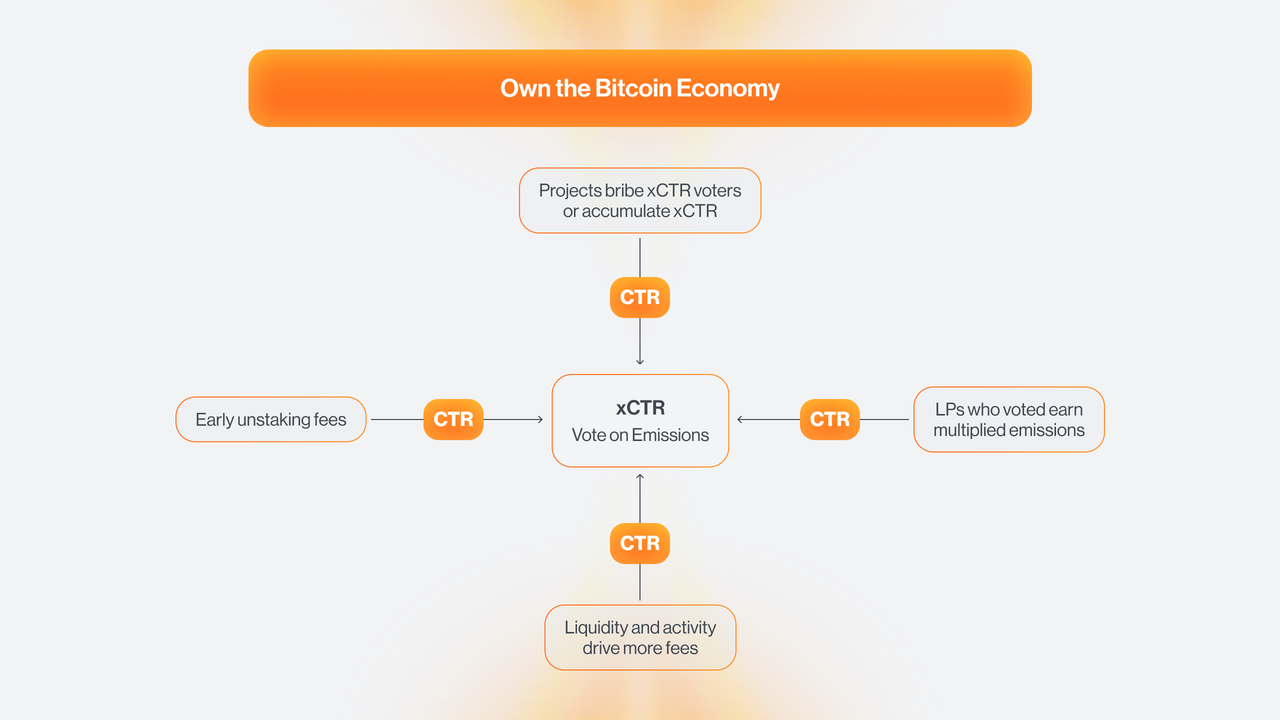
CTR is Citrea’s ecosystem governance and incentive token, mainly used for governance voting, liquidity incentives, ecosystem rewards, and Treasury coordination.
Citrea also adopts a dual Treasury and Gauge incentive model, allowing the community to decide how liquidity and ecosystem resources are allocated. This mechanism has some similarities to veToken models used in certain DeFi protocols, but Citrea places greater emphasis on Bitcoin asset scenarios and BTCFi liquidity development.
CTR is also an important part of Citrea’s governance system, helping coordinate the ecosystem’s long term development and incentive direction.
How Is Citrea Different From Other Bitcoin Layer2 Networks?
The current Bitcoin Layer2 ecosystem includes multiple scaling paths, including independent chains, sidechains, Rollups, and hybrid architectures.
Compared with Layer 2 projects such as Stacks, Citrea’s main feature is its stronger emphasis on Bitcoin native Settlement. It uses ZK Proofs and BitVM verification mechanisms to bring final security as much as possible back to the Bitcoin mainnet. At the same time, Citrea supports a Type 2 zkEVM, making it easier for Ethereum applications to migrate into the Bitcoin ecosystem.
By contrast, some traditional Bitcoin Layer2 networks rely more heavily on federated validators, multisig bridges, or independent security networks.
| Project |
Technical Approach |
EVM Support |
Security Source |
| Citrea |
ZK Rollup + BitVM |
Yes |
Bitcoin |
| Stacks |
Independent chain + PoX |
Partially compatible |
Stacks validators |
| Rootstock |
Federated sidechain |
EVM |
Federation |
| Merlin Chain |
ZK + Bridge |
EVM |
Hybrid model |
That said, Citrea’s technical complexity is also relatively higher, and its long term ecosystem development still depends on the maturity of Bitcoin Rollup infrastructure.
Citrea’s Current Funding and Ecosystem Development
Citrea has completed approximately $16.7 million in total funding, with investors including Galaxy, Founders Fund, Delphi Digital, Maven11, and Mirana Ventures. Among these rounds, Citrea completed a $14 million Series A financing round in October 2024.
According to public data, Citrea’s mainnet is already live, its ecosystem has more than 40,000 addresses, and cumulative transactions have exceeded one million. CTR has also opened for spot trading.
However, Bitcoin Rollups are still at an early stage. The market continues to pay close attention to issues such as Rollup costs, the practical efficiency of BitVM, the scale of BTCFi liquidity, and cross chain bridge security.
Summary
As one of the more representative ZK Rollup projects in the current Bitcoin Layer2 and BTCFi space, Citrea’s core goal is to provide BTC with smart contract and on-chain financial capabilities while inheriting Bitcoin’s security.
Through zkEVM, BitVM, ctUSD, and the BTCFi ecosystem, Citrea is attempting to expand Bitcoin from a pure store of value network into programmable financial infrastructure.
FAQs
Is Citrea a Bitcoin Layer2?
Yes. Citrea is a scaling project in the Bitcoin Layer2 and Bitcoin Rollup category.
What is BitVM?
BitVM is a technical approach that enables complex off chain computation verification without modifying Bitcoin’s consensus rules.
What is ctUSD?
ctUSD is a Bitcoin native stablecoin within the Citrea ecosystem, used for BTCFi liquidity and DeFi trading.
What is the CTR token used for?
CTR is used for governance voting, liquidity incentives, ecosystem rewards, and Treasury coordination.
How is Citrea different from traditional Bitcoin sidechains?
Citrea places greater emphasis on Bitcoin native Rollup architecture, while traditional sidechains usually rely on federated validators or custodial bridges.
Is Citrea mainnet already live?
Citrea mainnet is already live, with ecosystem applications and trading activity open.