For decisions around mainstream crypto card types, fee structure often affects long-term experience more than whether a card can be opened at all. Many U cards show modest headline rates on marketing pages, yet real cost usually spans top-up, FX conversion, spending, withdrawal, and payment-network stages. Focusing on a single fee line tends to understate total drag and can misread low onboarding friction as low ongoing cost.
What Components Make Up U Card Fees?
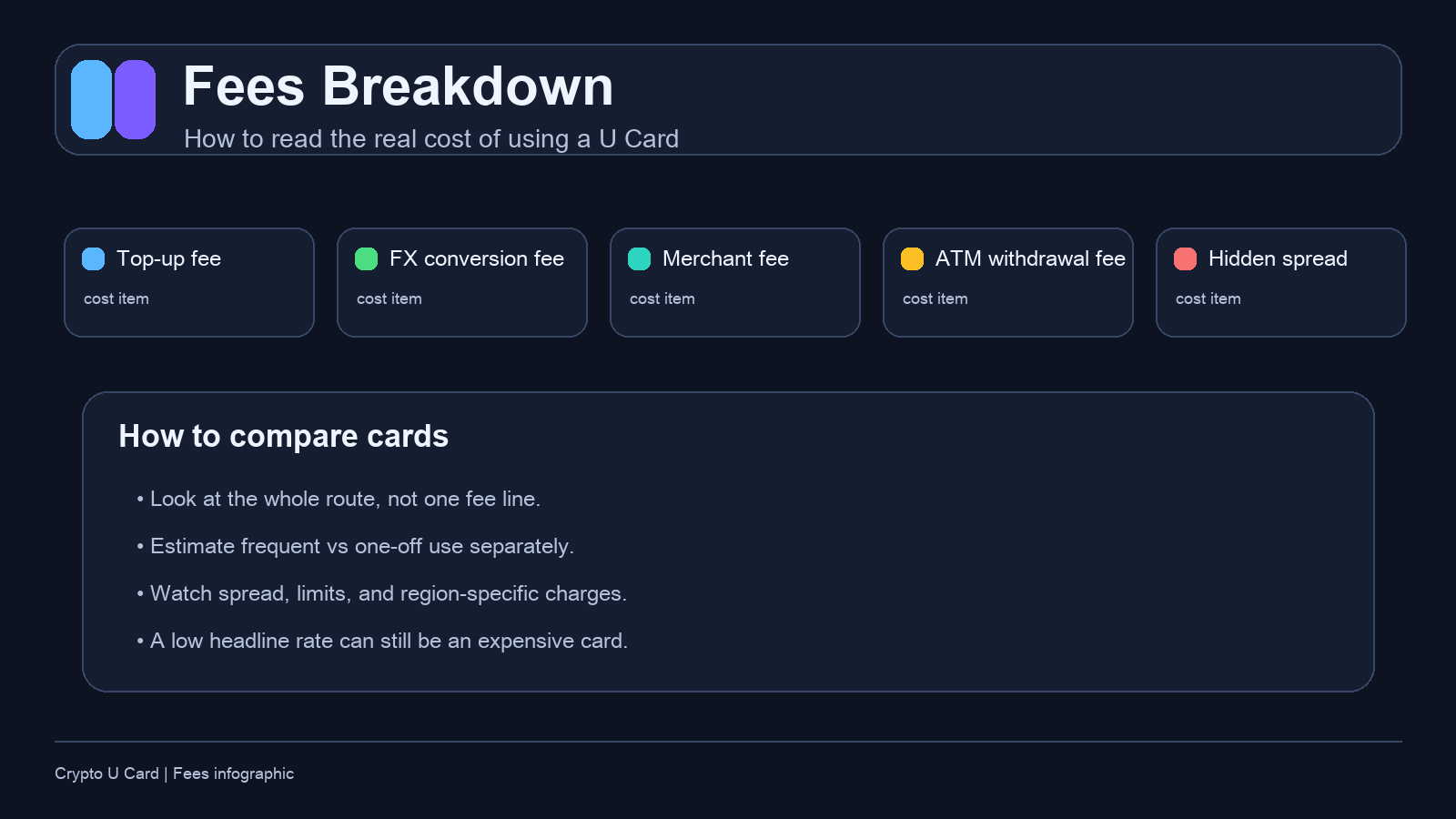
U card charges commonly fall into five categories: top-up fees, FX conversion fees, spending fees, ATM withdrawal fees, and—on some products—maintenance or dormancy fees. On paper they occur at different stages; in practice they often chain within one use path. A user may top up stablecoin, convert to a fiat-denominated ledger, then withdraw at an overseas ATM—triggering three cost types in one journey.
The useful distinction is not memorizing every label but knowing which charge applies before top-up, which during conversion, and which at payment or withdrawal. Once fee nodes are mapped to actions, judging whether a U card fits a given frequency and scenario becomes much clearer.
Top-up fees may attach to on-chain deposits, internal transfers from exchange balances, or fiat-on-ramp partners. FX fees may appear as explicit percentages or as spread baked into the conversion quote. Spending fees sometimes surface as foreign-transaction surcharges or network pass-throughs. Withdrawal fees split between issuer schedules and third-party ATM operator surcharges. Maintenance or inactivity fees, where they exist, penalize dormant accounts rather than active spenders—another reason use pattern shapes total cost.
What Do Top-Up, FX, Spending, and Withdrawal Fees Mean?
| Fee type |
Meaning |
Common trigger |
| Top-up fee |
Cost of moving assets into the card system or platform channel |
Deposit / funding |
| FX conversion fee |
Cost of converting between currencies or asset types |
Stablecoin to spendable fiat balance |
| Spending fee |
Charges in payment-network or merchant environments |
Card payment |
| Withdrawal fee |
Cost of extracting cash via ATM or similar |
Cash withdrawal |
Top-up fees apply before or at the moment funds enter the card ecosystem. FX fees apply while assets are booked as spendable balance. Spending and withdrawal fees apply when the payment network executes a transaction. Many users conflate FX and withdrawal fees; they attach to different actions—conversion versus cash extraction. Separating them improves cost estimates materially.
A zero top-up fee does not imply zero conversion cost. Issuers may subsidize deposits while recovering margin on spread during FX. Similarly, “no foreign transaction fee” on spending does not rule out unfavorable conversion rates on the ledger currency versus merchant currency. Line-item labels on statements help, but effective cost still requires comparing starting asset value to final spendable or withdrawn amount.
Why Do Actual U Card Costs Vary So Much Across Products?
Published rates rarely capture full cost. Two U cards may both advertise “1% FX fee,” yet one applies a wider spread on the quoted rate, leaving lower net balance after conversion. Regional coverage, merchant environments, ATM networks, and payment-network rules also differ, so the same action on different products can trigger different add-on charges.
User behavior reshapes cost structure. Heavy online subscription use amplifies FX and spending fees; frequent small ATM withdrawals amplify withdrawal fees and limit-related cost inflation. U card pricing is therefore not abstractly “high” or “low” but “expensive or cheap on the specific path actually used.”
Product tiering adds another layer. Basic tiers may carry higher FX spread; premium tiers may waive certain fees but require higher verification or minimum activity. Virtual vs physical U cards can differ in issuance fees, replacement costs, and whether ATM withdrawal is available at all—capabilities that change which fee categories ever apply.
How Should Total U Card Cost Be Compared Across Scenarios?
Effective comparison is scenario-based, not a flat rate-table copy. First clarify whether use is mainly online subscriptions, travel spending, or ATM withdrawal. Then place top-up, FX, spending, and withdrawal costs into the same framework for each candidate product. That approach reduces distortion from any single highlighted rate.
| Scenario |
Primary cost drivers |
What to verify |
| Online subscriptions |
FX fee, spending fee |
Payment stability, decline rates, repeat billing |
| Travel spending |
FX fee, POS charges |
Rate loss, merchant compatibility, overseas success rate |
| ATM withdrawal |
Withdrawal fee, limits |
Per-transaction cost, daily cap, double charging |
The table highlights that the same card can look cheap in one scenario and expensive in another. A product strong for travel POS may suit subscriptions poorly; one smooth for recurring online pay may be costly for frequent cash withdrawal. Comparison should target lowest total path cost, not the smallest individual line item.
Running a dry-run calculation helps. Example: deposit 1,000 USDT, note converted ledger balance, simulate one typical payment or one ATM withdrawal, and record all fees and spread implied by the balance change. Repeating that exercise for the second product under the same assumptions produces a fairer side-by-side view than comparing marketing percentages alone.
Hidden costs appear most often in overseas spending, repeated small withdrawals, and settlement in non-mainstream currencies. Overseas purchases may trigger both FX conversion and network-layer charges; when local merchant currency diverges sharply from the card’s ledger currency, spread loss grows. Many small withdrawals dilute any benefit from low percentage fees because fixed ATM charges dominate per unit.
Some paths advertised as “free withdrawal” may shift cost into conversion or intermediary channels instead. When payment occurs in a cross-border setting, U card cross-border payments vs bank wire helps separate charges originating on the payment network from those arising during currency conversion—two layers that statements do not always label clearly.
Dynamic currency conversion at merchants or ATMs—opting to pay in home currency rather than local—often widens effective spread beyond issuer-published FX fees. Declined transactions may still incur authorization holds that temporarily lock balance even when no purchase completes. Subscription retries after a failed billing cycle can stack multiple FX conversions if each attempt re-quotes balance.
How Can U Card Fee Drag Be Reduced in Practice?
The first lever is reducing unnecessary repeated FX. When payment scenarios are stable, maintaining a clearer top-up and spending path usually beats frequent small conversions. Second, separating high-frequency spending from frequent withdrawal on one product helps when fee structures penalize one activity more—especially if ATM access carries fixed per-use charges.
Third, walking through a typical path once before heavy use—one top-up, one conversion, one payment or withdrawal—surfaces combined cost early instead of after large volume. Where fees interact with account stability, U card compliance and risk clarifies that some apparent “fee anomalies” reflect risk holds or regional rules rather than published rate tables alone.
Matching card form to use case limits structural waste: virtual cards avoid physical issuance costs but cannot access ATM fee categories that never apply; physical cards suit cash needs but may carry replacement or delivery fees. Aligning top-up asset with ledger currency—when the product allows—can remove an FX leg entirely. For withdrawal-heavy needs, verifying limits and fee schedules in U card cash withdrawal flow prevents choosing a spend-optimized card for a cash-optimized task.
Summary
Judging U card fees means tracing costs across a full path, not hunting one lowest rate. Top-up fees, FX fees, withdrawal fees, and spread jointly determine real loss. Scenario-based comparison—rather than headline marketing—avoids mistaking cheap onboarding for cheap ongoing use. Modeling one complete cycle before scaling volume is the most reliable way to compare total cost across products.
FAQ
How much are U card fees in general?
There is no universal figure. Charges shift with top-up method, conversion path, withdrawal frequency, and regional rules. For most users, the critical question is which fee categories fire on their actual path—not what an “average” rate might suggest across all products.
Which U card fees are most often overlooked?
Exchange-rate spread and cumulative loss from small, high-frequency operations are the usual blind spots. Marketing pages emphasize explicit percentages, yet final amounts often reflect conversion environment and network rules that do not appear as separate line items.
What is the difference between FX fees and withdrawal fees?
FX fees apply during currency or asset conversion—for example, stablecoin to fiat-denominated card balance. Withdrawal fees apply when balance is taken as cash through ATM or similar rails. One corresponds to conversion; the other to extraction. They are not the same charge.
How should U card rates be compared across products?
Break down by scenario first, then align top-up, FX, spending, and withdrawal costs in one comparison frame. Single-rate comparisons easily miss hidden charges and scenario-specific amplification—especially for cross-border pay or repeated ATM use.
Are U card cross-border payment costs high?
That depends on whether currency conversion, payment-network rules, and merchant settings stack charges. Occasional cross-border payments may stay modest; frequent FX, many small payments, or regular withdrawals raise combined drag. Total path modeling matters more than any one foreign-transaction label.