 Image: https://x.com/ChairmanSelig/status/2028966230003204213
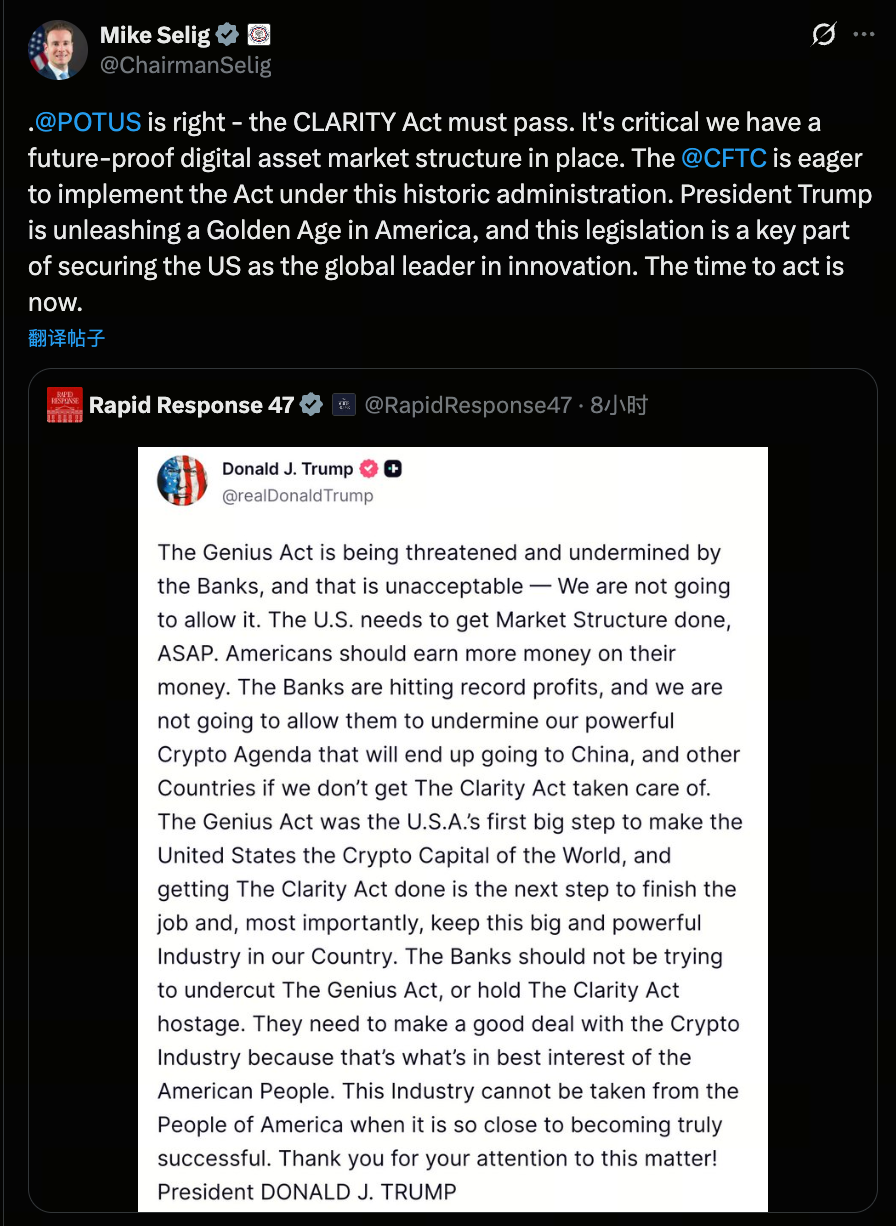
In March 2026, U.S. Commodity Futures Trading Commission (CFTC) Chairman Mike Selig once again publicly called for expedited passage of the CLARITY Act, stating unequivocally that the CFTC stands ready to implement the law during Trump’s administration. This was not a routine policy statement—it signaled a decisive acceleration in the structural shift of U.S. digital asset regulation.
Selig also disclosed that the CFTC will establish clearer standards for “self-certified prediction market contracts” and will issue an Advance Notice of Proposed Rulemaking (ANPRM). This move signals that the long-standing gray areas of digital assets and prediction markets are about to enter a formal regulatory restructuring process.
The key question is no longer whether regulation will occur, but rather—how to fundamentally reshape the market structure.
I. The True Meaning of the CLARITY Act: Ending Regulatory Ambiguity
In recent years, the greatest uncertainty plaguing the U.S. digital asset industry has stemmed not from market volatility, but from overlapping and contested regulatory jurisdiction.
The U.S. Securities and Exchange Commission (SEC) has long classified some tokens as securities via enforcement actions, while the CFTC contends that mainstream crypto assets resemble commodities. This “dual-track” regulatory regime has led to:
- Project teams struggling to chart compliant paths
- Trading platforms unable to clarify their registration categories
- Institutional capital remaining largely on the sidelines
The CLARITY Act’s core aim is to define digital asset classifications and regulatory jurisdiction, placing “commodity-type digital assets” under the CFTC’s purview and establishing unified market structure rules.
The intent is not regulatory leniency, but a shift from “enforcement-driven oversight” to “legislative structural clarity.”
If enacted, the U.S. would, for the first time, possess a comprehensive framework for digital asset market structure—impacting not only exchanges and token issuers, but also the entire derivatives and prediction market ecosystem.
II. A Shift in Power: The CFTC’s Evolving Role
Should the CLARITY Act pass, the CFTC would transition from a traditional futures regulator to the primary overseer of the digital commodity market.
This would bring three major changes:
1. Digital assets would be treated more as “commodities” than “securities”
This reduces the risk of certain tokens being retroactively classified as illegal securities offerings, thereby increasing regulatory certainty.
2. The derivatives market would expand
Under the CFTC’s framework, digital asset futures, options, and structured products would enjoy a firmer legal foundation.
3. The regulatory logic for prediction markets would be redefined
This is the aspect currently drawing the most attention.
III. The Regulatory Battle Over Prediction Markets: Ending the Gray Zone?
Prediction markets have grown rapidly in recent years, especially in areas like political elections, macroeconomic data, and geopolitical events.
However, three major controversies persist:
- Do these markets constitute gambling?
- Are they futures contracts?
- Do they affect public policy and electoral fairness?
The CFTC currently allows some contracts to go live through “self-certification,” meaning a platform can operate after declaring compliance with the Commodity Exchange Act (CEA).
The core issue:
Are the underlying events in prediction markets actually “commodities”?
If an event is deemed to involve public interest or sensitive political matters, the CFTC has authority to deny or restrict such contracts.
Selig’s announcement of an ANPRM means:
- The boundaries of self-certification will be more clearly delineated
- Political contracts may be separately classified
- Additional thresholds may apply to public policy events
This marks a pivotal shift from “principle-based” to “categorical” regulation for prediction markets.
IV. The Trump Factor: Shifting Regulatory Philosophy
Selig’s explicit reference to Trump’s support for the CLARITY Act is more than a political gesture—it reflects a change in regulatory philosophy. Under Trump’s framework, regulatory policy emphasizes:
- Prioritizing innovation
- Clear rules
- Reducing uncertainty
Unlike previous approaches where enforcement defined boundaries, the current trend is to clarify responsibilities through legislation, with agencies executing these mandates. This transition signals a shift from a climate of “strict uncertainty” to one that is “clear and actionable.” For markets, certainty itself is a competitive advantage.
1. Compliant trading platforms gain regulatory advantage
Once classifications are clarified, registration pathways become straightforward. While compliance costs may rise, regulatory risk falls—potentially increasing institutional participation.
2. Non-compliant prediction markets face elimination
As self-certification rules tighten, smaller or politically focused platforms may not survive. The market will consolidate around players with robust capital and compliance capabilities.
3. U.S. competitiveness will strengthen
The European Union has already adopted the MiCA framework, and Singapore and Hong Kong are also advancing digital asset regulation. If the U.S. enacts the CLARITY Act, its global competitiveness will be significantly enhanced.
Regulatory clarity is the central factor attracting both innovation and capital.
VI. What Comes Next
1. The bill passes swiftly, and rules are rapidly implemented
- The CFTC’s authority expands
- Prediction market categories are clarified
- Institutional capital accelerates its entry
The U.S. becomes the world’s hub for digital commodities and prediction markets.
2. Legislative progress is slow, but ANPRM leads
- Prediction market rules are clarified first
- Market structure becomes partly transparent
- Uncertainty persists
The industry enters a phase of “transitional compliance.”
3. Political resistance increases and the bill stalls
- Regulatory ambiguity continues
- SEC-CFTC disputes persist
- Corporate exodus accelerates
Market structure reform is postponed.
The Real Inflection Point: “Definition Rights” Over Market Movements
Selig’s remarks and the ANPRM signal a fundamental shift: U.S. digital asset markets are moving from “peripheral experimentation” toward “institutional integration.” What matters most isn’t short-term price action, but rather:
- Who holds regulatory authority
- Which assets are designated as commodities
- Where the legal boundaries for prediction markets are drawn
If the CLARITY Act passes, the U.S. will formally recognize digital assets as part of an independent market structure, providing a clear regulatory framework. This is a contest over “definition rights.” In the coming years, the industry’s competitive landscape will likely be shaped by this structural transformation.
Prediction markets may well be the first area to be fundamentally redefined.







