Unlike traditional banks, which primarily focus on deposit and loan operations, Synchrony Financial’s core value lies in bridging consumers and merchants. Through partnerships with retail brands, healthcare providers, and service enterprises, SYF enables consumers to access more flexible payment options while helping merchants boost sales efficiency and customer loyalty. This model has evolved consumer finance from a simple credit tool into a critical infrastructure for the modern retail ecosystem.
Why Consumer Finance Is Essential to Modern Retail
Competition in today’s retail market extends beyond products and services—it also involves the payment experience and financing capabilities. For consumers, greater payment flexibility eases the burden of large one-time expenses; for merchants, consumer finance drives higher conversion rates and larger average order values. As a result, consumer finance has become a cornerstone of the retail landscape.
In the past, major purchases required consumers to save up or rely on traditional bank loans. Consumer finance institutions now offer more convenient credit channels, allowing shoppers to access installment plans directly at checkout and enhance their purchasing power. This model has become a mainstream payment method, especially in furniture, home appliances, medical services, and electronics.
With the rise of e-commerce and digital payments, consumer finance has grown even more critical. Consumers demand instant approvals and seamless payment experiences, while merchants seek to minimize friction and improve conversion. Consumer finance has thus become a vital link between consumer needs and the retail market.
Key Application Scenarios for SYF’s Credit Card Services
Credit cards are one of Synchrony Financial’s core businesses. Unlike general-purpose cards from traditional banks, SYF specializes in retail co-branded and private-label credit cards, partnering with brands to build a consumer finance ecosystem.
In retail settings, credit cards serve both as payment instruments and customer management tools. When consumers use co-branded cards, they typically earn rewards points, cashback, or membership perks, boosting their spending intent and brand loyalty. For retailers, this approach fosters long-term customer relationships.
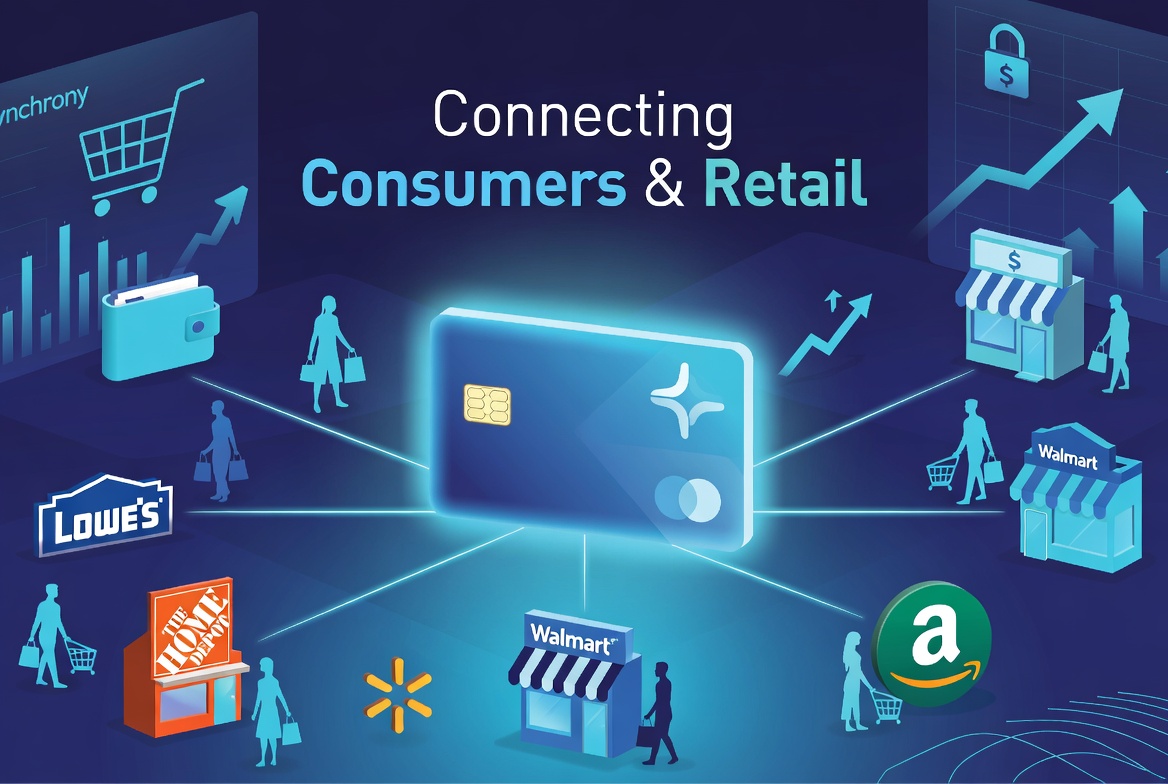
Today, Synchrony Financial’s credit card services span retail shopping, home improvement, electronics, automotive services, and e-commerce. Through extensive brand partnerships, the company has built a credit card network covering a wide range of consumer scenarios, establishing itself as one of the largest retail credit card providers in the United States.
How Installment Payments Support High-Value Purchases
Not every purchase calls for a lump-sum payment. For higher-priced goods or services, consumers often prefer installment plans to ease short-term financial pressure. Synchrony Financial’s consumer financing services are built around this need.
In categories such as furniture, home renovations, electronics, and education and training, installment payments have become a key option. Consumers can tailor repayment schedules to their budgets, while merchants benefit from higher conversion rates and larger order sizes. For many industries, installment plans have evolved from an add-on feature into a major driver of sales.
From a business perspective, consumer financing expands buyers’ purchasing power and helps merchants reach a broader customer base. By offering financing solutions in partnership with merchants, Synchrony Financial creates a more flexible link between consumer demand and payment capacity.
Why the Medical and Home Improvement Sectors Rely on Consumer Finance
Healthcare and home improvement are among the most consumer finance-intensive sectors. These expenses tend to be high and driven by urgent needs, so consumers often require flexible payment arrangements.
In healthcare, dental work, eye care, cosmetic procedures, and certain treatments are frequently not fully covered by insurance. Many consumers turn to loans or installment plans to manage these costs, reducing the burden of a single large payment. Consumer finance thus serves as a valuable supplement to the healthcare system.
Home improvement spending follows a similar pattern. Furniture purchases, kitchen remodeling, flooring replacement, and full renovations typically involve significant budgets. With consumer financing, homeowners can accelerate their projects, while merchants boost sales efficiency. For Synchrony Financial, the medical and home improvement sectors are key business areas and growth engines.
How Digital Payments and Mobile Finance Expand Service Horizons
Digital transformation is reshaping the consumer finance industry. As mobile payments, e-commerce, and online financial services become ubiquitous, consumers increasingly prefer digital channels for payments and financing applications.
Synchrony Financial continues to advance its digital offerings, enabling consumers to apply for credit, view account details, manage repayments, and complete payments entirely online. This digital experience not only enhances convenience but also reduces the operational costs of traditional finance.
For retailers, digital payment tools improve the customer experience across both online and offline channels. Digital financial services help merchants streamline payment processes and boost transaction efficiency. As mobile internet penetration deepens, digital payments have become an integral part of the consumer finance ecosystem.
Why the Consumer Finance Ecosystem Drives Growth
The value of the consumer finance ecosystem extends beyond any single financial product—it stems from the long-term relationships among consumers, merchants, and financial institutions. When consumers consistently use credit cards and financing services, merchants enjoy more stable sales, and financial institutions accumulate valuable customer data and transaction history.
For Synchrony Financial, its partner network is a core competitive advantage. By collaborating with a vast array of retail brands, healthcare providers, and service enterprises, the company covers numerous consumption scenarios and continues to scale its business. This ecosystem transforms consumer finance from a mere lending operation into a platform that connects the entire consumer market.
As the digital economy and e-commerce evolve, the importance of this ecosystem only grows. Consumers still demand flexible payment options, while merchants continue to seek ways to improve sales efficiency and customer loyalty. This enduring supply-demand dynamic provides a solid foundation for the long-term growth of the consumer finance industry.
How to Buy SYF (Synchrony Financial) Stock
SYF is the NYSE ticker for Synchrony Financial. Traditionally, investors can purchase SYF through a U.S. stock brokerage account, gaining exposure to the U.S. consumer finance industry.
Because Synchrony Financial’s business spans credit cards, consumer loans, and retail financial services, its performance is closely tied to consumer spending, credit conditions, and retail market activity. Many market participants view SYF as a key bellwether for the U.S. consumer finance sector.
As digital asset markets increasingly integrate with traditional finance, new trading instruments tied to stock price movements have emerged. For example, some platforms offer CFD products linked to stock prices, allowing users to trade based on price changes without directly owning the underlying shares.
Take Gate TradFi as an example: users can follow digital assets, stocks, ETFs, indices, and commodities within a single account. Some markets also offer Gate CFD products, providing more options for cross-market asset allocation and price monitoring.
Regardless of the method chosen, investors should thoroughly understand the product structure, trading rules, and regulatory requirements in their jurisdiction.
Summary
Synchrony Financial connects consumers and the retail market through credit cards, consumer loans, installment payments, and digital financial services. Whether for everyday shopping, medical expenses, home improvements, or online payments, consumer finance has become an essential pillar of the modern retail system. Leveraging a broad partner network and a wide range of consumption scenarios, SYF has carved out a unique ecosystem advantage in the U.S. consumer finance market and continues to serve as a vital link between consumers and merchants.
FAQ
What consumer finance services does Synchrony Financial mainly provide?
Synchrony Financial primarily offers credit cards, co-branded credit cards, consumer loans, installment payment plans, and digital payment services.
Why is consumer finance important for the retail industry?
Consumer finance lowers the payment barrier for consumers, boosts purchasing power, and helps merchants increase sales conversion rates and customer loyalty.
What are the main use cases for SYF credit cards?
SYF credit cards are widely used in retail shopping, home improvement, electronics purchases, automotive services, and e-commerce.
Why is consumer finance commonly used for medical expenses?
Medical costs are often high, and consumer finance provides installment payment options that allow consumers to manage their spending more flexibly.
How is digital payment changing the consumer finance industry?
Digital payments streamline application, payment, and account management processes, enabling consumer finance services to reach more online and mobile scenarios.
What is the biggest difference between SYF and traditional banks?
Synchrony Financial specializes in consumer-focused financial services, while traditional banks typically offer a broader range of deposit, loan, and corporate banking products.