The development of artificial intelligence is pushing the global tech industry into a new phase centered on hashrate. As large language models, generative AI, and intelligent agent systems continue to scale, market demand for GPUs, data centers, and high-performance storage resources is growing steadily. Competition in the AI industry goes beyond processing power alone—it now extends to data transmission efficiency and storage system performance.
SK Hynix is one of the world’s largest memory chip manufacturers and a key player in the AI infrastructure supply chain. Through its deep expertise in DRAM, HBM, and enterprise-grade SSDs, SK Hynix has become a vital link connecting AI chips, server makers, and data center operators. Its products are widely deployed across the world’s leading AI compute platforms.
What Are the Key Components of the AI Value Chain?
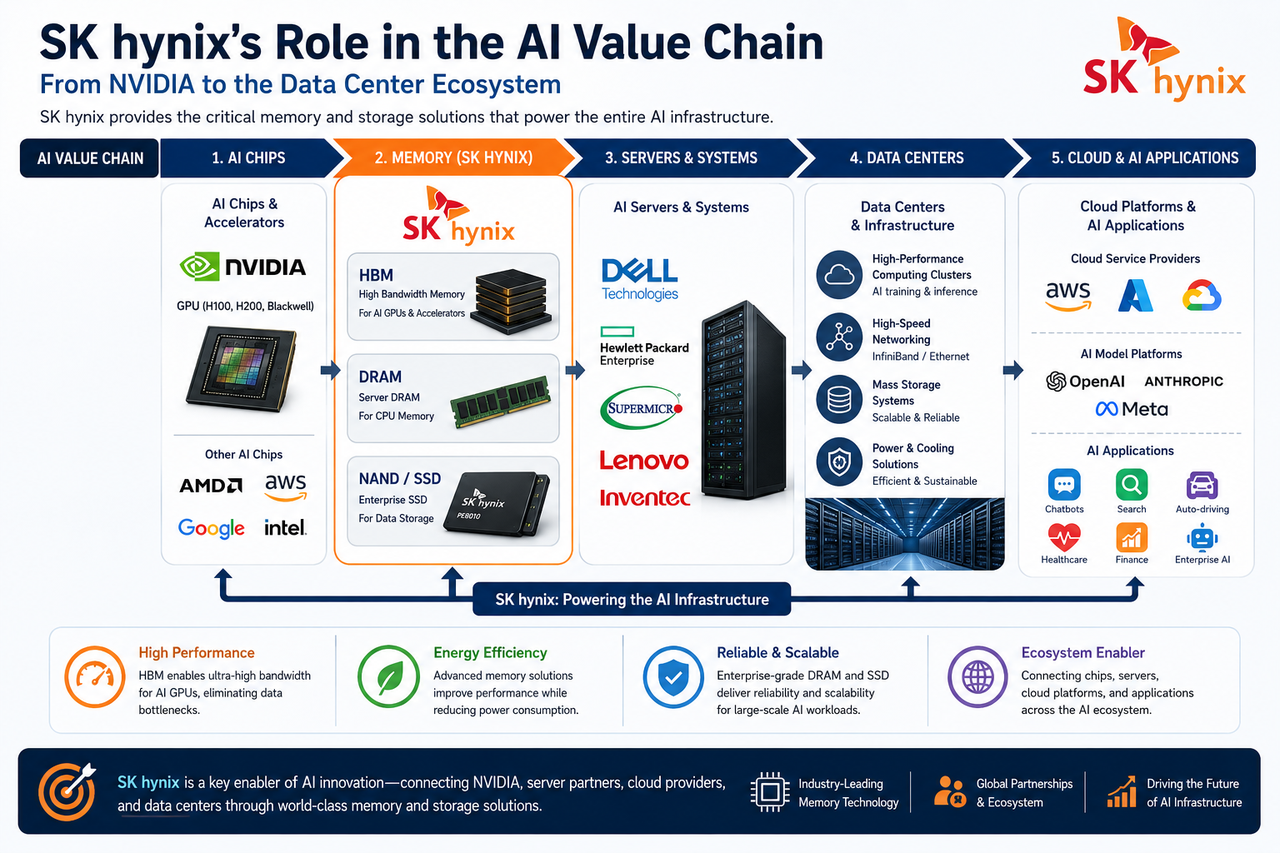
The AI value chain is typically divided into three layers: infrastructure, platform, and application. The infrastructure layer supplies computing, storage, and networking resources—forming the bedrock of the entire AI ecosystem.
The infrastructure layer mainly includes GPU chips, memory, servers, networking equipment, and data centers. The platform layer covers cloud computing services, large model development platforms, and AI frameworks. The application layer includes real-world scenarios like chatbots, search engines, autonomous driving, and enterprise AI solutions.
SK Hynix primarily operates in the infrastructure layer, providing essential storage capabilities for AI systems.
AI Value Chain Structure
| Industry Layer |
Key Components |
Representative Companies |
| Application Layer |
AI Assistants, Autonomous Driving, Enterprise AI |
OpenAI, Anthropic, Baidu |
| Platform Layer |
Cloud Computing, Large Model Platforms |
Microsoft, Google, AWS |
| Infrastructure Layer |
GPUs, HBM, Servers |
NVIDIA, SK Hynix, TSMC |
Why Is Storage a Critical Infrastructure in the AI Era?
Training AI models demands processing enormous datasets, and gains in compute power must be backed by rapid data transfers.
Modern GPUs can execute trillions of operations per second. But if the storage system can’t supply data fast enough, those compute resources can’t reach their potential—a phenomenon known as the “storage bottleneck” or “data bottleneck.”
As large model parameters balloon from billions to trillions, storage systems have evolved from a supporting role to a decisive factor in AI performance.
That’s why HBM, DRAM, and high-speed SSDs have grown increasingly crucial, with storage capability now a core pillar of the AI compute ecosystem.
What Role Does SK Hynix Play in the AI Value Chain?
SK Hynix’s primary role is delivering high-performance storage solutions for the AI industry. Unlike GPUs, which handle computation, SK Hynix’s products focus on data storage and high-speed data transfer.
During AI model training, GPUs constantly read parameters and training data from memory. HBM provides a high-speed data stream to the GPU, keeping the compute process running without pause.
So while SK Hynix doesn’t directly develop AI models or build AI applications, its products keep the entire AI compute system running smoothly.
SK Hynix’s Role in the AI Ecosystem
| AI Ecosystem Component |
Function |
SK Hynix Contribution |
| GPU Manufacturers |
Provide Compute Power |
Supply HBM |
| Server Manufacturers |
Assemble AI Servers |
Provide DRAM and SSDs |
| Cloud Platforms |
Deploy AI Services |
Provide Storage Support |
| Data Centers |
Run AI Clusters |
Provide Infrastructure Storage |
What Is the Relationship Between SK Hynix and NVIDIA?
NVIDIA is a major force in the global AI GPU market, and GPUs can’t deliver peak performance without high-speed storage support.
Modern AI GPUs rely on HBM to handle massive data flows. HBM creates an ultra-high-bandwidth link between the GPU and memory, significantly boosting training efficiency.
SK Hynix has invested heavily in HBM R&D and is now a leading global HBM supplier. As AI GPU demand for HBM climbs, SK Hynix’s importance in the NVIDIA ecosystem continues to grow.
This partnership also positions SK Hynix as a key player in building the AI infrastructure.
Why Has HBM Become Essential for AI GPUs?
Traditional DRAM can no longer keep up with the data speed demands of modern AI chips.
HBM leverages 3D stacking and TSV (Through-Silicon Via) technology to achieve far higher bandwidth than conventional memory. GPUs can access training data quickly through HBM, reducing idle time and improving overall performance.
For large model training, HBM has gone from optional to core infrastructure. As models grow even larger, HBM’s strategic value in AI systems only increases.
HBM vs. Traditional Memory
| Comparison Aspect |
HBM |
Traditional DRAM |
| Data Bandwidth |
Extremely High |
Moderate |
| Power Consumption |
Lower |
Higher |
| AI Suitability |
Excellent |
Average |
| GPU Synergy |
High |
Moderate |
| Data Center Value |
High |
Moderate |
How Does SK Hynix Enter the Data Center Ecosystem?
AI data centers typically combine GPU clusters, high-speed networks, and huge storage systems.
In a large AI data center, GPUs handle calculations, HBM provides fast data access, DRAM expands server memory, and SSDs manage long-term storage.
SK Hynix covers all three major product lines—HBM, DRAM, and enterprise SSDs—so it plays a part in multiple critical areas of AI data centers.
This product breadth makes it a key supplier to global cloud platforms and hyperscale data centers.
Cloud platforms are the backbone of AI services. Whether training large models or running inference, huge numbers of servers and storage devices are needed.
Cloud providers must balance performance, power consumption, and reliability—placing tough demands on memory chips.
SK Hynix’s high-performance DRAM, enterprise SSDs, and HBM products are built to meet the needs of massive AI clusters, making them a common choice for cloud computing and hyperscale data center environments.
As AI workloads keep growing, cloud platforms will push demand for high-performance storage even higher.
How Does AI Compute Growth Drive SK Hynix’s Development?
The rise of AI is reshaping the semiconductor demand landscape.
In the past, memory chips mainly served PCs and smartphones. Today, AI servers and data centers have become a major growth engine for the storage industry.
As more companies deploy large models and AI applications, demand for GPUs and HBM rises together. Since HBM is a vital component of AI chips, expansions in AI compute power directly fuel the storage market.
So AI infrastructure investment is now a key driver of SK Hynix’s long-term business growth.
What Competition and Challenges Does SK Hynix Face?
Despite SK Hynix’s strong position in the AI storage market, competition is fierce.
Samsung Electronics and Micron Technology are also pouring resources into HBM to capture market share. Meanwhile, advanced packaging, yield rates, and supply chain management are critical competitive factors.
As the AI industry speeds ahead, the bar for storage innovation keeps rising. Future competition won’t be just about capacity and bandwidth—it will extend to energy efficiency, packaging, and system-level integration.
Summary
SK Hynix is a key player in the global AI infrastructure supply chain, primarily supplying high-performance storage solutions for AI chips, servers, and data centers. Through its HBM, DRAM, and enterprise SSD products, SK Hynix connects NVIDIA, server manufacturers, cloud platforms, and the broader AI application ecosystem.
As generative AI and large models drive surging global demand for compute power, storage systems grow ever more critical. HBM has become a core component of modern AI GPUs, and SK Hynix—backed by decades of technological expertise and strategic positioning—holds a vital place in the global AI value chain.
FAQs
What is SK Hynix’s main role in the AI value chain?
SK Hynix provides high-performance storage solutions for the AI industry, including HBM, DRAM, and enterprise SSDs. These products are widely used in AI chips, servers, and data center infrastructure.
What is the relationship between SK Hynix and NVIDIA?
NVIDIA’s AI GPUs require high-bandwidth memory to function optimally, and SK Hynix is a leading global HBM supplier. The two companies work together to build the AI compute ecosystem.
Why do data centers need SK Hynix products?
Data centers need large amounts of DRAM, SSDs, and HBM to support computing and storage tasks. SK Hynix can supply all these critical storage products, making it an important partner for AI data centers.
How does AI compute growth affect SK Hynix?
Growth in AI compute demand drives expansion of GPUs, servers, and data centers—all of which require massive high-performance storage resources, increasing demand for HBM, DRAM, and SSDs.
Who are SK Hynix’s main competitors?
The global memory market is primarily contested by Samsung Electronics and Micron Technology. These three companies dominate core markets for DRAM, NAND, and HBM.