Saylor Signals Another Bitcoin Move as MicroStrategy’s Pattern Gains Market Attention

Beginner
Quick Reads
Last Updated 2026-03-27 07:56:03
Reading Time: 1m
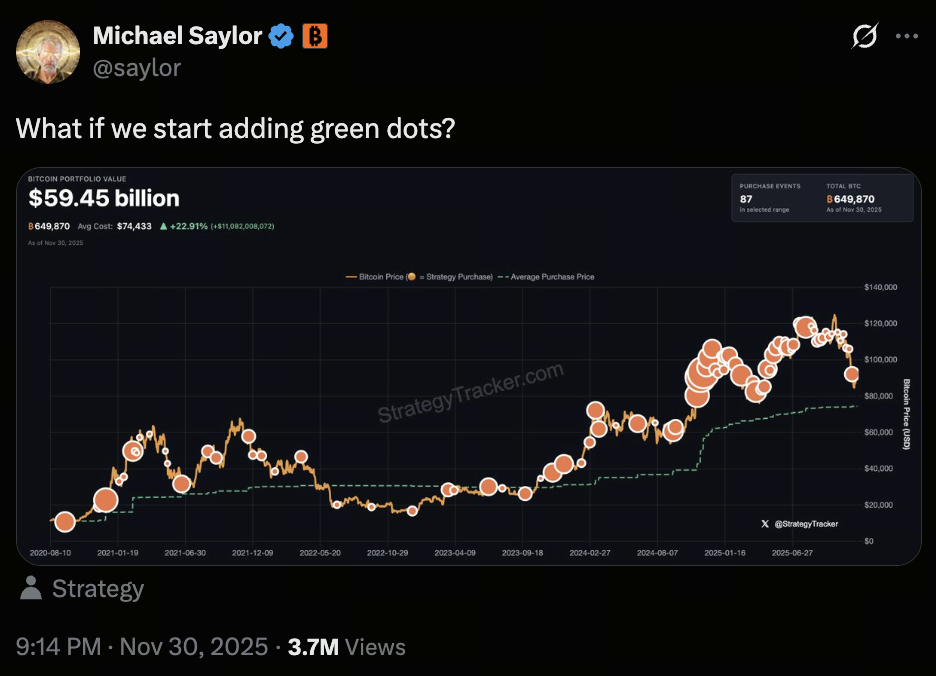
MicroStrategy founder Michael Saylor has posted another Bitcoin tracker update, sparking renewed speculation as the market recognizes a familiar pattern. As the cycle of tracker updates followed by purchase announcements becomes routine, Saylor’s personal posts now signal corporate actions rather than merely sharing opinions. The market views these updates as among the most distinctive leading indicators in the cryptocurrency sector.

Saylor Issues Tracker Again: A Market-Critical Cycle Signal

(Source: saylor)

On November 30, MicroStrategy founder Michael Saylor once again released updated Bitcoin tracking data. For investors who follow his moves, these posts have evolved beyond simple market observations—they now signal the onset of new corporate accumulation. Historically, Saylor’s Tracker updates closely precede MicroStrategy’s official buy announcements, creating a cadence that commands intense market attention.

From Messaging Cadence to Market Signals: The Spillover Effect of Enterprise Communications

MicroStrategy’s Bitcoin accumulation strategy has remained remarkably consistent, leading the market to treat Saylor’s posts as actionable signals. Each time the Tracker is updated, some investors move early to position themselves for potential upside. This expectation has made Saylor’s social presence a key part of the market narrative, extending the impact of corporate PR into actual trading decisions.

The Power of Narrative: Culture, Conviction, and Brand Building

Saylor’s communications consistently reflect strong conviction. Phrases like “continue accumulating Bitcoin” have become part of the community’s culture. He leverages clear, memorable language to reinforce his narrative, positioning MicroStrategy as the archetype of enterprise-level BTC conviction. This approach not only amplifies his posts’ reach but also sharpens MicroStrategy’s brand identity.

Market Sentiment Chain Reaction: From Corporate Moves to Price Action

Each of Saylor’s public statements has the potential to spark short-term market volatility, especially in the sentiment-driven crypto sector. The interplay of narrative, expectation, and capital flows has turned his posts into market-moving events. Traders’ reactions to these updates reveal the unique structure of the crypto market: information—especially from key figures—can quickly shift short-term price momentum.

Corporate Benchmark Effect: MicroStrategy’s “Long-Term Accumulation Model”

MicroStrategy’s ongoing Bitcoin accumulation has become a standout example in corporate asset allocation, showing how BTC can serve as a strategic asset for scarcity and growth. However, this model still heavily depends on Bitcoin’s long-term performance, making it difficult for more conservative firms to replicate. Nonetheless, MicroStrategy’s approach offers alternative strategies for institutional investors.

To learn more about Web3, click to register: https://www.gate.com/

Summary

Saylor has established a regular information cadence, enabling the market to anticipate and interpret MicroStrategy’s accumulation moves within a clear framework. This case, built on narrative, strategy, and market expectations, has become a model for the industry. As this rhythm becomes ingrained in market behavior, its influence extends well beyond individual posts, serving as a key barometer for Bitcoin market sentiment.

Author: Allen
Disclaimer
* The information is not intended to be and does not constitute financial advice or any other recommendation of any sort offered or endorsed by Gate.
* This article may not be reproduced, transmitted or copied without referencing Gate. Contravention is an infringement of Copyright Act and may be subject to legal action.

Related Articles

AI-Native Settlement Layers: How United Stables Is Building the Next Financial Rail
Beginner

AI-Native Settlement Layers: How United Stables Is Building the Next Financial Rail

Stablecoins were originally designed as dollar substitutes within exchanges, primarily used for asset pricing and trade settlement. As on-chain financial ecosystems have matured, their role has expanded beyond simple payments to include collateral assets, cross-chain liquidity mediums, and unified settlement units. In particular, as AI systems and automated agents begin to participate directly in economic activity, demand has risen sharply for programmable value units capable of instant settlement. This shift is pushing stablecoins toward the role of foundational financial infrastructure.
2026-03-25 03:16:17
The ve(3,3) Flywheel Explained: How AERO Tokenomics Powers Aerodrome’s DeFi Economy
Beginner

The ve(3,3) Flywheel Explained: How AERO Tokenomics Powers Aerodrome’s DeFi Economy

In the competition for DeFi liquidity, high-inflation mining alone is no longer enough to build lasting advantages. Aerodrome applies the ve(3,3) economic model to redesign token emissions, voting mechanisms, and revenue distribution, creating a liquidity flywheel centered on governance and cash flow. This article examines AERO tokenomics, the veAERO locking mechanism, and protocol revenue models to explain how Aerodrome builds a sustainable DeFi economic system.
2026-03-25 06:41:58
Aerodrome Tokenomics: How ve(3,3) Powers Base's Most Profitable DEX
Beginner

Aerodrome Tokenomics: How ve(3,3) Powers Base's Most Profitable DEX

AERO is the native token of Aerodrome Finance, a core decentralized exchange and liquidity protocol in the Base ecosystem. It is primarily used for liquidity incentives and ecosystem operations. veAERO is a governance NFT that users receive by locking AERO, representing both voting power and the right to share protocol revenue. Through a dual track structure of AERO as a utility token and veAERO as a governance credential, Aerodrome separates liquidity usage value from long term governance power, allowing participants to act as liquidity providers, governance decision makers, and revenue sharers within the same system.
2026-03-25 06:40:31
DePIN Identity Network and Real World Applications: How Humanity Protocol Brings on-chain Identity Into the Physical World
Beginner

DePIN Identity Network and Real World Applications: How Humanity Protocol Brings on-chain Identity Into the Physical World

Most Web3 identity systems remain confined to on-chain environments and struggle to achieve meaningful adoption in real world settings. Through a DePIN architecture and physical verification hardware, Humanity Protocol aims to bring decentralized identity into access control systems, hospitality, public services, and offline events, allowing on-chain identity to function not just as a digital credential, but as foundational infrastructure for real world access.
2026-03-25 07:40:53
How is the price of PAXG determined? Pegging mechanism, trading depth, and influencing factors
Beginner

How is the price of PAXG determined? Pegging mechanism, trading depth, and influencing factors

PAXG (Pax Gold) is a tokenized asset backed by physical gold reserves, launched by fintech firm Paxos and issued as an ERC-20 token on the Ethereum blockchain. The core concept is to digitally represent real-world gold assets, allowing investors to hold and trade gold via the blockchain network. Because each PAXG token corresponds to a specific quantity of physical gold, its price is theoretically expected to closely track the global gold market.
2026-03-24 19:11:40
How Does PAXG Work? In-Depth Overview of the Physical Gold Tokenization Mechanism
Beginner

How Does PAXG Work? In-Depth Overview of the Physical Gold Tokenization Mechanism

PAXG (Pax Gold) is a tokenized asset backed by physical gold, issued by the fintech company Paxos and traded on the Ethereum blockchain as an ERC-20 token. The core concept is to tokenize physical gold on-chain, with each PAXG token representing ownership of a certain amount of gold. This structure enables investors to hold and trade gold in the form of a digital asset.
2026-03-24 19:12:51





