The corporate information and product calculation formulas for OpenAI are not interchangeable. The most common mistake is directly using a post-money valuation from the financing table as the settlement basis for OPENAI.

According to the Gate project page FAQ, the implied valuation for this round of OPENAI is $895 billion (i.e., 1 OPENAI = $722). The announcement further clarifies that the roughly $895 billion figure is calculated from the current committed price and the corresponding total share count of 1.23 billion–1.24 billion shares. If the formula deviates from these two inputs, the resulting figure is no longer a valid reference under the same disclosure standard.
What Does OPENAI's Implied Valuation Mean in Official Disclosures?
The implied valuation is a reference calculation disclosed in the product, connecting the per-unit committed price to a hypothetical total share count to arrive at a total valuation. It answers the question: “Given the subscription input for this round, what is the implied market capitalization?” It does not represent “the company value confirmed by OpenAI management,” nor does it mean “the pre-market must settle at a specific price.”
Since OPENAI is structured as a mirror note, OPENAI vs. Actual Equity highlights: even if the implied valuation is similar in magnitude to some figures reported in financing news, this does not change its non-equity nature, nor should the figure be interpreted as shareholder equity. The similarity in scale simply indicates that the mapping input may have referenced comparable private placement pricing, but it does not eliminate legal structural differences.
How Do the Committed Price and Total Shares Yield Approximately $895 Billion?
The official disclosure details both components: the committed price provides the per-unit input, and the reference total share count scales the unit price to a total valuation. The project page states 1 OPENAI = $722; the announcement gives a total share range of about 1.23 billion to 1.24 billion shares, equating to an implied valuation of about $895 billion. This range indicates the result is an approximation, influenced by rounding and disclosure conventions.
| Calculation Element |
Official Disclosure Standard |
Purpose |
| Committed Price |
1 OPENAI = 722 USDT/GUSD |
Per-unit reference price |
| Reference Total Shares |
About 1.23–1.24 billion shares |
Scales to total valuation |
| Implied Valuation |
About $895 billion |
Reference value based on the first two items |
Historical post-money valuations in the project page’s financing table represent a different set of disclosures, intended to illustrate the company’s financing background, and should not be equated with the current OPENAI formula.
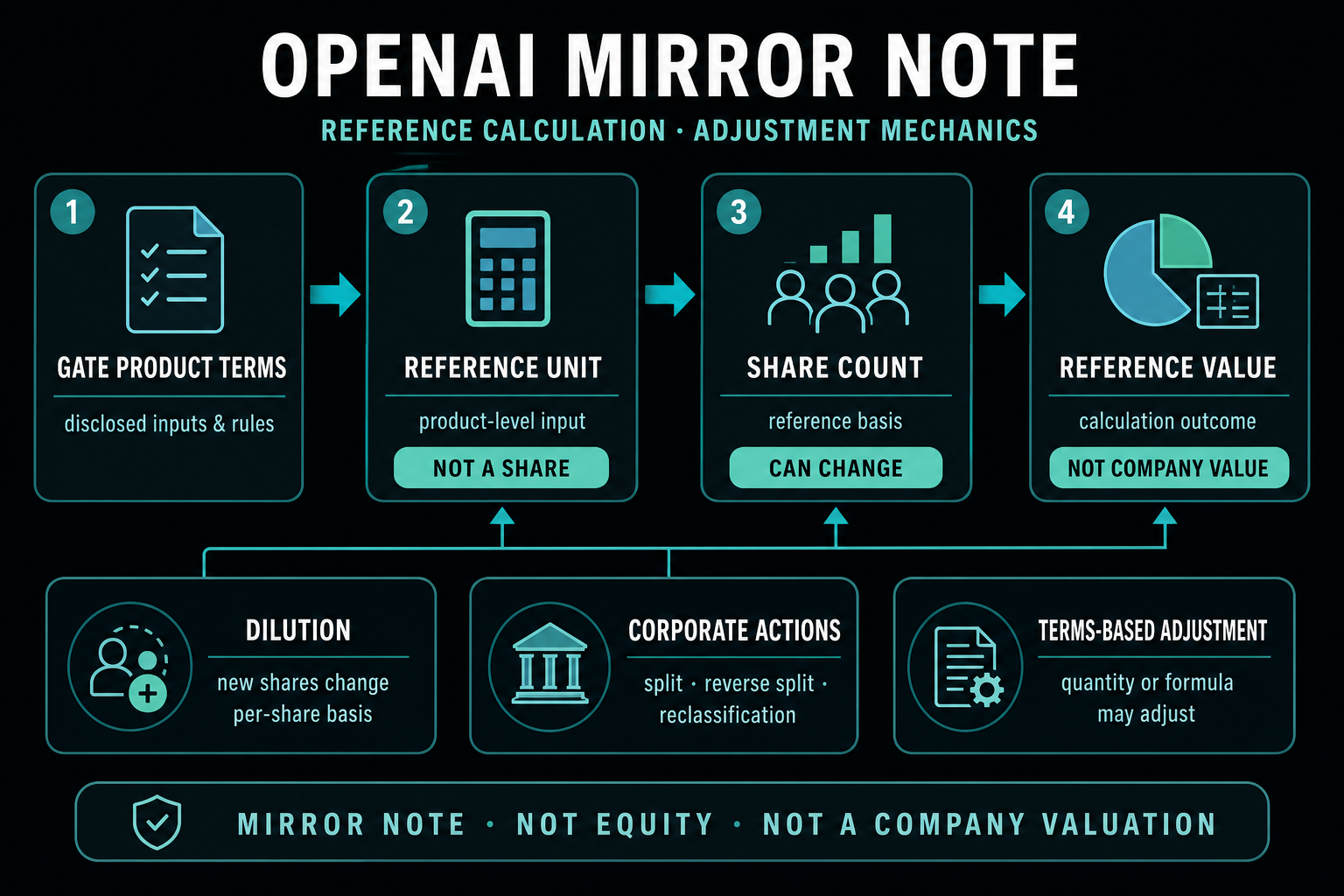 Image description: The committed price and reference share count form the inputs for the implied valuation; company actions may alter the reference basis.
Why Does a Change in Share Count Affect Dilution Understanding?
The announcement explains that if the company issues or cancels shares in the future, the total share count may change, thereby impacting the estimated implied valuation. As a mirror note tracking the value of common stock, future issuances may dilute the per-share value at that time. Dilution refers to how the reference basis changes, not whether certificate holders lose company equity—since the certificate is not equity to begin with.
Therefore, when OpenAI-related articles discuss “post-financing valuation changes,” the key checkpoint for OPENAI product readers is whether the product still uses the original share count standard and whether the holding amount or reference value is adjusted according to the terms.
How Are Stock Splits, Reverse Splits, and Reclassifications Handled?
The official disclosure states that if a stock split, reverse split, or other common stock reclassification occurs, user holdings will be recalculated and adjusted accordingly, with details announced separately. Such events change the meaning of “each unit,” so quantities before and after adjustment cannot be directly compared without conversion.
The purpose of the adjustment is to maintain the economic reference relationship defined by the terms, not to deliver adjusted actual OpenAI shares to holders.
How Do Implied Valuation and Pre-Market Price Differ?
Implied valuation is derived from a disclosed formula; pre-market price is determined by Pre-Market supply and demand, liquidity, and trading rules. Pre-Market trading and settlement explains that pre-market trades use temporary trading codes and corresponding circulating supply. Transaction prices do not validate company valuation, and implied valuation does not serve as a pre-market target price or settlement commitment.
The FAQ further notes: the market’s implied valuation of OPENAI may differ, as the implied valuation is based on the subscription price for that round and factors such as the target company’s private placement pricing and applicable fees. The approximately $895 billion figure is based on the current subscription price and hypothetical total share count.
What Are the Limitations and Risks When Interpreting Valuations?
Limitations first arise from the product’s nature and the company’s unrelated statement: OpenAI does not participate in, authorize, or endorse the product, nor does it receive any raised funds. Therefore, interpreting the implied valuation as “the company-confirmed valuation for holders” lacks disclosure support. Additionally, changes in share count standards, company actions, and term updates can make figures non-comparable over time: the same “$895 billion” label may reflect different mapping assumptions after changes in share count. Furthermore, as OpenAI is not publicly listed, there is limited verifiable transaction data, and pre-market liquidity may be insufficient, so price discovery is incomplete.
The product risk checklist is suitable for clause-level review: account eligibility, regional restrictions, lending prohibitions, maturity date, and event settlement are all more relevant to the product’s actual constraints than simply referencing a total figure. Quoting only the approximately $895 billion figure without verifying the formula’s assumptions and non-equity boundaries can easily lead to mistaking the product’s reference value for OpenAI’s company valuation, and overlooking that dilution and stock split adjustments may alter the comparison basis.
For OpenAI researchers, it’s also important to remember that historical post-money valuations in the project page’s financing table belong to a different timeline. Those numbers can illustrate capital structure stories but cannot automatically replace the committed price × reference share formula for the current OPENAI, nor can they be used to infer the fair market value required at settlement.
Summary
When discussing valuations under the OpenAI keyword, it is essential to distinguish between the company’s financing narrative and Gate’s implied valuation formula for the current OPENAI. The official standard is: 1 OPENAI = $722, combined with about 1.23–1.24 billion shares, resulting in an approximate reference value of $895 billion. This figure serves as a mapping explanation for the mirror note, is subject to adjustment with changes in share count and company actions, and does not equate to the pre-market price or actual equity value. Separately verifying formula inputs, company action terms, and pre-market mechanisms is the prudent way to interpret these figures.
FAQ
How Is OPENAI’s Implied Valuation Calculated?
According to the official explanation, it is calculated from the committed price and the reference total share count for the round. The example disclosed is 1 OPENAI = $722, with a reference total of about 1.23–1.24 billion shares, resulting in about $895 billion.
Is the Approximately $895 Billion Figure OpenAI’s Official Company Valuation?
No, this is not a company-confirmed valuation in the context of the product. It is a reference implied valuation provided by Gate for the current OPENAI mirror note, used to explain the price and share inputs.
Why Does a Change in Share Count Affect the OPENAI Reference Value?
Issuance or cancellation alters the total share count, thus affecting the implied valuation estimate based on price × shares; issuance may also dilute the per-share reference value.
How Is OPENAI Adjusted After a Stock Split or Reverse Split?
The official disclosure states that user holdings will be adjusted according to actual company actions, with details announced separately. The adjustment maintains the mirror relationship and does not represent delivery of OpenAI shares.
Are Implied Valuation and Pre-Market Price the Same?
No, they are not. The former is a reference value based on a disclosed formula, while the latter is determined by pre-market trading supply, demand, and rules, with no guarantee of convergence.
What Is Most Important to Verify When Reviewing OPENAI Valuation?
Verify the non-equity boundary, committed price and share count standard, company action adjustment terms, and whether pre-market and settlement rules are being misapplied as valuation evidence.