Unlike consumer brands that depend on end retail markets, MLM mainly serves engineering contractors, real estate developers and government infrastructure projects. As a result, its operating performance is closely tied to construction activity in the United States.
The construction materials industry may not receive the same market attention as the technology sector, but it is an essential foundational industry for the modern economy. Whether expanding highways, developing residential communities or building large industrial projects, large volumes of aggregates and concrete materials are required. For this reason, understanding MLM’s revenue structure is also an important way to understand how the U.S. infrastructure construction market works.
As one of the largest construction materials producers in North America, Martin Marietta operates across aggregates, crushed stone, sand and gravel, cement, ready-mixed concrete, asphalt and other areas. The company has long served the residential construction, commercial real estate, industrial facilities and public works markets, so it is usually classified as a construction materials or infrastructure-related company. MLM is the stock ticker for Martin Marietta Materials on the New York Stock Exchange, NYSE, and the company is headquartered in Raleigh, North Carolina, United States.
Unlike many manufacturing companies, Martin Marietta’s core competitiveness does not come from the consumer brand market. Instead, it comes from resource reserves, quarry locations and regional supply networks. Because construction materials are costly to transport, companies often need production capacity near demand markets, making resource location itself an important competitive advantage.
Capital markets often view MLM as one of the important indicators for observing U.S. infrastructure construction and real estate investment activity.
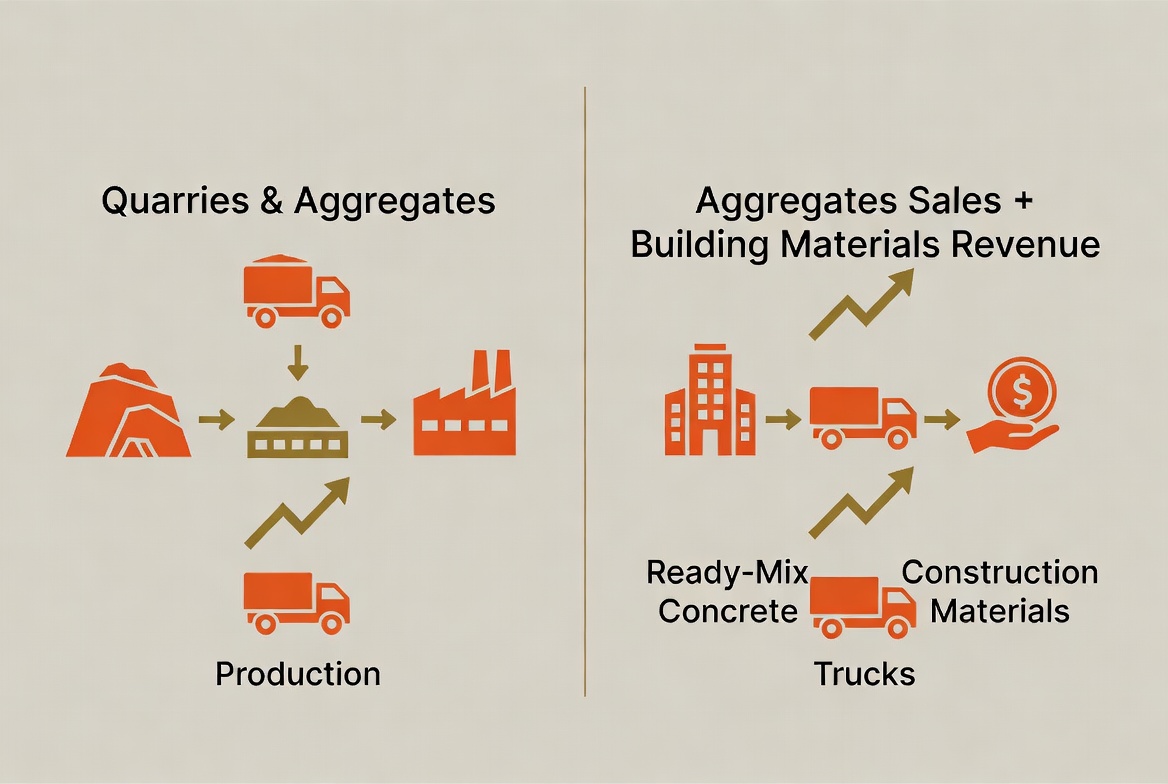
What Are Martin Marietta’s Revenue Sources?
Martin Marietta’s revenue mainly comes from the sale of construction materials. Aggregates occupy the central position, supported by revenue from cement, concrete and other construction products.
The overall revenue structure can be summarized as follows:
| Revenue Segment |
Main Content |
| Aggregates business |
Crushed stone, sand and gravel, and related construction aggregates |
| Cement business |
Cement production and sales |
| Ready-mixed concrete |
Supply for commercial and residential projects |
| Asphalt products |
Materials for road construction |
| Other materials businesses |
Supporting construction products and services |
Compared with consumer industries, revenue for construction materials companies is often directly linked to the number and scale of projects. When infrastructure investment increases or the real estate market is active, demand for construction materials usually rises at the same time.
Because large engineering projects typically require ongoing materials procurement, Martin Marietta can obtain a relatively stable source of orders through long-term customer relationships.
How the Aggregates Business Generates Revenue
The aggregates business is Martin Marietta’s most important source of revenue and the core foundation of its business model.
Aggregates usually include crushed stone, sand and gravel, and processed mineral particle materials. These materials are widely used in the construction of roads, bridges, homes and commercial buildings. Although the unit price of aggregates is relatively low, engineering projects use them in very large quantities, creating a substantial market.
Martin Marietta first extracts natural rock resources from quarries, then uses crushing, screening and processing equipment to produce aggregate products that meet engineering standards. The company then transports these products to project sites through rail, road or other logistics systems.
The aggregates business has clear resource characteristics. High-quality quarries take a long time to develop, while land approvals and environmental regulations are relatively strict, which limits new supply to some extent. This means companies with large resource reserves can often build long-term competitive barriers.
For Martin Marietta, aggregates not only contribute the largest share of revenue, but also serve as an important underlying asset supporting the company’s long-term value.
How Cement and Ready-Mixed Concrete Contribute to Growth
Beyond aggregates, cement and ready-mixed concrete are also important sources of growth for Martin Marietta.
Cement is the core raw material used to produce concrete, while concrete is widely used in building structures, bridge projects and road construction. Compared with aggregates, cement and concrete products have higher added value, which can improve overall profitability.
The ready-mixed concrete business usually needs to be closer to construction sites. Because the product has higher requirements for transport time and quality control, companies often need to build regional production networks. This model helps strengthen customer relationships and expand market coverage.
From an industry perspective, many engineering projects purchase aggregates, cement and concrete products at the same time. Companies with a complete product system can provide customers with one-stop solutions, improving overall market competitiveness.
As a result, the cement and ready-mixed concrete businesses not only expand revenue sources, but also help Martin Marietta increase the value it captures from each project.
Infrastructure construction is one of Martin Marietta’s most important sources of end demand.
Highways, bridges, railways, airports and public facilities all require large quantities of construction materials. Compared with the residential market, infrastructure projects are usually larger in scale and have longer construction cycles, creating sustained demand.
The United States has a vast infrastructure network, and many of its facilities have already been in operation for decades. As demand increases for road resurfacing, bridge maintenance and transportation system upgrades, the construction materials industry can continue to gain new market opportunities.
In addition, government infrastructure investment often has strong stability. Even when the real estate market fluctuates, public works projects may continue moving forward, helping construction materials companies maintain revenue levels.
For Martin Marietta, infrastructure construction creates short-term orders and also serves as an important market logic supporting long-term growth.
Why Regional Resource Advantages Strengthen Competitiveness
One of the most important competitive factors in the construction materials industry is the combination of resources and geography.
Unlike electronics or consumer goods, aggregates and concrete carry relatively high transportation costs. When transport distances are too long, logistics costs can quickly erode profit margins. Because of this, most construction projects prefer nearby suppliers.
Martin Marietta has built a production network across multiple states through long-term acquisitions and resource development. This footprint allows the company to stay close to major construction markets and reduce transportation costs.
At the same time, high-quality quarry resources are scarce. Developing new mining areas usually requires complex approval procedures, so existing resource reserves are themselves an important competitive barrier.
Over the long term, regional resource advantages can not only improve profitability, but also strengthen customer stickiness and market share.
How to Buy MLM, Martin Marietta Materials, Stock
MLM is the stock ticker for Martin Marietta Materials on the New York Stock Exchange. Traditionally, investors can buy MLM stock through brokerage accounts that support U.S. stock trading, allowing them to participate in the development of the U.S. construction materials industry.
Because Martin Marietta’s operating performance is closely related to infrastructure investment, real estate construction activity and demand for construction materials, many investors view it as an important representative company for observing the U.S. construction market.
As digital asset markets and traditional financial markets gradually become more integrated, more trading tools linked to stock price movements have also appeared. For example, some platforms offer CFD products linked to U.S. stock prices, allowing users to participate in market price changes without directly holding the underlying shares.
Gate TradFi is continuing to expand its coverage of traditional financial assets. Users can monitor digital assets, U.S. stocks, ETFs, indices and commodities within a unified account environment. Some markets also offer Gate CFD products, providing more options for cross-market asset allocation and market observation.
Regardless of how investors participate in the market, they should fully understand the product structure, trading mechanism and regulatory requirements in their region.
Conclusion
Martin Marietta Materials has a business model built on the construction materials supply chain, with aggregates as its core revenue source, while cement and ready-mixed concrete further broaden its revenue structure. The company builds its competitive advantage through resource reserves, regional positioning and long-term customer relationships, and it benefits deeply from demand in U.S. infrastructure construction and real estate markets. At its core, MLM is not simply a construction materials producer. It is an important participant in the U.S. engineering and construction system.
FAQs
What is MLM’s main business?
MLM mainly produces and sells aggregates, cement, ready-mixed concrete and other construction materials. It is one of the important construction materials suppliers in the United States.
What is Martin Marietta’s largest source of revenue?
The aggregates business is Martin Marietta’s largest source of revenue and its most central business segment.
Why does the aggregates business have competitive barriers?
The aggregates business depends on high-quality mining resources and regional supply networks, while new resource development is limited by approvals and environmental requirements, creating relatively high barriers to entry.
Infrastructure construction projects require large amounts of construction materials, so increased investment in roads, bridges and public works usually drives demand growth for MLM’s products.
Yes. Residential construction and commercial real estate development require large amounts of aggregates and concrete, so the level of activity in the real estate market affects the company’s revenue performance.
Is MLM in a cyclical industry?
The construction materials industry is closely related to economic construction activity, so it has certain cyclical characteristics. However, infrastructure investment can provide some degree of long-term demand support.