As the Solana DeFi ecosystem continues to grow, liquid staking has gradually become an important part of onchain yield infrastructure. Compared with traditional staking, LSTs allow users to keep earning staking rewards while still using their assets in lending, DEX trading, yield aggregators, and other onchain activities. As a result, more protocols are building new financial use cases around LSTs.
In the Solana ecosystem, JitoSOL, mSOL, and bSOL are among the most representative liquid staking tokens today. Although they are all LSTs, they differ clearly in reward sources, validator strategies, MEV integration, and ecosystem positioning.
A Brief Overview of JitoSOL
JitoSOL is the Solana liquid staking token launched by Jito. When users deposit SOL into the Jito Stake Pool, they receive a corresponding amount of JitoSOL and continue earning staking rewards.
Unlike some traditional LSTs, JitoSOL’s core feature is its use of MEV, or maximum extractable value, rewards. The Jito Validator Client optimizes transaction ordering within blocks and returns part of the related revenue to stakers. As a result, JitoSOL’s yield is usually made up of both staking rewards and MEV rewards.
What Is mSOL?
mSOL is the Solana liquid staking token launched by Marinade Finance. It is also one of the earliest mainstream LSTs in the Solana ecosystem.
When users deposit SOL into the Marinade Stake Pool, they receive a corresponding amount of mSOL. The underlying assets are delegated across multiple validator nodes to reduce the risk of validator concentration.
Compared with some protocols that focus on enhanced yield, mSOL places greater emphasis on liquid staking infrastructure itself, as well as broad compatibility with the Solana DeFi ecosystem. For this reason, mSOL has long been integrated by many lending protocols, DEXs, and yield aggregators.
What Is bSOL?
bSOL is the Solana liquid staking token launched by BlazeStake.
Like some other LSTs, bSOL allows users to keep their assets liquid while earning staking rewards. However, BlazeStake places stronger emphasis on validator decentralization, aiming to improve network decentralization by delegating to more small and midsized validators.
For this reason, bSOL is positioned more as decentralized staking infrastructure than as a yield enhancement product.
What Are the Core Differences Between JitoSOL, mSOL, and bSOL?
Although all three are Solana LSTs, their protocol goals are not exactly the same.
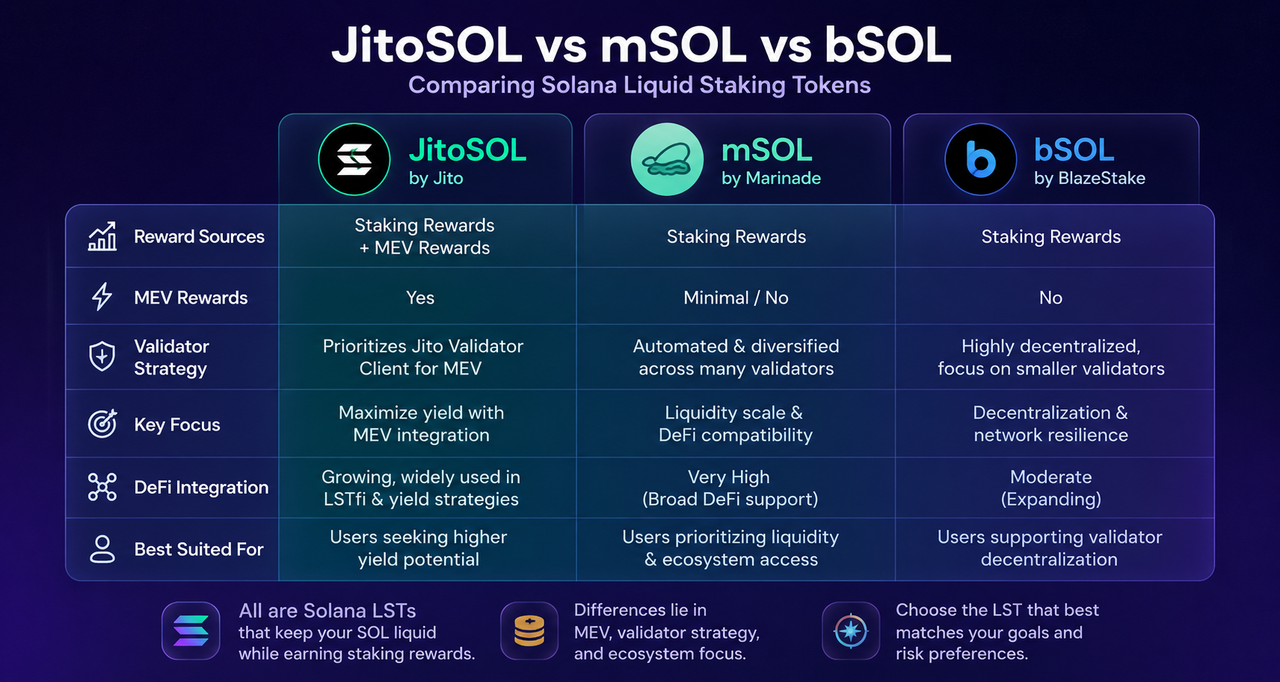
JitoSOL places more emphasis on yield enhancement and MEV integration. mSOL focuses more on ecosystem compatibility and liquidity scale. bSOL, meanwhile, gives greater priority to validator distribution and network decentralization.
| LST |
Protocol |
Reward Source |
Includes MEV Rewards |
Core Feature |
| JitoSOL |
Jito |
Staking + MEV |
Yes |
Enhanced yield |
| mSOL |
Marinade |
Staking |
Limited |
Broad DeFi integration |
| bSOL |
BlazeStake |
Staking |
No |
Validator decentralization |
These differences in positioning also lead to differences in yield, risk structure, and ecosystem usage across the three LSTs.
How Do the Reward Structures of JitoSOL, mSOL, and bSOL Differ?
The base yield of Solana LSTs usually comes from staking rewards, but some protocols introduce additional sources of return.
JitoSOL stands out because it integrates MEV rewards into its staking model. When transaction activity on the Solana network is high, related MEV rewards may increase overall yield.
mSOL’s yield mainly comes from traditional staking. Since it focuses more on ecosystem compatibility, its reward structure is relatively stable, but it has fewer additional sources of yield.
bSOL also relies mainly on staking rewards, though its validator decentralization strategy may affect yield performance at different stages.
It is important to note that yields across different protocols can fluctuate with network activity, validator performance, and market conditions.
How Do the Validator Strategies of JitoSOL, mSOL, and bSOL Differ?
Validator delegation strategy is one of the key differences among LST protocols.
The Jito Stake Pool prioritizes validators that run the Jito Validator Client so that it can capture additional MEV rewards.
Marinade places greater emphasis on validator decentralization and automated delegation, using dynamic allocation mechanisms to reduce network concentration risk.
BlazeStake takes an even more active approach in this area. One of its core goals is to increase the participation of small and midsized validators, so its delegation strategy is usually more decentralization oriented.
These strategies affect not only yield, but also each protocol’s role in network security and decentralization.
Which LST Is Used More Widely in DeFi?
The level of ecosystem integration also varies across different LSTs.
Because mSOL launched earlier, it has long been supported by many Solana DeFi protocols and offers relatively high compatibility across lending, DEX, and yield aggregator platforms.
JitoSOL, meanwhile, has gradually become an important asset in Solana yield strategies as the Jito ecosystem has expanded. Its use is increasing in particular across LSTFi and restaking related scenarios.
bSOL has a relatively smaller ecosystem, but it still has some influence among communities that emphasize decentralized staking.
Overall, the DeFi usage of an LST is usually closely tied to its liquidity scale, protocol partnerships, and market adoption.
How Do the Risk Structures of JitoSOL, mSOL, and bSOL Differ?
Although all Solana LSTs face smart contract, liquidity, and network risks, the risk structure of each protocol is not exactly the same.
Because JitoSOL introduces an MEV reward mechanism, it also involves additional risks related to transaction ordering and MEV.
mSOL’s risks are more closely tied to its large scale ecosystem integration, since it is deeply connected with multiple DeFi protocols.
For bSOL, its emphasis on validator decentralization may expose it to differences in the stability of some small and midsized validators.
In addition, all LSTs may temporarily depeg during periods of market volatility. Their market prices may not always remain fully aligned with their theoretical value.
How Should Users Choose Between Different Types of Solana LSTs?
The design direction of each LST makes it better suited to different needs.
Users who care more about enhanced yield will often look at products that include MEV reward mechanisms. Users who prioritize DeFi liquidity and protocol compatibility may prefer assets with broader ecosystem integration. Those who place more value on network decentralization may focus on validator distribution strategies.
However, the yield, risk, and liquidity profile of each protocol can change with market conditions. The actual performance of an LST will also be affected by Solana network activity and the broader DeFi market environment.
Conclusion
JitoSOL, mSOL, and bSOL are all Solana liquid staking tokens, but they differ clearly in protocol goals and operating mechanisms. JitoSOL places more emphasis on MEV based yield enhancement. mSOL focuses more on DeFi ecosystem compatibility. bSOL gives greater priority to validator decentralization and network decentralization.
As the Solana DeFi and LSTFi ecosystems continue to expand, different types of liquid staking assets are forming more specialized market positions.
FAQs
Why Does JitoSOL Have Additional Yield?
JitoSOL introduces an MEV reward mechanism, so in addition to staking rewards, it may also receive extra MEV rewards.
Why Is mSOL More Common in DeFi?
mSOL launched earlier and has long been integrated with multiple Solana DeFi protocols, giving it stronger ecosystem compatibility and greater liquidity scale.
What Is the Main Feature of bSOL?
bSOL places greater emphasis on validator decentralization and aims to improve network decentralization by supporting more small and midsized validators.
Can Different LSTs Depeg?
During periods of market volatility or insufficient liquidity, the market price of an LST may temporarily deviate from its theoretical value.
Which Solana LST Has Higher Yield?
The yield of different LSTs changes with staking performance, network activity, and market conditions, so actual returns may continue to fluctuate.







