From a market influence standpoint, GBTC is one of the earliest Bitcoin investment products to gain institutional traction, while IBIT stands as one of the most representative products of the spot Bitcoin ETF era. Although both are built around Bitcoin, they diverge significantly in their growth trajectories and market roles.
As spot Bitcoin ETFs increasingly become a key vehicle for traditional finance to allocate digital assets, the comparison between IBIT and GBTC has emerged as a major topic of market discussion.
IBIT's Positioning
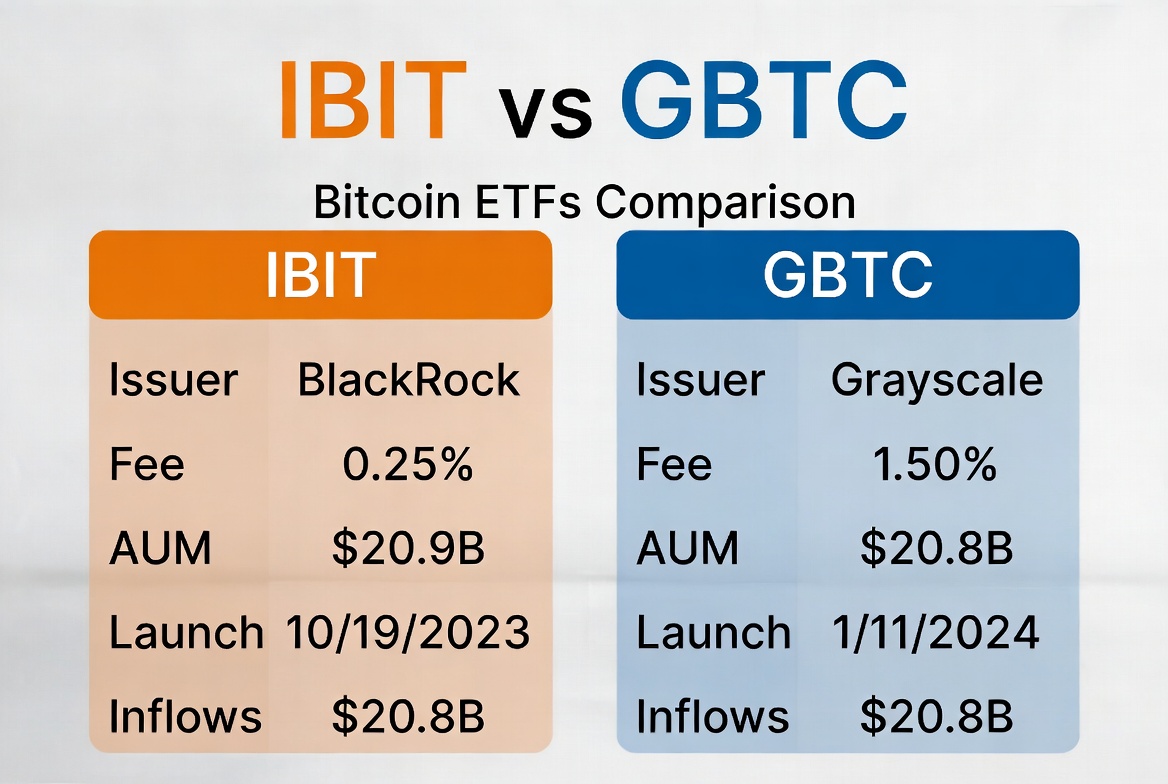
IBIT is a spot Bitcoin ETF launched by BlackRock's iShares. Its core objective is to track the spot market price of Bitcoin and back its ETF share value with holdings of real Bitcoin.
The launch of IBIT marks the official entry of the traditional asset management industry into the spot Bitcoin ETF space. As one of the world's largest asset managers, BlackRock's involvement has further accelerated institutional interest in digital assets.
In terms of operation, IBIT uses a standard spot ETF structure. The fund supports its net asset value by purchasing and holding real Bitcoin, and uses creation and redemption mechanisms to keep the market price aligned with the net asset value.
Leveraging extensive ETF operational experience and a broad institutional client base, IBIT quickly became one of the Bitcoin ETFs with the largest capital inflows in the world after its launch.
GBTC's Positioning
GBTC is a Bitcoin investment product from Grayscale and one of the longest-standing institutional-grade Bitcoin investment tools in the digital asset market.
Before spot Bitcoin ETFs were approved, GBTC was long seen as a vital gateway for institutional investors into the Bitcoin market. Many traditional investment institutions gained their first exposure to Bitcoin prices through GBTC.
Compared to the spot ETF era, GBTC has a much earlier development history. It originally used a trust structure rather than a standard ETF framework. Investors participated in the Bitcoin market by purchasing trust shares, while the fund held the corresponding Bitcoin assets.
Following the approval of U.S. spot Bitcoin ETFs, GBTC gradually completed its product transformation and entered the competitive spot ETF arena. As such, GBTC holds significant historical importance in both the Bitcoin trust era and the ETF era.
Product Structure Differences Between IBIT and GBTC
From an underlying asset perspective, both IBIT and GBTC hold real Bitcoin, making them both spot Bitcoin investment tools.
However, their development paths differ markedly. IBIT adopted a spot ETF structure from the very start, while GBTC underwent a transition from a Bitcoin trust product to a spot ETF product.
This historical backdrop creates differences in market perception and investor composition. IBIT embodies the new generation of spot ETFs, whereas GBTC retains stronger characteristics of the early digital asset market.
From a market understanding standpoint, IBIT symbolizes the entry of traditional asset management into the digital asset space, while GBTC represents a key milestone in the early financial experimentation of the crypto industry.
Fee Mechanism Differences Between IBIT and GBTC
Fee levels are a critical factor for investors comparing ETF products, as fees directly affect long-term holding costs.
For long-term investors, even minor differences in expense ratios can accumulate significantly over years of holding. As a result, management fees often serve as a key reference when institutional investors choose ETF products.
With growing competition in the spot Bitcoin ETF market, issuers are competing to attract inflows through more attractive fee structures. Lower management fees can boost a product's appeal and enhance its long-term competitiveness.
Beyond base management fees, investors also consider trading costs, bid-ask spreads, and market liquidity, as these factors equally impact the actual investment experience.
Liquidity Differences Between IBIT and GBTC
Liquidity determines how easily investors can buy or sell an ETF and is a key measure of ETF market maturity.
Generally, higher trading volume and narrower bid-ask spreads indicate better liquidity. Strong liquidity helps investors execute trades at prices close to the market price and reduces transaction costs.
Since its launch, IBIT has attracted substantial institutional and retail capital, building high market activity. Its growing fund size has further strengthened its liquidity advantage.
GBTC, with its long-established investor base, also enjoys high market attention. However, as competition in the spot ETF market intensifies, capital flows and market activity continue to shift.
For large institutions, liquidity is directly tied to execution efficiency, making liquidity differences an important dimension when comparing these two ETFs.
Market Positioning Differences Between IBIT and GBTC
Although both IBIT and GBTC revolve around Bitcoin, they have distinct brand positions in the market.
IBIT emphasizes the allocation needs of traditional finance for digital assets. BlackRock's global influence in asset management makes IBIT easier for institutional investors to integrate into existing asset allocation frameworks.
In contrast, GBTC is more closely linked to the historical development of the digital asset industry. Many early institutional Bitcoin investors first encountered digital assets through GBTC.
In terms of market image, IBIT resembles a digital asset ETF built by a traditional financial institution, while GBTC is more like a product that grew out of the digital asset industry and gradually integrated into the traditional financial system.
This positioning difference does not imply that one is better than the other—it simply reflects the different backgrounds and market strategies of the two institutions.
Application Scenarios of IBIT and GBTC in Different Market Environments
In institutional asset allocation, both IBIT and GBTC can serve as tools for gaining Bitcoin price exposure.
For institutions that prioritize standardized asset allocation and ETF management systems, IBIT typically fits more easily into existing portfolio management frameworks. Large wealth managers, pension funds, and traditional fund managers tend to focus on product size, brand influence, and market liquidity.
For investors familiar with the history of the digital asset market, GBTC carries strong industry significance. Some investors have tracked GBTC's performance for years and continue to view it as an important Bitcoin investment vehicle.
| Comparison Dimension |
IBIT |
GBTC |
| Issuer |
BlackRock (iShares) |
Grayscale |
| Product Starting Point |
Spot Bitcoin ETF |
Bitcoin trust transitioning to ETF |
| Market Image |
Representative of traditional finance |
Pioneer in the crypto industry |
| Main Investor Focus |
ETF allocation needs |
Historical digital asset participant |
| Core Function |
Bitcoin price exposure |
Bitcoin price exposure |
At their core, both products serve the same ultimate purpose—helping investors gain Bitcoin price exposure through the securities market. Different investors have different priorities, which may lead them to choose one over the other.
Conclusion
IBIT and GBTC are both major products in the spot Bitcoin investment market, providing investors with price exposure through holdings of real Bitcoin.
IBIT represents the push by traditional asset management to bring digital assets into the mainstream financial system, while GBTC represents the early financialization achievements of the digital asset industry. The two products differ in structure, fees, liquidity, and market positioning, but their ultimate goal is the same: to help investors access the Bitcoin market more conveniently.
As the spot Bitcoin ETF market continues to evolve, IBIT and GBTC will remain key windows for observing institutional capital flows and the financialization of digital assets.
FAQ
Are IBIT and GBTC both spot Bitcoin ETFs?
Yes, both are currently spot Bitcoin investment products that track BTC prices by holding real Bitcoin assets.
What is the biggest difference between IBIT and GBTC?
The biggest difference lies in their development backgrounds. IBIT has been a spot ETF from the start, while GBTC began as a Bitcoin trust and later transitioned into the spot ETF market.
Why do investors compare IBIT and GBTC?
Both are large, high-profile Bitcoin investment tools, so they are frequently compared in terms of fees, liquidity, and market positioning.
Why is liquidity important?
Higher liquidity typically means narrower bid-ask spreads and greater trading efficiency, helping to reduce investor transaction costs.
Do both IBIT and GBTC follow Bitcoin price fluctuations?
Yes. Because both hold real Bitcoin assets, their long-term price trends generally have a high correlation with the Bitcoin market price.
How can I trade IBIT or GBTC?
IBIT and GBTC can typically be bought and sold through securities accounts that support U.S. stock trading. Gate TradFi, for example, also offers related CFD products, allowing investors to participate through price movements without directly holding ETF shares.