Why Stablecoins Are Starting to Chase Yield
Stablecoins were originally primarily designed as a medium of exchange and a store of value within the crypto market. Because their prices remain relatively stable, many investors hold stablecoins during market volatility to wait for opportunities or use them for cross-border transfers and payments.
Now, with the stablecoin market expanding rapidly, more institutions are asking a new question: If large sums of capital sit idle in stablecoins for the long term, can they generate ongoing returns — just like cash management tools in traditional finance?
In traditional finance, corporations and institutions rarely let significant cash sit idle. Instead, they deploy it into money market funds, short-term Treasuries, or other low-risk fixed-income vehicles. OpenTrade aims to bring that model on-chain, enabling stablecoins to tap into yields generated by real-world assets.
What Is an RWA Yield Vault?
An RWA Yield Vault is essentially an on-chain asset management tool designed to generate extra returns for capital while maintaining the liquidity of stablecoins.
Unlike typical DeFi yield pools, RWA vaults don't rely on liquidity mining or token incentives as their primary yield source. Instead, they allocate funds to real-world financial assets — U.S. Treasuries, short-term notes, or other fixed-income instruments.
When those assets earn interest, the returns are distributed to vault participants according to a predefined formula. Because the yield originates from real-world financial markets, the return structure tends to be more transparent and easier to assess compared to many high-risk DeFi strategies.
How OpenTrade’s Yield Vault Works
 (Source: opentrade_io)
OpenTrade's operational logic closely mirrors traditional asset management, but with the entire process digitized and automated via blockchain.
First, users deposit stablecoins like USDC into the vault. Once the funds enter the system, the platform allocates them based on a pre-set strategy — deploying a portion into Treasuries, fixed-income instruments, or other yield sources that meet risk management criteria. The income generated by those assets accumulates continuously, with the smart contract handling both recording and distribution. When users withdraw, they receive their original principal plus their share of the returns.
Throughout the workflow, blockchain serves as the record-keeping and automated settlement layer, while the actual yield is sourced from off-chain financial markets.
The Role of Smart Contracts in Yield Management
Older yield products often required heavy manual work for tasks like calculating returns, documenting asset allocations, and settling capital. This not only drove up operational costs but also increased the risk of information opacity (or lack of transparency).
OpenTrade automates many of these functions through smart contracts. Once funds enter the vault, the system automatically records each participant's proportional share and distributes returns accordingly. This approach not only boosts efficiency but also brings greater transparency to the yield lifecycle. Users can track asset movements and earnings clearly without having to rely solely on a single financial institution for updates.
How Curation+ Adds Flexibility to Yield Strategies
 (Source: opentrade_io)
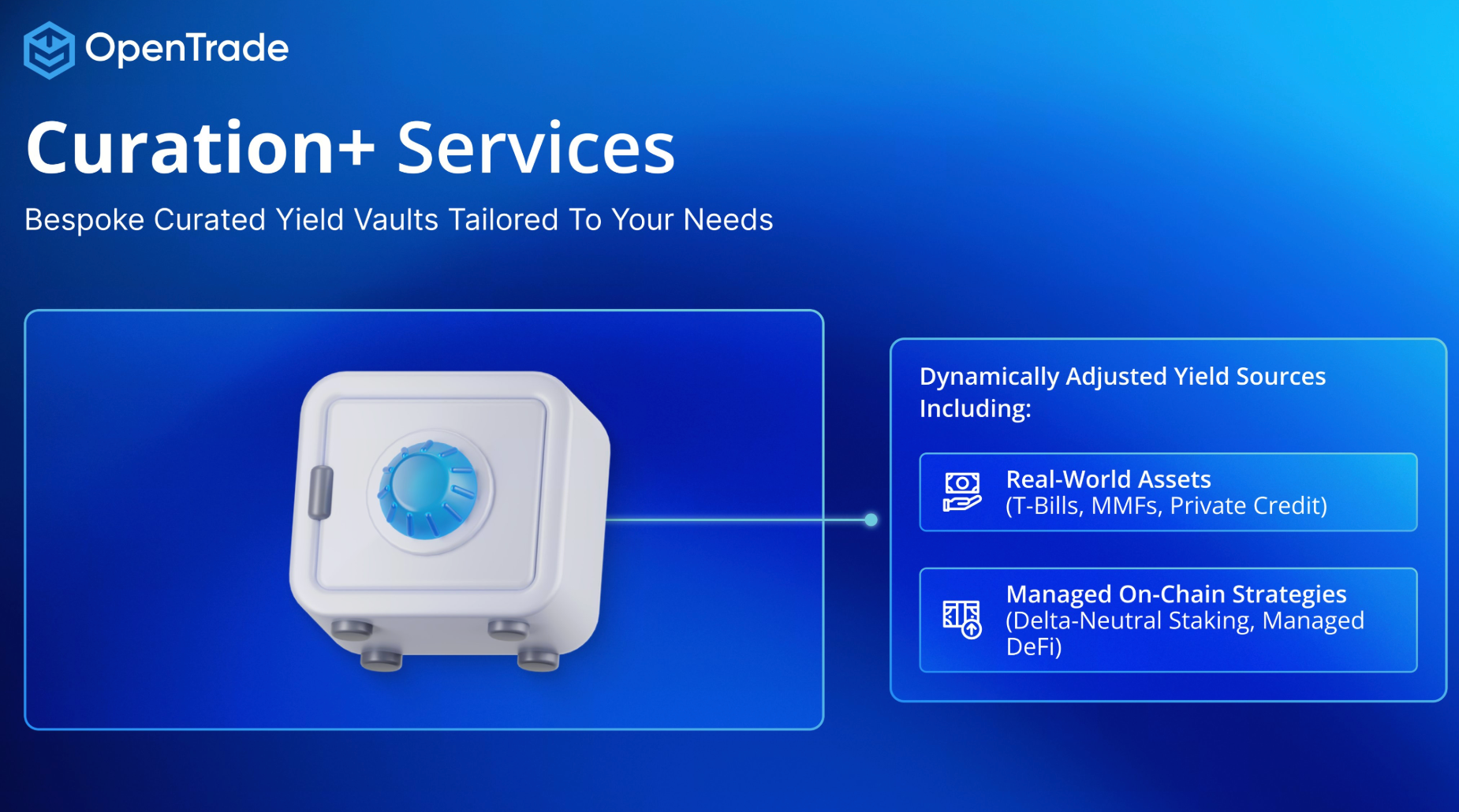
As on-chain finance matures, different institutions have developed divergent needs for yield products. Some seek low risk and steady returns, while others are willing to take on more risk for higher potential gains. A single fixed product can no longer serve everyone. That's why OpenTrade introduced the Curation+ framework.
Curation+ allows platforms or institutions to design custom yield strategies according to their own requirements — not just asset allocation ratios, but also risk controls, liquidity parameters, and compliance filters. This transforms yield products from simple vaults into a full-fledged on-chain asset management infrastructure.
Why the RWA Yield Model Is Gaining Traction
RWA has become one of the hottest trends in Web3, largely because the market is looking for more sustainable yield sources. Early DeFi's explosive growth was heavily fueled by token incentives and liquidity mining. But those models typically require constant token issuance to sustain returns, raising long-term sustainability concerns.
By contrast, RWA yields come from real-world financial markets — built on Treasury rates, bond yields, and cash-flow assets. That gives on-chain finance a direct link to traditional finance, drawing increasing interest from institutional capital. For the stablecoin ecosystem, RWA is more than just a new yield source — it could become a foundational pillar of future on-chain finance.
Summary
OpenTrade's RWA Yield Vaults represent a shift from early crypto-native yield models toward a new phase where on-chain finance integrates with real-world financial markets. By combining stablecoins, smart contracts, and real-world assets, OpenTrade aims to create a financial infrastructure that balances efficiency, transparency, and yield. As the RWA market continues to expand, these yield vaults are well-positioned to become a key component of on-chain asset management going forward.







