The energy industry is undergoing a digital transformation. Power equipment was once viewed as purely physical infrastructure, with value measured solely by generation, storage, or supply capacity. But with the rise of IoT, smart grids, and blockchain technology, energy devices now generate data and exchange value. Energy systems are evolving from traditional infrastructure networks into digital energy networks.
In this context, energy asset tokenization has become a key direction for the energy internet. As a major project in the energy DePIN space, OpenVPP aims to integrate distributed energy resources—including electric vehicles (EVs), battery storage systems, solar equipment, and smart meters—into a unified blockchain network.
What Is Energy Asset Tokenization?
Energy asset tokenization is a digital process that uses blockchain to map energy equipment and its generated value onto the chain.
In traditional energy systems, EVs, batteries, and solar systems create value, but that value is typically siloed on closed platforms or in corporate databases.
The core goal of tokenization is to create a unified digital representation, making energy assets verifiable, traceable, and programmable.
Technically, energy asset tokenization is a specialized form of real-world asset (RWA) tokenization. Instead of real estate or bonds, the underlying assets are energy infrastructure and its operational capacity.
Why Do Energy Devices Need a Digital Identity?
A digital identity is the first step to bringing energy assets on-chain.
The real world is filled with diverse energy devices—EVs, battery storage systems, solar panels, smart meters, and more. Without a standardized identity system, blockchain networks cannot verify device provenance or operational status.
OpenVPP assigns each device a digital identity that records its core attributes.
This information typically includes:
A digital identity allows every device to become an independent, verifiable on-chain entity within the network.
How Does OpenVPP Bring Energy Assets On-Chain?
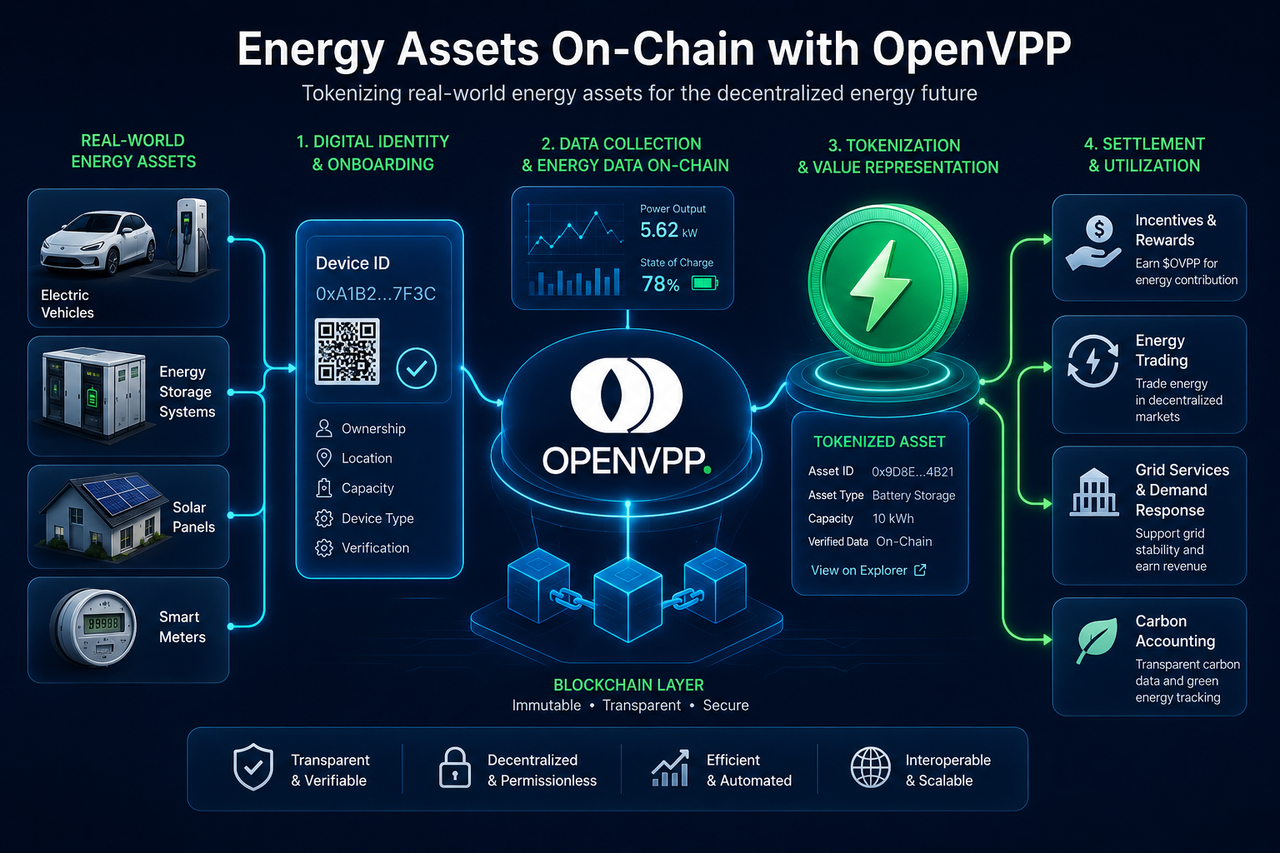
OpenVPP’s on-chain energy asset process consists of three layers: identity, data, and value.
Once a device connects to the network, identity verification is completed first.
Then, operational data—such as power generation, consumption, storage capacity, and grid response behavior—is continuously uploaded.
Finally, the system generates value records based on device contributions and executes incentives and settlements via smart contracts.
The full process can be summarized as:
Physical Device → Digital Identity → On-Chain Data → Value Mapping → On-Chain Settlement
This structure gives real-world energy assets a complete digital lifecycle.
How Can an Electric Vehicle Become an On-Chain Energy Asset?
EVs are not just transportation—they are mobile energy storage units.
With Vehicle-to-Grid (V2G) technology, EV batteries can switch flexibly between charging and discharging, helping regulate the grid.
In the OpenVPP network, each EV receives a digital identity upon connection.
The system continuously records:
This data forms the EV’s energy contribution profile.
When the vehicle participates in demand response or storage services, its contributions are recorded and factored into on-chain incentive calculations.
So within OpenVPP, EVs are not just energy consumers—they are also energy service providers.
How Are Energy Storage Devices Tokenized?
Storage devices represent one of the most typical use cases for energy asset tokenization.
Battery storage systems store electricity when supply exceeds demand and release it during peak hours.
In traditional energy markets, the value of storage equipment is typically managed centrally by operators.
OpenVPP records storage behavior on-chain, allowing contributions to be independently quantified.
For example:
-
Amount of electricity stored
-
Number of discharge cycles
-
Response speed
-
Grid regulation capability
These metrics build a device credit and contribution record.
Over time, the storage device develops a comprehensive digital asset profile.
How Does OpenVPP Record the Value of Energy Data?
Energy data is a critical component of energy asset digitization.
Traditional systems tend to focus only on energy transaction outcomes, ignoring the intrinsic value of data.
OpenVPP treats device operational data as a key network resource.
The system continuously records:
-
Generation behavior
-
Storage behavior
-
Consumption behavior
-
Grid support behavior
This data supports demand forecasting, grid dispatching, and energy market operations.
In an energy internet environment, data value and energy value together form the asset value system.
What Are the Use Cases for Energy Asset Tokenization?
Bringing energy assets on-chain is not just a technical innovation—it can also enable new energy collaboration models.
Decentralized Energy Networks
Devices can participate directly in network operations without relying entirely on a centralized coordinator.
Virtual Power Plant Coordination
Tokenized devices can form a key resource pool for virtual power plants.
Energy Market Settlement
Contributions can be recorded and settled in real time, boosting market transparency.
Carbon Emission Tracking
On-chain data provides more transparent proof of green energy sources.
Energy Infrastructure Financing
Digital asset records enhance the verifiability and transparency of energy infrastructure.
What Challenges Does Energy Asset Tokenization Face?
Energy asset tokenization is still in its early stages.
First, a reliable data verification mechanism is needed between physical devices and on-chain data. If data authenticity cannot be guaranteed, on-chain records lose their value.
Second, different countries and regions have varying regulatory frameworks for energy markets and digital assets.
In addition, a lack of device standardization makes network compatibility more difficult.
Going forward, one key direction is establishing unified energy data standards and device identity protocols.
How Does OpenVPP Differ from Traditional Energy Asset Management?
| Comparison Dimension |
OpenVPP Model |
Traditional Model |
| Device Identity |
On-chain digital identity |
Enterprise database |
| Data Storage |
Distributed records |
Centralized storage |
| Value Confirmation |
Smart contract calculation |
Manual or platform accounting |
| Asset Transparency |
High |
Relatively limited |
| Network Participation |
Open network |
Platform-managed |
| Incentive Mechanism |
Digital asset rewards |
Fixed subsidies |
OpenVPP emphasizes digitization of energy assets and open value network construction, while traditional models focus on centralized management and operations.
Summary
Energy asset tokenization is a key direction for both the energy internet and real-world asset tokenization. By establishing digital identities, on-chain data records, and smart contract settlement mechanisms, EVs, storage devices, solar systems, and other energy infrastructure can obtain verifiable digital representations.
OpenVPP connects real-world energy devices through a decentralized virtual power plant network, mapping energy contributions, device capabilities, and operational data into the blockchain environment.
FAQs
How does OpenVPP bring energy assets on-chain?
OpenVPP connects real-world energy devices to the blockchain through device identity verification, real-time data collection, and smart contract settlement, establishing corresponding digital identity and value record systems.
Why can an electric vehicle be considered an energy asset?
EV batteries have storage capacity and can participate in grid regulation and demand response in V2G scenarios. So EVs are not just transportation—they also provide energy services.
Can NFTs be used for energy device management?
NFTs can serve as carriers for digital identities of energy devices, recording ownership, operational history, and contribution data to form verifiable digital credentials.
Does energy asset tokenization belong to RWA?
It is a form of real-world asset (RWA) tokenization. Unlike traditional RWA like real estate or bonds, the underlying assets here are energy infrastructure and the data and services it generates.
What is the biggest difference between OpenVPP and traditional energy management platforms?
OpenVPP uses blockchain to record device identity and energy data and relies on smart contracts for value settlement. Traditional platforms use centralized databases and operational models, resulting in clear differences in transparency and openness.