To understand the Holo hosting process, start by referencing the Holo (HOT) Hosting Network Overview. Holochain defines how applications collaborate in an agent-centric architecture, while Holo organizes host resources into accessible services and connects them to traditional web portals via the Web Bridge. This process-focused discussion addresses “how it operates,” rather than reviewing isolated events.
Which roles must be understood before starting? (Host / App Provider / Web User / Web Bridge)
The Holo hosting process involves at least four distinct roles: hosts provide computing power and storage, app providers manage hApp deployment and accessibility strategies, the bridge layer handles protocol translation, and web users initiate requests through browsers. Clear role boundaries are essential for identifying whether issues arise from the supply side, the application side, or the entry point. Confusing the “framework layer” and “hosting layer” undermines troubleshooting, which is a central theme in the ongoing discussion of Holo vs. Holochain: Hosting vs. P2P Framework.
| Role |
Core Actions |
Main Output |
Common Misconceptions |
| Host |
Connects to the network, contributes capacity, stays online |
Schedulable computing power and storage |
Assumed to only support dedicated hardware |
| App Provider |
Configures hosting strategy, manages access paths |
Sustainable, accessible hApp services |
Bridge issues mistaken for application code errors |
| Web Bridge |
Protocol translation, routing, entry exposure |
HTTP-accessible interfaces |
Assumed that bridging equals centralized hosting |
| Web User |
Browser requests, session interactions |
Access experience and usability feedback |
Assumed that running a P2P node is required |
This table clarifies responsibilities: when access slows, first check host capacity and bridge paths before examining application logic, rather than simply attributing issues to “network instability.”
How do hosts provide computing power and storage? (Including HoloPort and software hosts)
Host onboarding generally involves four steps: device preparation, identity and configuration registration, capacity declaration, and online contribution. HoloPort offers a hardware gateway, while software hosts allow broader device participation. Both paths require resource contribution and online reliability, but differ in deployment method and operational threshold.
Host supply is not a “more is better” linear model. Hosting availability depends on capacity quality, load distribution, node health, and peak request handling. Increasing host numbers without uniform quality can still cause localized bottlenecks, so health checks and fallback strategies are critical.
| Step |
HoloPort Path |
Software Host Path |
Verification Focus |
| 1. Access Preparation |
Power on hardware, establish network connectivity |
Configure system environment and dependencies |
Meets basic operating requirements |
| 2. Identity Configuration |
Bind device and host identity |
Register host instance and initialize parameters |
Identity and permissions are correct |
| 3. Capacity Declaration |
Report computing/storage capacity |
Declare allocatable resource pool |
Resource declaration matches actual measurement |
| 4. Online Contribution |
Maintain availability and respond to scheduling |
Receive tasks and provide continuous service |
Online rate and stability meet standards |
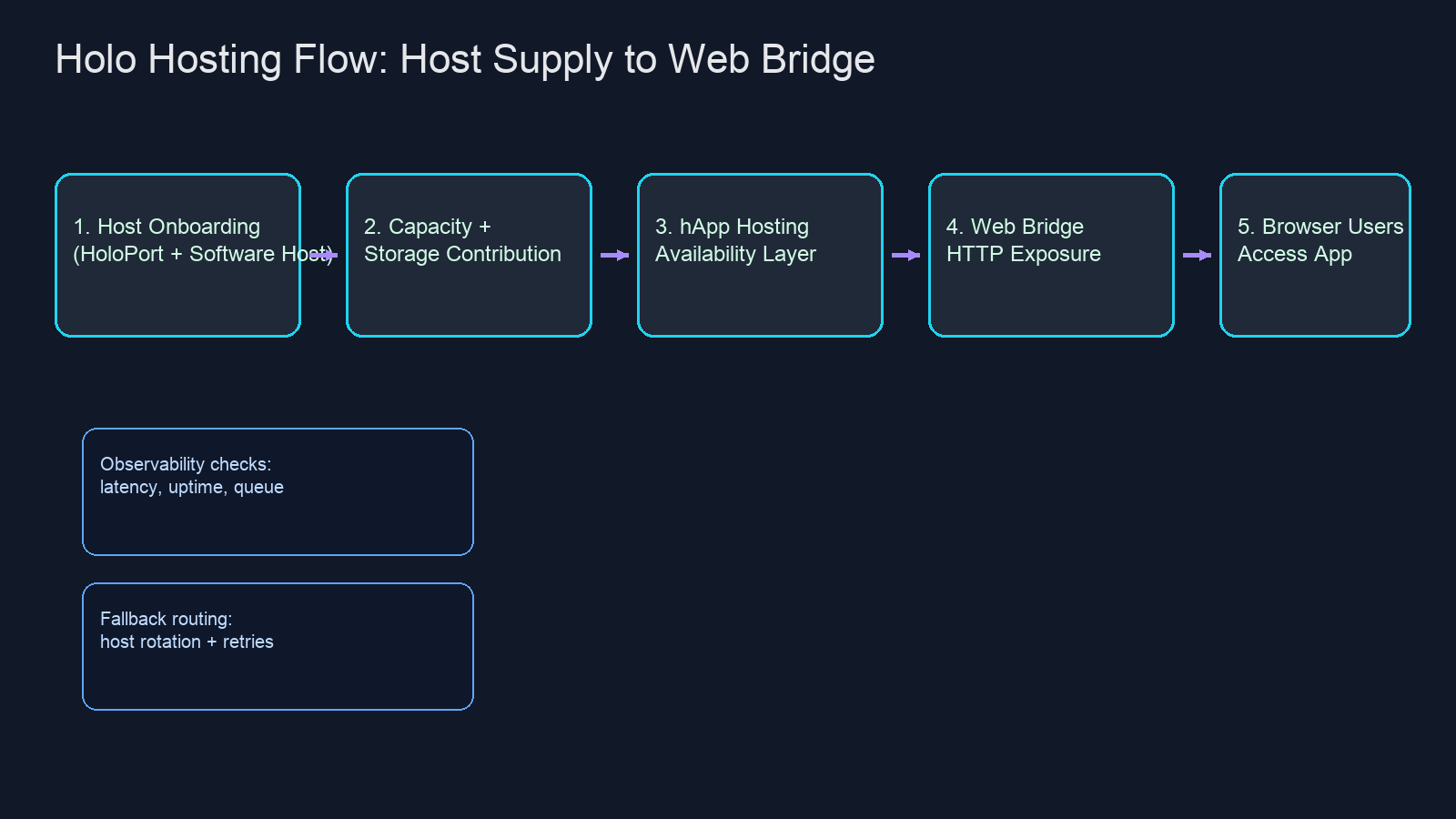
Figure 1. Holo hosting flow from host onboarding and resource contribution to Web Bridge exposure.
How are applications hosted and kept accessible?
The core of the application-side process is “continuous accessibility after deployment,” not “one-time launch completion.” App providers must define availability strategies at the hosting layer: which service entry points are exposed externally, which capabilities run internally, and how to maintain consistent responsiveness during peak demand. As a result, the hosting process includes ongoing monitoring.
In practice, app providers typically perform hosting configuration, bind accessibility strategies, test request paths, and conduct stability checks. Each step produces verifiable signals such as interface responses, latency windows, and failure retry ratios. This systematic verification is directly related to “availability and boundary risks” discussed in the Holo Risks and Limits Checklist.
How does Web Bridge connect traditional users?
The Web Bridge translates distributed application requests into standard web access paths, allowing web users to interact without understanding underlying P2P mechanics. The bridge layer manages entry discovery, request translation, routing, and result delivery. For users, it feels like “accessing a website”; for the system, protocol compatibility and reliable accessibility are critical.
Bridging does not eliminate all complexity automatically. It lowers access barriers but still requires handling high concurrency, retries, path switching, and caching. Treating the bridge as a simple reverse proxy overlooks hosting network capacity constraints and routing dependencies.
When do fees and accounting occur in the process? (HOT / HoloFuel design intent; do not assert full implementation)
Within the process, fees and accounting are not limited to “final payment”—measurement begins as soon as resources are used. Host resource contribution, app service consumption, and bridge request forwarding are all “measurable events.” The accounting design aims to keep resource consumption and value exchange within the same logical chain.
HOT and HoloFuel should be understood as “design intent plus progress status.” HOT was historically a placeholder token, while HoloFuel is intended for mutual-credit accounting in the hosting economy. Full availability and expansion to broader scenarios depend on public roadmaps and official information, and should not be assumed as fully implemented.
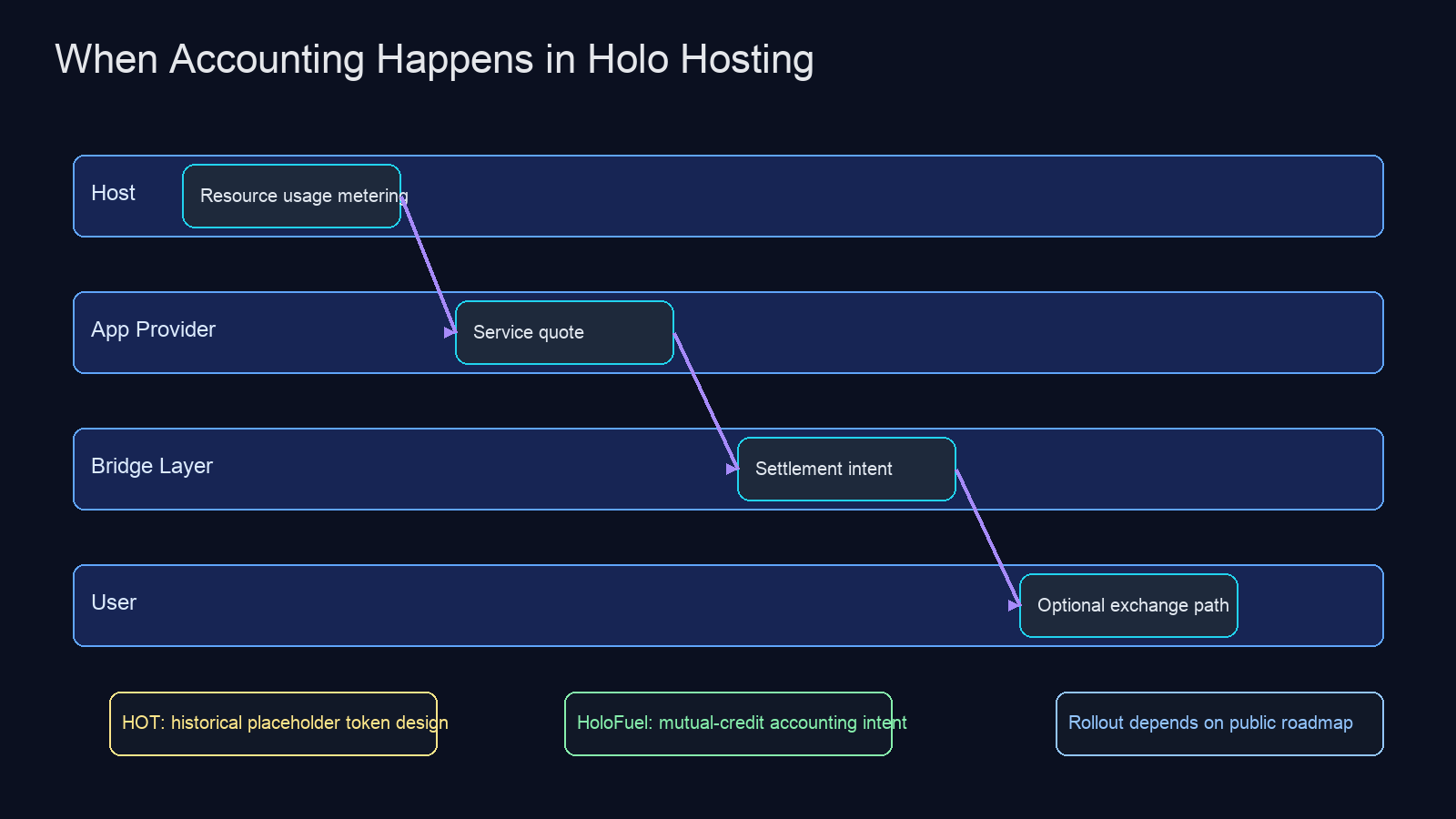 Figure 2. Accounting touchpoints for hosts, app providers, bridge layers, and users, and the design semantics of HOT / HoloFuel.
What are the risk points and verification items in the process?
Key process risks include supply-side stability, bridge layer availability, and accounting/settlement misconceptions. Supply-side risks involve uneven node online rates and concentrated loads; bridge layer risks involve request congestion and insufficient fallback; cognitive risks involve mistaking token design intent for current functionality. Focusing only on “page access” risks missing consistency and recoverability issues.
Verification items should be established for each stage: host side checks online rate and resource fulfillment, app side checks interface latency and error rate, bridge side checks translation success rate and fallback time, payment semantics side checks consistency of public statements and implementation. Process-oriented content is valuable for converting “abstract mechanisms” into “verifiable checklists.”
| Risk Point |
Trigger Scenario |
Verification Item |
Mitigation Direction |
| Host supply fluctuation |
Load increases during peak periods |
Online rate, capacity fulfillment rate |
Expand healthy hosts and optimize scheduling |
| Bridge congestion or routing anomaly |
Sudden request surge or path failure |
Translation success rate, fallback time |
Enhance routing strategy and retry mechanism |
| Application accessibility discontinuity |
Deployment update or dependency change |
Interface availability, error rate |
Staged release and rollback plan |
| Accounting cognitive misalignment |
Equating design intent with current status |
Consistency check of official statements |
Clarify “design goals vs. implementation status” |
These checks should be performed periodically, not just after failures. Process stability relies on ongoing verification, not one-time configuration.
Summary
The Holo hosting process can be summarized as: hosts provide resources, app providers organize accessibility, Web Bridge connects protocols, and web users access through standard entry points. The key is not any single component, but the collaboration of four roles along the same service path. HOT and HoloFuel are best understood as accounting design semantics, with practical status verified according to public progress. Only by viewing role division, process steps, and verification items together can the hosting system be reliably assessed as “truly usable.”
FAQ
How does Holo work?
Holo leverages a network of hosts to provide computing power and storage, then organizes application hosting into an accessible service layer. The Web Bridge translates requests for traditional web access, letting users interact with hApps via browsers. The process typically includes host onboarding, application configuration, bridge forwarding, and usability monitoring.
What is HoloPort?
HoloPort is a hardware gateway for host participants, enabling standardized entry into the hosting network and resource contribution. It operates alongside software hosts, differing mainly in deployment and operational threshold. Both must meet requirements for online stability and capacity fulfillment.
How does Holo hosting differ from AWS and similar cloud services?
Holo hosting emphasizes community-driven host supply and distributed application accessibility, with Web Bridge connecting distributed capabilities to web entry points. AWS and similar clouds rely on centralized data centers and unified service stacks. The two differ in resource organization, availability strategies, and governance boundaries.
What is the purpose of the HOT token?
HOT historically served as a placeholder token, semantically connected to later hosting accounting systems. It is not equivalent to a “fully enabled hosting settlement system.” Understanding HOT requires distinguishing between token trading, network accounting design, and actual usability scope.
What is HoloFuel? How does it relate to HOT?
HoloFuel is designed for mutual-credit accounting and payments within the hosting network, describing resource consumption and service exchange. HOT is historically a placeholder, with future connection logic to HoloFuel. Specific conversion, settlement, and coverage depend on official information and roadmap progress.







