GUSD: A New Generation of Yield-Bearing Stablecoin Backed by Real Assets

Beginner
Quick Reads
Last Updated 2026-03-28 11:39:22
Reading Time: 1m
GUSD is an innovative stablecoin that combines a fixed value with maturity-based returns. This allows holders to not only preserve their assets but also earn yield.

A New Era for Stablecoins
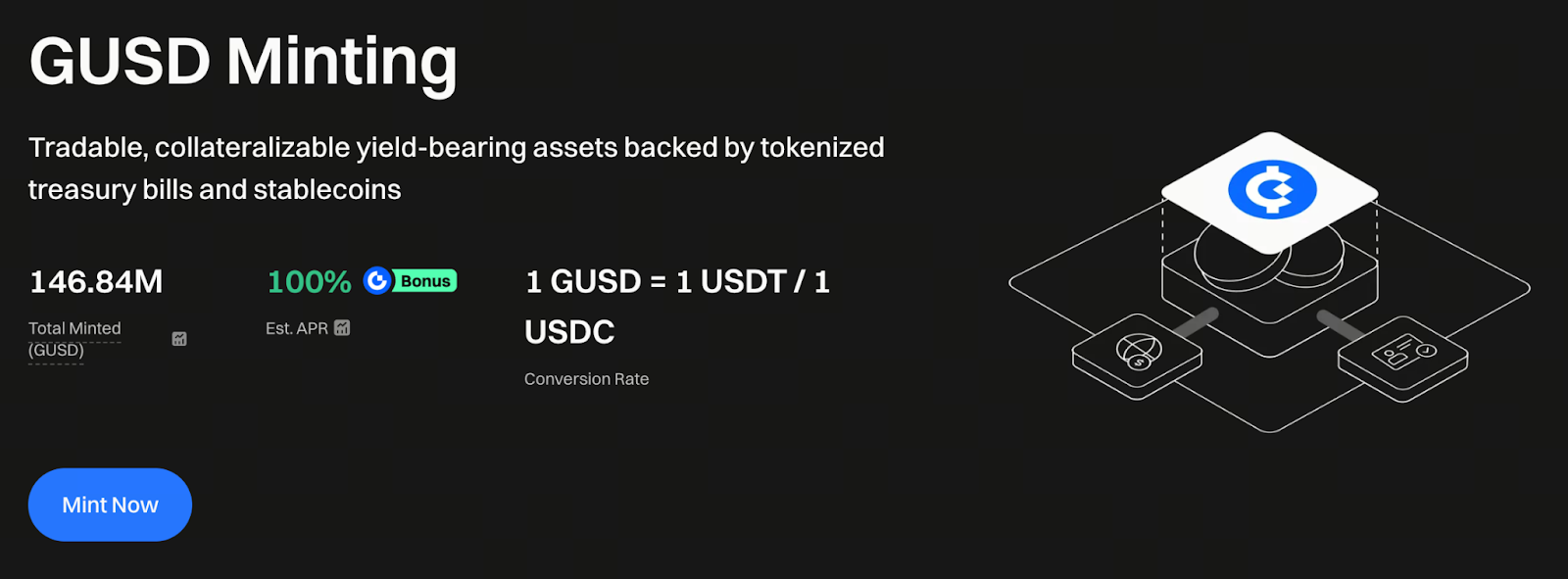
Traditionally, most stablecoins have focused exclusively on maintaining a peg to fiat currencies like the US dollar, primarily serving payment and hedging purposes. Gate USD (GUSD) challenges this conventional approach by combining a fixed value with maturity-based yield. Holding GUSD is no longer just about preserving value—it’s like owning a digital, interest-bearing instrument on-chain. This innovation transforms stablecoins from mere stores of value into yield-generating digital assets.

Real-World Assets as Value Foundation

Short-term U.S. Treasury bonds and other income-generating financial assets, not just cash reserves, anchor GUSD’s stability. These real-world assets (RWAs) provide consistent cash flow, making GUSD’s value foundation more resilient and aligning it with the structure of yield-bearing notes in traditional finance—moving beyond the passive peg model common to most stablecoins.

Two Simple Ways to Acquire GUSD

There are two straightforward methods for users to obtain GUSD:

  • Purchase via exchange: Instantly swap USDT for GUSD and manage your holdings with ease.
  • On-chain minting: Holders of USDT or USDC can mint GUSD at a 1:1 ratio, ideal for long-term yield strategies or asset allocation.

Start minting GUSD today and earn yields calculated daily and presented on an annualized basis: https://www.gate.com/staking/GUSD?gt_disable_intercept_jump=1

Bond-Like Yield Model

GUSD features an accumulated yield and maturity settlement model, rather than daily payouts. For example:

  • If you mint GUSD with 100 USDT and the underlying assets generate a 20% return during your holding period, you could redeem approximately 120 USDC at maturity.

This structure makes GUSD function more like a yield-bearing on-chain bond token than a simple transactional medium.

Ecosystem Incentives and Versatile Utility

To drive user engagement, the platform has launched several incentive mechanisms for GUSD:

  • Staking rewards: Stake GUSD to earn steady base returns.
  • Limited-time event bonuses: Earn additional token rewards during special promotional periods.
  • Crossover integration: In the future, GUSD will support lending, Launchpool, CandyDrop, and more, expanding its role across Web3 applications.

These initiatives position GUSD as more than just a stablecoin—it becomes a core asset linking yield opportunities, financial management, and community engagement.

How GUSD Differs from Other Stablecoins

Relative to traditional stablecoins, GUSD stands out in three key areas:

  1. Longer holding means greater potential returns.
  2. Flexible minting: Supports both USDT and USDC as sources.
  3. Diverse use cases: Suitable for trading, margin, staking, and wealth management.

Additionally, the platform is advancing reserve transparency and compliance disclosures, ensuring GUSD’s asset backing is externally verifiable and bolstering market trust.

High Liquidity and Seamless Redemption

GUSD offers fast redemption to USDC, and can be converted to USDT or other major tokens as needed. The system is designed for low friction and ease of use, though users should be aware of possible differences in fees or settlement times across platforms.

Risk Notice

This content does not constitute an offer, solicitation, or investment advice. Please assess risks carefully and seek professional guidance before investing. Gate may restrict or prohibit access in certain regions; refer to the user agreement for details.

User Agreement: https://www.gate.com/legal/user-agreement

Conclusion

GUSD evolves stablecoins beyond the USD peg. It creates an on-chain, note-like asset backed by RWAs and yield mechanisms. This brings real-world value structures into Web3 finance. As transparency, compliance, and custody protocols are refined, GUSD is set to become the benchmark for integrating on-chain finance with real assets, ushering in a new era of stable returns for Web3.

Author: Allen
Disclaimer
* The information is not intended to be and does not constitute financial advice or any other recommendation of any sort offered or endorsed by Gate.
* This article may not be reproduced, transmitted or copied without referencing Gate. Contravention is an infringement of Copyright Act and may be subject to legal action.

Related Articles

AI-Native Settlement Layers: How United Stables Is Building the Next Financial Rail
Beginner

AI-Native Settlement Layers: How United Stables Is Building the Next Financial Rail

Stablecoins were originally designed as dollar substitutes within exchanges, primarily used for asset pricing and trade settlement. As on-chain financial ecosystems have matured, their role has expanded beyond simple payments to include collateral assets, cross-chain liquidity mediums, and unified settlement units. In particular, as AI systems and automated agents begin to participate directly in economic activity, demand has risen sharply for programmable value units capable of instant settlement. This shift is pushing stablecoins toward the role of foundational financial infrastructure.
2026-03-25 03:16:17
The ve(3,3) Flywheel Explained: How AERO Tokenomics Powers Aerodrome’s DeFi Economy
Beginner

The ve(3,3) Flywheel Explained: How AERO Tokenomics Powers Aerodrome’s DeFi Economy

In the competition for DeFi liquidity, high-inflation mining alone is no longer enough to build lasting advantages. Aerodrome applies the ve(3,3) economic model to redesign token emissions, voting mechanisms, and revenue distribution, creating a liquidity flywheel centered on governance and cash flow. This article examines AERO tokenomics, the veAERO locking mechanism, and protocol revenue models to explain how Aerodrome builds a sustainable DeFi economic system.
2026-03-25 06:41:58
Aerodrome Tokenomics: How ve(3,3) Powers Base's Most Profitable DEX
Beginner

Aerodrome Tokenomics: How ve(3,3) Powers Base's Most Profitable DEX

AERO is the native token of Aerodrome Finance, a core decentralized exchange and liquidity protocol in the Base ecosystem. It is primarily used for liquidity incentives and ecosystem operations. veAERO is a governance NFT that users receive by locking AERO, representing both voting power and the right to share protocol revenue. Through a dual track structure of AERO as a utility token and veAERO as a governance credential, Aerodrome separates liquidity usage value from long term governance power, allowing participants to act as liquidity providers, governance decision makers, and revenue sharers within the same system.
2026-03-25 06:40:31
How Does PAXG Work? In-Depth Overview of the Physical Gold Tokenization Mechanism
Beginner

How Does PAXG Work? In-Depth Overview of the Physical Gold Tokenization Mechanism

PAXG (Pax Gold) is a tokenized asset backed by physical gold, issued by the fintech company Paxos and traded on the Ethereum blockchain as an ERC-20 token. The core concept is to tokenize physical gold on-chain, with each PAXG token representing ownership of a certain amount of gold. This structure enables investors to hold and trade gold in the form of a digital asset.
2026-03-24 19:12:51
How is the price of PAXG determined? Pegging mechanism, trading depth, and influencing factors
Beginner

How is the price of PAXG determined? Pegging mechanism, trading depth, and influencing factors

PAXG (Pax Gold) is a tokenized asset backed by physical gold reserves, launched by fintech firm Paxos and issued as an ERC-20 token on the Ethereum blockchain. The core concept is to digitally represent real-world gold assets, allowing investors to hold and trade gold via the blockchain network. Because each PAXG token corresponds to a specific quantity of physical gold, its price is theoretically expected to closely track the global gold market.
2026-03-24 19:11:40
DePIN Identity Network and Real World Applications: How Humanity Protocol Brings on-chain Identity Into the Physical World
Beginner

DePIN Identity Network and Real World Applications: How Humanity Protocol Brings on-chain Identity Into the Physical World

Most Web3 identity systems remain confined to on-chain environments and struggle to achieve meaningful adoption in real world settings. Through a DePIN architecture and physical verification hardware, Humanity Protocol aims to bring decentralized identity into access control systems, hospitality, public services, and offline events, allowing on-chain identity to function not just as a digital credential, but as foundational infrastructure for real world access.
2026-03-25 07:40:53





