Gold Price Forecast for the Next Five Years: 2026–2030 Trend Outlook and Investment Implications, Could It Reach $6,000?

Beginner
Quick Reads
Last Updated 2026-03-25 18:13:30
Reading Time: 1m
Analyze current gold price trends alongside authoritative five-year forecasts, integrating an evaluation of market risks and opportunities. This gives investors insight into the potential trajectory of gold prices and the main drivers expected to shape the market over the next five years.

1. Introduction: Why Gold’s Price Outlook Matters Over the Next Five Years

Gold remains a globally recognized safe-haven asset, playing a pivotal role during economic cycles, periods of rising inflation, and shifts in monetary policy. In recent years, international gold prices have repeatedly set new records, prompting heightened market interest in its medium- and long-term trajectory.

With persistent global inflation, expanding sovereign debt, and continued central bank accumulation of gold reserves, gold’s value in asset allocation is being re-evaluated. “Gold price predictions for the next 5 years” has become a central research topic for both institutional and individual investors.

2. Current Gold Price Performance and Market Context
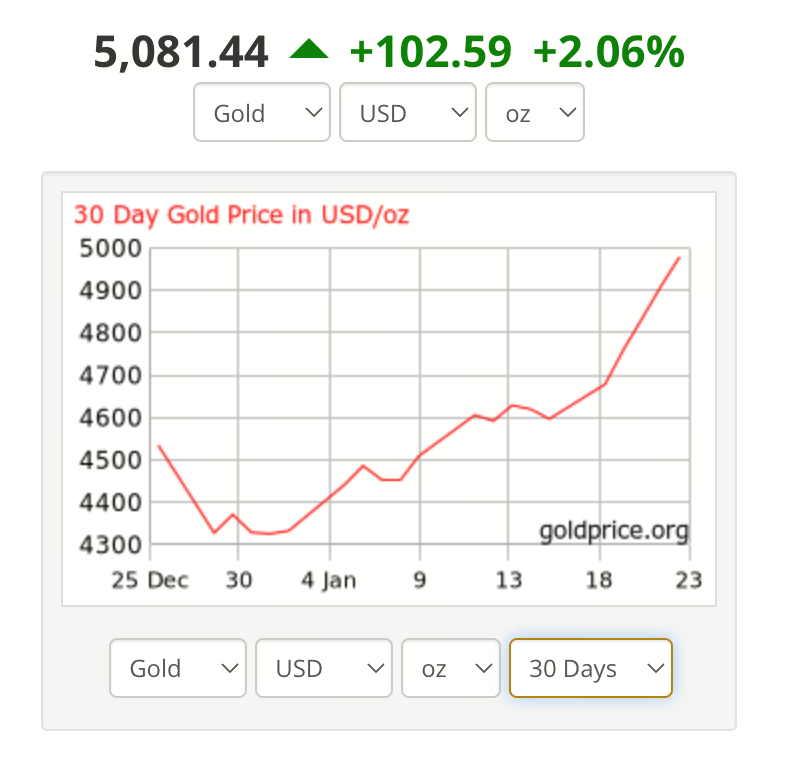

Chart: https://goldprice.org/

Currently, spot gold prices have surged past the $5,000 per ounce threshold, entering an unprecedented price range. This movement highlights rising global demand for safe-haven assets in an environment marked by macroeconomic uncertainty and geopolitical risk.

Major financial institutions have responded by raising their medium- and long-term gold price forecasts. For example, Goldman Sachs now projects gold will reach $5,400/oz by the end of 2026, underscoring Wall Street’s bullish outlook on the long-term value of precious metals.

Overall, the interplay of multiple macroeconomic variables has driven gold prices into a pronounced uptrend, providing a solid foundation for forecasting over the next five years.

3. Gold Price Forecast for 2026: Key Milestone Assessment

Looking forward, 2026 is widely viewed as a critical mid-term inflection point, with institutional forecasts centering on the following scenarios:

  • Goldman Sachs expects gold to reach approximately $5,400/oz by year-end 2026;
  • The World Gold Council and similar organizations anticipate gold prices will remain elevated, supported primarily by ongoing central bank purchases and safe-haven capital flows;
  • Forecasting models focus on shifts in the dollar cycle, inflation expectations, and adjustments to central bank asset structures.

In summary, 2026 is more likely to mark a “high-level confirmation” rather than a reversal of the prevailing trend.

4. 2027–2028 Medium-Term Outlook

As the market moves into 2027–2028, focus shifts from short-term targets to medium-term stability:

  • Most institutions estimate gold will trade within the $4,800–$5,800/oz range, with potential to set new record highs;
  • If global macroeconomic uncertainty intensifies, price volatility could increase significantly;
  • Compared to short-term moves, medium-term trends will be shaped more by monetary policy shifts, global economic growth rates, and evolving geopolitical risks.

During this phase, gold behaves more as a “high-volatility asset” rather than a commodity in a one-way rally.

5. 2029–2030: Long-Term Trends and Potential Highs

From a long-term perspective, 2029–2030 is the period that draws the greatest investor attention:

  • Several long-term models suggest that if inflation remains above target, global debt continues to expand, and central banks keep accumulating gold, prices could challenge the $6,000–$7,000/oz range;
  • In highly optimistic scenarios, some analysts expect gold could break all historical records around 2030;
  • However, these projections are highly dependent on macroeconomic variables and are extremely sensitive to uncertainty.

As such, forecasts for this period serve better as strategic references than as precise price anchors.

6. Key Drivers Analysis

The main factors influencing gold prices over the next five years include:

  1. Macroeconomic conditions and monetary policy: If the Federal Reserve and other major central banks enter rate-cutting cycles or maintain accommodative policies, gold’s appeal as a non-yielding asset will grow.
  2. Geopolitical and financial risks: Trade disputes, regional conflicts, and concerns over financial system stability all boost safe-haven demand.
  3. Central bank and institutional investor demand: Global central banks’ ongoing accumulation of gold reserves is becoming a fundamental long-term support for prices.

  4. Risk Factors to Monitor


While most forecasts favor a medium- to long-term bullish view, the following risks require attention:

  • A sustained strong dollar could temporarily weigh on gold prices;
  • A faster-than-expected global economic recovery and rising risk appetite may reduce demand for gold as a portfolio allocation;
  • Changes in market liquidity could amplify short-term price swings.

Therefore, no single forecasting model or institutional opinion should be regarded as a definitive conclusion.

8. Investment Strategy Summary

Drawing on a comprehensive assessment of gold price forecasts for the next five years:

  • The medium- to long-term outlook remains broadly bullish;
  • Ongoing monitoring of macroeconomic policy, dollar trends, and geopolitical risks is essential;
  • Using gold as a diversification tool rather than a single-direction bet aligns best with prudent investment principles.
Author: Max
Disclaimer
* The information is not intended to be and does not constitute financial advice or any other recommendation of any sort offered or endorsed by Gate.
* This article may not be reproduced, transmitted or copied without referencing Gate. Contravention is an infringement of Copyright Act and may be subject to legal action.

Related Articles

What is Fartcoin? All You Need to Know About FARTCOIN
Intermediate

What is Fartcoin? All You Need to Know About FARTCOIN

Fartcoin (FARTCOIN) is a representative meme coin within the Solana ecosystem based on an AI-driven narrative. Its core concept originated from an experiment aimed at exploring the "boundaries between AI Agents and humor." More than just a digital asset with social attributes, the project deeply couples absurd humor culture with on-chain financial logic by integrating autonomous AI interaction models.
2026-04-21 03:51:49
AI-Native Settlement Layers: How United Stables Is Building the Next Financial Rail
Beginner

AI-Native Settlement Layers: How United Stables Is Building the Next Financial Rail

Stablecoins were originally designed as dollar substitutes within exchanges, primarily used for asset pricing and trade settlement. As on-chain financial ecosystems have matured, their role has expanded beyond simple payments to include collateral assets, cross-chain liquidity mediums, and unified settlement units. In particular, as AI systems and automated agents begin to participate directly in economic activity, demand has risen sharply for programmable value units capable of instant settlement. This shift is pushing stablecoins toward the role of foundational financial infrastructure.
2026-03-25 03:16:17
Aster vs Hyperliquid: Which Perp DEX Will Prevail?
Beginner

Aster vs Hyperliquid: Which Perp DEX Will Prevail?

Aster and Hyperliquid are the two representative protocols of the "purpose-built L1 path" within the current decentralized perpetual exchange (Perp DEX) sector. As a pioneer in the field, Hyperliquid has built a deep liquidity moat through its highly mature order book architecture and strong community consensus. Conversely, Aster, as a rising challenger, seeks to leapfrog the competition in high-performance trading through more aggressive multi-chain aggregation logic, private transaction modules, and an underlying execution environment optimized for 2026 market demands.
2026-03-24 11:58:33
DePIN Identity Network and Real World Applications: How Humanity Protocol Brings on-chain Identity Into the Physical World
Beginner

DePIN Identity Network and Real World Applications: How Humanity Protocol Brings on-chain Identity Into the Physical World

Most Web3 identity systems remain confined to on-chain environments and struggle to achieve meaningful adoption in real world settings. Through a DePIN architecture and physical verification hardware, Humanity Protocol aims to bring decentralized identity into access control systems, hospitality, public services, and offline events, allowing on-chain identity to function not just as a digital credential, but as foundational infrastructure for real world access.
2026-03-25 07:40:53
Aerodrome Tokenomics: How ve(3,3) Powers Base's Most Profitable DEX
Beginner

Aerodrome Tokenomics: How ve(3,3) Powers Base's Most Profitable DEX

AERO is the native token of Aerodrome Finance, a core decentralized exchange and liquidity protocol in the Base ecosystem. It is primarily used for liquidity incentives and ecosystem operations. veAERO is a governance NFT that users receive by locking AERO, representing both voting power and the right to share protocol revenue. Through a dual track structure of AERO as a utility token and veAERO as a governance credential, Aerodrome separates liquidity usage value from long term governance power, allowing participants to act as liquidity providers, governance decision makers, and revenue sharers within the same system.
2026-03-25 06:40:31
How Does Kite Work? An In-Depth Look at Kite's Identity and Programmable Permission Architecture
Beginner

How Does Kite Work? An In-Depth Look at Kite's Identity and Programmable Permission Architecture

Kite is an EVM compatible Layer 1 blockchain network that runs on proof of stake. It is designed to give AI agents verifiable identity, programmable permissions, and real time settlement in an on-chain execution environment. In Kite's design, AI is no longer only a tool that follows instructions. It becomes an economic participant with independent on-chain identity and direct control over assets. Within secure and auditable infrastructure, an AI agent can complete payments, call services, and coordinate tasks autonomously, making Kite a foundational layer for the emerging agent economy.
2026-03-25 06:02:34