Glamsterdam’s impact extends well beyond the protocol layer. Whenever the boundaries of underlying coordination or execution constraints shift, transaction paths, monitoring metrics, release cadence, and user expectations at the application layer are all recalibrated. As detailed in the Glamsterdam vs Dencun/Fusaka comparison, Glamsterdam’s influence on the application layer follows a different trajectory from the capacity-focused optimizations of the Dencun phase, demanding more sophisticated expectation management and phased validation.
To fully grasp these changes, begin with the Glamsterdam upgrade overview, then examine both the ePBS (EIP-7732) mechanism and BAL (EIP-7928) with parallel execution to understand how the coordination and execution layers are evolving. This foundation enables teams to identify actionable changes at the application level.
What underlying assumptions of DApps will Glamsterdam disrupt?
The first group affected includes high-frequency interactive applications—those highly sensitive to confirmation cadence, retry logic, and state consistency. Shifts in execution constraints can render historical thresholds unreliable. Systems like liquidation bots, aggregation routers, and high-frequency market makers require careful reassessment.
The second group comprises applications with complex cross-contract dependencies. Systems with long call chains and tightly coupled states are particularly prone to “locally normal, globally abnormal” issues during upgrades. Teams should break down these chains for granular validation, not just rely on end-to-end results. For sophisticated DeFi strategies, segment-level monitoring is essential—single success rate metrics are insufficient.
The third group includes applications reliant on external infrastructure quality, such as aggregators, liquidation bots, and data indexing services. Changes at the base layer can manifest as latency, ordering, or retry issues at the business layer. If indexing delays fall out of sync with on-chain confirmations, frontend displays may temporarily diverge from actual blockchain state.
How should application teams assess the real impact of ePBS and BAL?
Assessment should proceed in two steps: “mechanism analysis” and “business mapping.” Mechanism analysis clarifies which coordination boundaries ePBS redefines and what access constraints BAL introduces. Business mapping identifies which transaction paths, strategy modules, and alert rules are affected.
A practical method is to build a “critical path matrix”—compare pre- and post-upgrade behaviors for transaction creation, state updates, liquidation triggers, and failure rollbacks. This matrix approach prevents tunnel vision on single performance metrics. Each path should be annotated with responsible teams, test status, and rollback conditions for full traceability.
| Assessment Dimension |
ePBS Key Considerations |
BAL Key Considerations |
| Confirmation Cadence |
Greater block coordination stability |
Reduced execution jitter |
| Failure Modes |
Improved anomaly localization for build/propose |
Fewer conflict-induced rollbacks |
| Monitoring Metrics |
Layered indicators established |
Access constraint metrics covered |
This framework helps product and engineering teams divide responsibilities and prevents misattribution of coordination layer issues to the application layer.
What capabilities should infrastructure providers prioritize for adjustment?
Service providers should focus on three priorities: evolving monitoring models, upgrading capacity planning, and refining fault isolation by layer. Monitoring should shift from aggregate volatility to granular stage metrics; capacity planning must consider both peak and tail latency; fault isolation should pinpoint whether issues arise in the coordination, execution, or business layer.
Simultaneously, standardized event semantics should be coordinated with application teams to prevent the same anomaly from being interpreted inconsistently across systems, which can lead to communication breakdowns. Providers should publish indicator change notices before the upgrade window, detailing new monitoring items and alert threshold logic.
The most common pitfall post-upgrade is expecting “instant results.” A safer approach is to break performance goals into phases: prioritize availability, then stability, then efficiency. Ensure system behavior is explainable before pursuing maximum throughput.
| Metric Level |
Common Legacy Issues |
New Metric Recommendations |
| Average Latency |
Masks long-tail risks |
Focus on P95/P99 percentiles |
| Success Rate |
Overlooks retry costs |
Track both first and ultimate success |
| Fee Performance |
Only short-term averages |
Layered, scenario-specific observation |
| User Experience |
Solely on-chain confirmation |
Integrate frontend and backend metrics |
The key principle is “align metrics with mechanisms.” If metrics can’t account for mechanism changes, teams will struggle to make informed decisions. External communication should avoid conflating the Ethereum.org roadmap upgrade window with hard performance commitments.
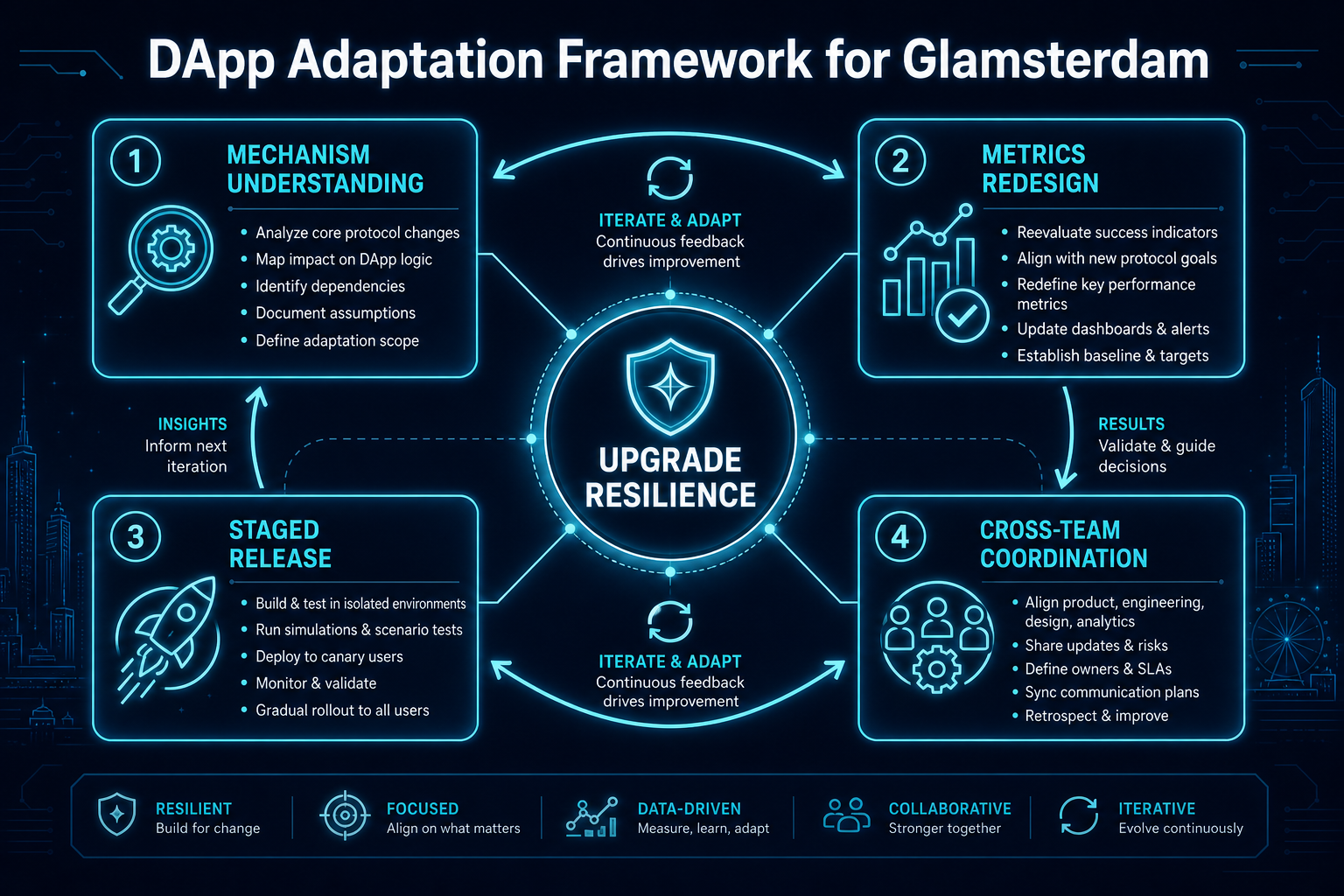 Figure 1. DApp adaptation framework: mechanism analysis, metric recalibration, phased rollout, and collaborative governance.
How should product release cadence be structured for maximum stability?
A phased rollout is recommended: begin with internal traffic, expand to a small user cohort, and finally proceed to full deployment. Each phase must have explicit rollback conditions to ensure anomalies are reversible. A phased rollout without rollback criteria is not risk management—it merely delays issue exposure.
Release strategies should be synchronized with the node upgrade preparation checklist. Without coordinated windows, applications and nodes may advance independently, resulting in unclear responsibilities and delayed responses. Joint planning should include a unified timeline, standardized event semantics, and daily upgrade reporting.
| Rollout Phase |
Traffic Share |
Example Rollback Condition |
| Internal Validation |
0% external users |
Critical path anomaly rate exceeds threshold |
| Limited Beta |
1%–5% |
P99 latency degradation persists |
| Full Release |
100% |
Metrics from prior phases are stable and compliant |
This table offers a structured reference for phased releases. Rollback conditions must be confirmed in writing pre-launch to prevent disputes during execution.
What additional checks should security assessments include?
Beyond standard audits, upgrades require “behavioral differential audits”: verify if transaction sequences, failure patterns, or retry side effects change pre- and post-upgrade. Pay special attention to edge cases in liquidation and risk management modules.
Security reviews should also cover the alerting and monitoring systems themselves. If alert rules are based on outdated baselines, upgrades can trigger both false positives and missed alerts, undermining defense. Security teams should validate anomaly injection scenarios on testnets to ensure alerts fire as intended.
What risk boundaries are most easily overlooked in ecosystem collaboration?
The most frequently missed is “interface semantic consistency.” After protocol upgrades, different teams may interpret the same event differently, causing product, risk, and ops teams to diverge in understanding—escalating technical issues into coordination failures.
Another common gap is “communication cadence.” While pre-launch communication may be robust, lack of routine post-launch reviews allows small issues to snowball into systemic deviations. Establishing daily upgrade reports or regular syncs can significantly reduce friction. Cross-team alignment on a single source of truth—such as the Ethereum.org roadmap and testnet announcements—helps minimize information fragmentation.
Summary
Glamsterdam’s significance for DApps is not just “potential performance changes”—it’s a call to upgrade engineering governance itself. By focusing on mechanism analysis, metric recalibration, phased rollout, and cross-team collaboration, application teams can turn upgrade risks into lasting systemic improvements.
FAQ
Will Glamsterdam directly boost performance for all DApps?
No, not automatically. Actual outcomes depend on application architecture, state access patterns, infrastructure robustness, and adaptation quality.
What should DApp teams prioritize before the upgrade?
Complete critical path matrix assessments and testnet validation, and update alert thresholds and rollback strategies—don’t rely on legacy execution assumptions.
Why emphasize phased rollout?
Because upgrade periods are highly uncertain, phased rollout keeps risk contained and enables iterative improvement as each stage informs the next.
Why should application and node teams coordinate their plans?
Base-layer upgrades cascade across the stack. Without joint planning, anomaly detection and resolution can become misaligned. Coordination greatly enhances response efficiency.
Does the roadmap schedule equate to performance improvement timing?
No. The roadmap window reflects protocol development cadence. Actual performance gains depend on implementation quality and ecosystem adaptation—these are separate timelines.
What changes will end users notice?
Most users will experience improvements in confirmation stability and peak-time performance, rather than changes in a single fee metric. Product communications should focus on clear, explainable experience indicators and avoid overpromising.