As specialization across the global semiconductor industry continues to deepen, more companies are choosing to focus on chip design while outsourcing production to professional wafer foundries. This model makes GlobalFoundries an important manufacturing platform connecting chip innovation with end applications, while also creating a revenue system centered on manufacturing services.
GlobalFoundries is headquartered in New York State and is one of the world’s leading wafer foundries. The company operates manufacturing sites in the United States, Germany, Singapore, and other regions, providing semiconductor manufacturing services to customers around the world. GFS is the stock ticker of GlobalFoundries Inc., which is listed and traded on the Nasdaq Stock Market in the United States.
Unlike many semiconductor companies, GlobalFoundries does not directly compete in consumer electronics brands. Instead, it sits in the middle of the industry chain. Its customers include communications chip companies, automotive electronics suppliers, industrial control manufacturers, IoT solution providers, and others. Because it serves a broad range of customers, GlobalFoundries’ operating performance often reflects changes in demand across multiple end markets.
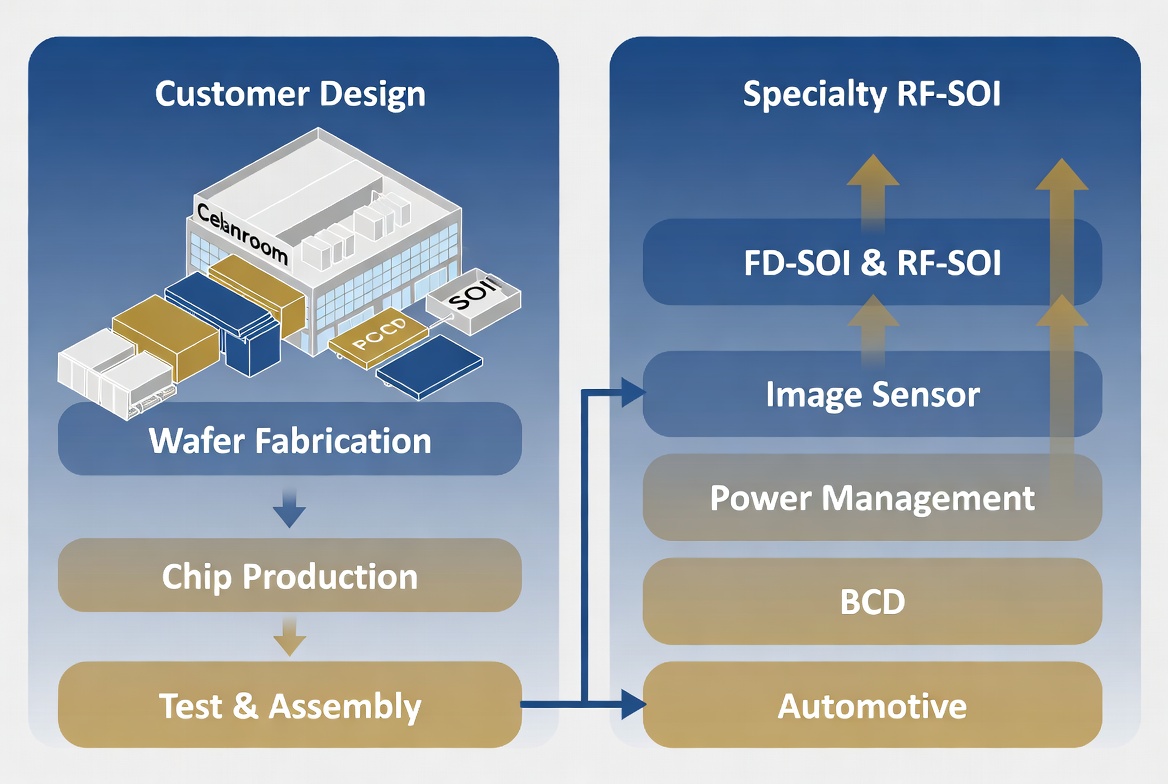
What Are GlobalFoundries’ Revenue Sources?
GlobalFoundries’ revenue mainly comes from wafer manufacturing services.
After customers complete their chip designs, they need a wafer foundry to move those designs into mass production. GlobalFoundries uses its process platforms, production equipment, and manufacturing capabilities to produce wafers, charging fees based on order size, process node, and product complexity.
From a revenue structure perspective, GlobalFoundries does not depend on a single industry. Instead, it covers multiple market segments.
| Revenue Source |
Main Customers |
| Automotive electronics chips |
Automotive supply chain companies |
| Communications chips |
Network equipment and communications companies |
| Industrial control chips |
Industrial automation companies |
| IoT chips |
IoT device manufacturers |
| RF chips |
Wireless communications supply chain |
This diversified customer structure helps reduce the impact that cyclical fluctuations in any single industry may have on overall revenue.
How the Wafer Foundry Business Generates Revenue
At its core, wafer foundry is a manufacturing service business.
After customers submit their chip designs to GlobalFoundries, the company is responsible for manufacturing steps such as photolithography, deposition, etching, packaging collaboration, and mass production support. Once an order enters mass production, customers pay manufacturing fees based on production volume.
Like traditional manufacturing, wafer fabs require continuous investment in equipment, facilities, and process research and development, which creates high capital barriers for the industry. Once production lines are running steadily, however, economies of scale gradually begin to show.
For GlobalFoundries, higher wafer shipments and higher capacity utilization usually lead to lower unit manufacturing costs. Maintaining a stable order base is therefore an important foundation of the wafer foundry business model.
Why Mature Nodes Have Become an Important Revenue Source
Mature process nodes are one of GlobalFoundries’ most important revenue pillars.
The semiconductor industry often focuses its attention on advanced process nodes, but the vast majority of chips worldwide do not require the most advanced manufacturing technologies. Automotive electronics, industrial control, network equipment, and many consumer electronics products still rely heavily on chips made with mature process nodes.
The greatest advantages of mature nodes are stability and cost efficiency.
For automakers, a chip that has been validated over many years is often more attractive than one made with the newest process technology, because vehicles usually need product lifecycles of more than ten years. For industrial equipment, long term stable supply is likewise more important than maximum performance.
Therefore, even as advanced process technologies continue to develop, the mature node market still maintains substantial demand. This is also an important reason GlobalFoundries has long remained committed to its mature node strategy.
In addition to mature process nodes, specialty technology platforms are an important competitive advantage that sets GlobalFoundries apart from other wafer foundries.
Specialty technologies refer to manufacturing processes developed for specific application scenarios, such as RF chips, power management chips, embedded memory, and automotive grade chip processes.
These technologies often require long term research and development investment, as well as lengthy customer validation cycles, so the barriers to entry are relatively high.
RF chips are a clear example. Smartphones, wireless network equipment, and 5G infrastructure all require large numbers of RF devices. GlobalFoundries has long invested in technology platforms such as RF SOI and holds an important position in the global RF chip manufacturing market.
Because customers usually do not switch suppliers easily after completing product certification, specialty technologies not only raise technical barriers, but also strengthen customer stickiness.
Why Long Term Customer Relationships Strengthen Business Stability
Long term partnerships are an important feature of the wafer foundry industry.
For chip design companies, switching foundries often means going through product validation, process adaptation, and supply chain adjustments all over again. This takes time and increases both cost and risk.
As a result, once a chip completes mass production and enters the market, customers usually prefer to maintain stable partnerships.
This is especially true in the automotive electronics market. Many automotive platforms have lifecycles lasting several years or even more than a decade, and suppliers need to ensure stable long term supply. GlobalFoundries relies on its mature process platforms and long term service capabilities to build ongoing relationships with many customers.
This model gives GlobalFoundries greater order predictability and helps reduce the risk of revenue volatility.
How to Buy GFS (GlobalFoundries) Stock
GFS is listed and traded on the U.S. Nasdaq market and is one of the world’s major wafer foundry companies.
Traditionally, investors can buy GFS shares through brokerage accounts that support U.S. stock trading, gaining exposure to opportunities in the global semiconductor manufacturing industry. Because GlobalFoundries’ business covers automotive electronics, industrial control, communications networks, IoT, and other fields, it is also seen as an important representative company for observing the mature node market.
As digital assets and traditional financial markets gradually converge, more trading tools linked to stock price movements have also appeared. For example, some platforms offer CFD products tied to stock prices, allowing users to participate in market price movements without directly holding the underlying shares.
Taking Gate TradFi as an example, users can follow stocks, ETFs, indices, commodities, and digital asset markets within the same ecosystem. Some markets also offer Gate CFD products, providing more options for cross market asset management.
Regardless of how investors participate in the market, they should fully understand the product structure, trading rules, and regulatory requirements in their region.
Conclusion
GlobalFoundries’ business model is essentially a semiconductor manufacturing services model. The company generates revenue through wafer foundry services, mature process platforms, and specialty technologies, while relying on long term customer relationships to maintain business stability. Compared with companies that compete mainly through advanced process nodes, GlobalFoundries focuses more on automotive electronics, industrial control, and communications markets, creating a differentiated market position.
FAQs
How does GlobalFoundries mainly make money?
GlobalFoundries mainly earns revenue by providing wafer manufacturing services to chip design companies, including mature node manufacturing and specialty technology platform services.
Does GlobalFoundries design its own chips?
No. GlobalFoundries is a wafer foundry. Its main business is manufacturing chips, not designing them.
Why is there still market demand for mature process nodes?
Automotive electronics, industrial control, and communications equipment usually place greater importance on stability and long term supply, so many products are still manufactured using mature process nodes.
What areas do GlobalFoundries’ specialty technologies cover?
GlobalFoundries focuses on specialty technology platforms such as RF chips, automotive electronics chips, power management chips, and embedded memory.
Why are long term customer relationships important?
Switching wafer foundries usually requires product validation all over again, so customers often prefer long term partnerships. This helps improve order stability.
Is GlobalFoundries’ business model the same as TSMC’s?
Both are wafer foundries, but TSMC focuses more on the advanced process market, while GlobalFoundries mainly specializes in mature process nodes and specialty technologies.