Summary
- On Wednesday, Bitcoin surged more than 7% and Ethereum rose 9%, pushing the total cryptocurrency market capitalization back above $2.5 trillion.
- Among altcoins, EDGE jumped 81% following its listing on a Korean exchange, while MANTRA rose 54% alongside the official migration from the old OM token to the new token.
- The controversy surrounding AI military applications escalated, with Palantir criticizing Anthropic’s safety restrictions. Meanwhile, OpenAI’s annualized revenue surpassed $25 billion, up 230% year-on-year.
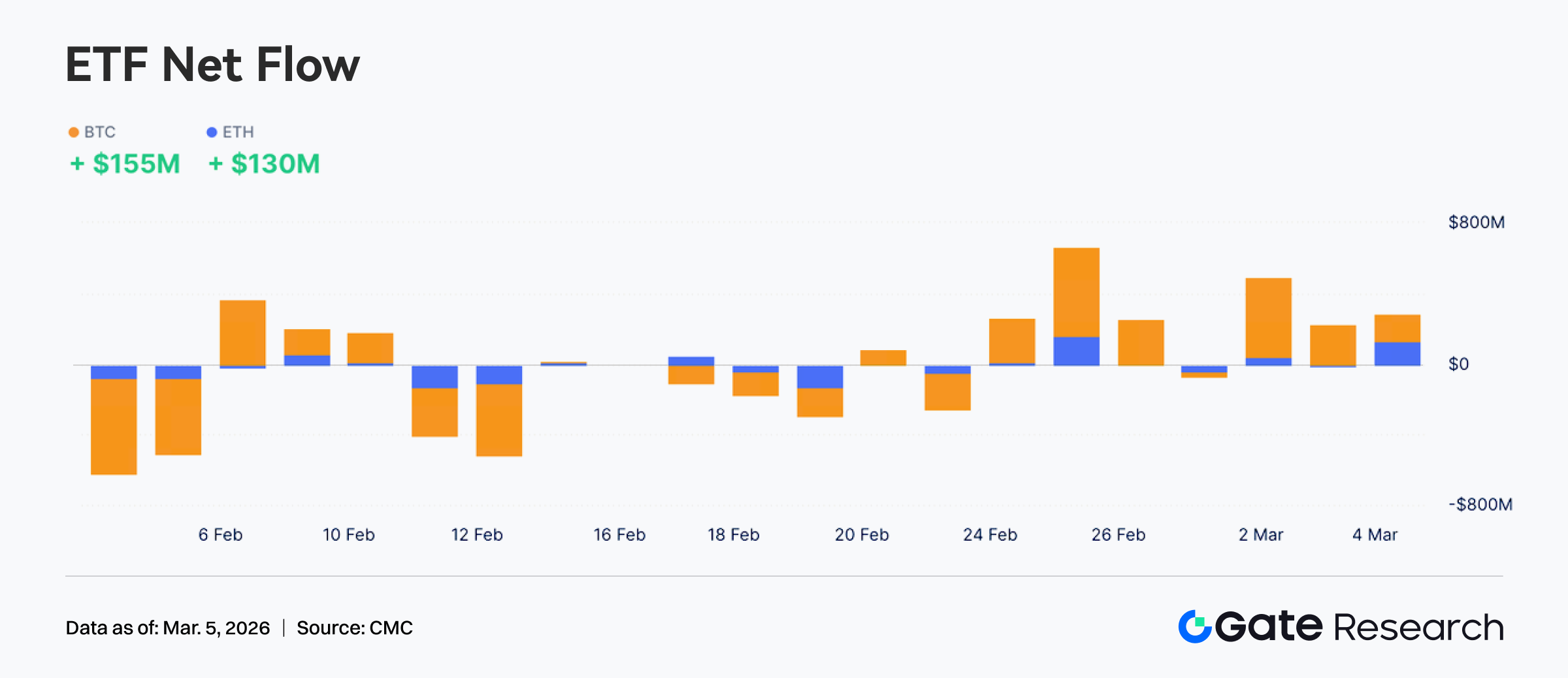
- Over the past week, crypto ETFs recorded continuous net inflows, with BTC and ETH jointly improving market sentiment.
- The prediction market sector continues to expand, with total notional trading volume exceeding $133.5 billion.
- HYPE, ENA, and RED are scheduled to unlock tokens worth approximately $319 million, $20.17 million, and $5.81 million, respectively, over the next seven days.
Market Overview
Market Commentary
- BTC Market Update — Bitcoin surged more than 7% on Wednesday, pushing the total crypto market capitalization back above $2.5 trillion, with the broader market gaining about 5.5% on the day. The rally was primarily driven by a short squeeze. Earlier, geopolitical tensions surrounding Iran triggered a wave of sell-offs, sending Bitcoin perpetual futures funding rates to extremely low levels. As geopolitical risks failed to escalate further, traders who had positioned for downside began rapidly closing their short positions, fueling a sharp rebound. According to K33 Research Head of Research Vetle Lunde, Bitcoin’s weekly RSI briefly dropped to 26.84, marking the third most oversold level in its history, which provided technical support for the rebound.
- ETH Market Update —Ethereum climbed nearly 9% intraday on Wednesday, with the price breaking above $2,100. From a daily structure perspective, ETH still trades below both the 100-day and 200-day moving averages, which remain downward sloping, suggesting the broader trend remains weak. The asset is currently moving within a descending channel, and the recent rebound appears to be driven by support near the channel’s lower boundary rather than a confirmed trend reversal. The key resistance zone remains around $2,300–$2,400, which previously served as a critical pivot during the earlier distribution phase. On the downside, $1,800 remains the major support level, having held firm during the previous sharp decline. A daily close above $2,400 would be the first signal of a potential structural trend shift.
- Altcoins — Over the past 24 hours, the crypto market has shown overall strength, with risk appetite recovering after the recent wave of sell-offs. The Fear & Greed Index currently stands at 29, a notable improvement compared with last week. However, this rally appears to be driven more by market sentiment and trading activity rather than a fundamental trend reversal. Among major assets, BTC (+7.04%), ETH (+8.15%), and SOL (+5.09%) led the gains and showed relatively strong performance.
- Stablecoins — The total stablecoin market capitalization currently stands at $311.8 billion, increasing by $2 billion over the past week, or approximately 0.65%.
- Gas Fee — Over the past week, Ethereum network gas fees generally remained below 1 Gwei, with the highest hourly peak reaching 0.216 Gwei. As of March 5, the average gas fee for the day was 0.196 Gwei.
Trending Tokens
Over the past 24 hours, the crypto market has shown broad strength, with risk appetite gradually recovering after the recent wave of liquidations. The Crypto Fear & Greed Index currently stands at 29, marking a noticeable improvement from last week. However, it is worth noting that the current rebound appears to be largely driven by market sentiment and trading behavior, rather than a confirmed structural trend reversal. Among major assets, BTC (+7.04%), ETH (+8.15%), and SOL (+5.09%) led the gains and outperformed the broader market. Among altcoins, EDGE, LMTS, and MANTRA posted particularly strong performance, which are analyzed below.
EDGE Definitive (+81.01%, Circulating Market Cap: $64.56M)
According to Gate market data, EDGE is currently trading at $0.17913, up over 81.01% in the past 24 hours. Definitive (EDGE) is a cross-chain decentralized trading terminal designed to provide advanced trading tools for all traders. It aggregates liquidity from more than 100 decentralized exchanges (DEXs) across multiple blockchains, supporting advanced order types such as limit orders, stop-loss orders, and time-weighted average price (TWAP).
EDGE was listed on a Korean exchange on March 4, providing direct trading access to Korean investors. The Korean market is known for high retail participation and active trading, which can generate substantial new buying demand. In addition, the recent sharp decline in the KOSPI index coincided with strong performance from newly listed altcoins on local exchanges, suggesting that some capital may have rotated from equities into crypto assets like EDGE, further supporting the rally.
LMTS Limitless (+39.38%, Circulating Market Cap: $22.54M)
According to Gate market data, LMTS is currently priced at $0.17024, rising over 39.38% in the past 24 hours. Limitless Exchange is a decentralized prediction market platform that allows users to trade real-world events through simple “Yes/No” contracts. The platform utilizes a Central Limit Order Book (CLOB) model to facilitate efficient trading, with market contracts that can be as short as five minutes in duration.
The recent surge in LMTS appears to be primarily driven by market sentiment and speculative trading activity. Retail participation has been high, with a turnover ratio reaching 0.198, while the 7-day gain has accelerated to 51.37%, indicating relatively strong liquidity relative to its market capitalization. If buying momentum holds above $0.150, the token could test the $0.200 psychological level. Conversely, a break below $0.120 may trigger a deeper pullback.
MANTRA MANTRA(+54.70%, Circulating Market Cap: $84.09M)
According to Gate market data, MANTRA is currently trading at $0.02322, up 54.70% in the past 24 hours. MANTRA is an RWA-focused Layer 1 blockchain that prioritizes security and compliance, designed to meet real-world regulatory requirements. Built for institutions and developers, MANTRA aims to provide a permissionless blockchain infrastructure capable of supporting permissioned applications.
The price surge coincided with the official announcement on March 4 regarding the migration from the legacy OM token to the new MANTRA token. Such events often create repricing effects, mandatory token swaps, and increased speculative participation. MANTRA’s 24-hour trading volume surged by 889,623.85% to $225 million, highlighting the significant level of market attention surrounding the migration event.
Key Market Data Highlights
Escalating Controversy Over Military AI Use: Palantir Criticizes Anthropic’s Safety Restrictions
Tensions between Palantir Technologies and Anthropic have recently escalated due to the U.S. military’s AI usage policies. Anthropic refused to relax two core restrictions on its Claude model—prohibiting its use for large-scale surveillance and fully autonomous weapons systems—leading to conflict with the Department of Defense. The government subsequently requested federal agencies to stop using Anthropic’s technology and instructed defense contractors, including Palantir, to gradually remove the Claude model. Because Palantir’s Maven AI military intelligence system relies on Claude, the decision forces the company to partially rebuild its AI software architecture and seek alternative models, potentially affecting defense contracts worth over $1 billion.
This conflict reflects a broader tension between AI safety ethics and national security demands. Anthropic aims to maintain strict safety boundaries, while the military and some contractors, such as Palantir, prioritize battlefield efficiency and technological availability. In the short term, the Pentagon may shift toward more open AI providers such as OpenAI or xAI. Over the longer term, the dispute could trigger a restructuring of the military AI supply chain and accelerate strategic divergence among AI companies between safety principles and government contracts.
OpenAI Annualized Revenue Exceeds $25 Billion, Up 230% Year-on-Year
On March 5, The Information reported that OpenAI’s annualized revenue exceeded $25 billion as of the end of February 2026. OpenAI CFO Sarah Friar previously confirmed in January 2026 that the company’s annualized revenue in 2025 had surpassed $20 billion, representing roughly 230% growth from $6 billion in 2024. However, some later disclosures suggest that OpenAI’s actual full-year revenue in 2025 was around $13.1 billion—above the company’s earlier $10 billion target but below the $20 billion peak annualized estimate. After rapid expansion in the first half of 2025, growth slowed during the second half. CNBC estimates that OpenAI’s mid-2025 annualized revenue ranged between $10–13 billion, while year-end annualized revenue was around $5.5 billion.
Notably, Anthropic, OpenAI’s direct competitor, recorded about $4 billion in annualized revenue in mid-2025, which surged to around $9 billion by year-end, driven by enterprise demand and products such as Claude Code. As of early March this year, its latest annualized revenue has exceeded $19 billion. Claude Code alone now generates a run rate above $2.5 billion and serves over 500 enterprise clients each spending more than $1 million annually, indicating that the gap between Anthropic and OpenAI is gradually narrowing.
Arthur Hayes: The Rebound Is Likely a Dead Cat Bounce; BTC Still Tied to SaaS Tech Stocks
On March 5, BitMEX co-founder Arthur Hayes commented after Bitcoin rebounded above $74,000 earlier in the morning that BTC (white line in his chart) has not yet decoupled from U.S. SaaS technology companies (green line). Overall, he believes the current rebound may be a “dead cat bounce,” suggesting the market may not be out of danger yet and investors should remain patient.
A dead cat bounce refers to a situation in financial markets where an asset experiences a brief and sharp rebound after a large and prolonged decline, only to resume falling afterward and potentially reach new lows. Historically, Hayes has consistently emphasized the influence of global macro liquidity on crypto markets. He often views Bitcoin as a leading indicator of global liquidity conditions, particularly during shifts in fiat monetary policy or major political and economic events—such as U.S. elections, budget negotiations, or Treasury refinancing announcements. Despite his short-term cautious stance, Hayes’ long-term bullish view on Bitcoin remains unchanged.
Focus of the Week
Crypto ETF Inflows Continue as BTC and ETH Support Market Sentiment Recovery
Over the past week, cryptocurrency ETFs have shown a clear net inflow trend. According to CoinMarketCap data, single-day ETF net inflows reached approximately $285 million, including about $155 million into BTC ETFs and $130 million into ETH ETFs. Following a period of volatility, capital has begun flowing back into crypto-related ETFs, suggesting a gradual recovery in institutional risk appetite and reflecting continued demand for exposure to major crypto assets.
ETF fund flows have also remained positive on a weekly basis. Over the past seven days, cumulative net inflows reached approximately $664 million, keeping the total crypto ETF assets under management (AUM) at around $105.2 billion. Among them, BTC ETFs account for about $92.37 billion, while ETH ETFs hold roughly $12.83 billion. Overall, institutional capital remains primarily concentrated in BTC products, though the share of ETH ETF inflows continues to rise, indicating growing institutional interest in the long-term value of the Ethereum ecosystem.
Market Sentiment Remains in the Fear Zone as the Crypto Fear & Greed Index Recovers to 29
The Crypto Fear & Greed Index currently stands at 29, remaining within the “Fear” zone, although it has improved from the previous “Extreme Fear” level. Over the past week, the index briefly fell to 16, reflecting heightened investor caution amid market volatility and macroeconomic uncertainty.
However, recent short-term movements show a gradual rebound in sentiment, suggesting that market confidence is slowly recovering. Historically, when the index remains in fear or extreme fear territory, markets often experience high uncertainty, but such conditions can also signal potential opportunities for capital to reassess risk asset allocation. Overall, the crypto market appears to be in a sentiment recovery phase, with investors still maintaining a relatively cautious stance.
Prediction Market Sector Expands as Total Notional Volume Surpasses $133.5 Billion
Latest data shows that the on-chain prediction market sector continues to expand steadily. The cumulative notional trading volume has now reached approximately $133.548 billion, while total trading volume stands at about $72.85 billion. The ecosystem has recorded over 542 million cumulative trades and around 2.8 million participating users. These figures indicate that prediction markets are gradually forming a more mature trading ecosystem, with both user activity and capital participation remaining strong.
From a platform perspective, Polymarket remains the dominant liquidity hub in the prediction market sector, with cumulative notional volume of about $58.75 billion, significantly ahead of competitors. Kalshi ranks second with approximately $47.43 billion, and currently leads the market in Open Interest, which stands at around $510 million. Overall, liquidity and user activity remain highly concentrated among leading platforms, reflecting a clear top-heavy market structure.
Funding Weekly Recap
According to RootData, between February 26 and March 5, 2026, a total of 13 crypto and related projects announced new funding rounds, covering sectors such as trading infrastructure, institutional liquidity networks, and digital asset services. Below are several of the largest funding announcements this week:
ARQ
On March 4, ARQ announced the completion of approximately $70 million in funding, led by Sequoia Capital, with participation from Founders Fund and other investors. ARQ is a crypto financial infrastructure project focused on institutional markets, aiming to build a trading and liquidity network connecting traditional finance and digital asset markets. Through its technology platform, the project seeks to provide institutional investors with more efficient trading, liquidity access, and risk management tools, improving the efficiency and security of institutional participation in crypto markets.
Crossover Markets
On March 5, the company announced the completion of a $31 million Series B funding round, valuing the company at around $200 million. The round included participation from Tradeweb Markets, with Wintermute also investing. Crossover Markets operates an electronic communication network (ECN) for institutional crypto trading, providing low-latency execution, deep liquidity, and efficient matching services designed for professional institutional traders.
STS Digital
On February 26, STS Digital announced the completion of approximately $30 million in strategic financing, with participation from CMT Digital, Arrington Capital, and other institutions. STS Digital is an institutional platform focused on digital asset infrastructure and investment services, offering trading, liquidity, and asset management solutions for professional investors and contributing to the institutionalization of the digital asset market.
Next Week to Watch
Token Unlocks
According to Tokenomist, several major token unlock events are scheduled over the next seven days (March 5 – March 12, 2026). The three largest unlocks include:
- HYPE — Approximately $319 million worth of tokens will be unlocked, representing 4.2% of circulating supply.
- ENA — Around $20.17 million in tokens will be unlocked, accounting for 2.1% of circulating supply.
- RED — About $5.81 million in tokens will be unlocked, representing 13.0% of circulating supply.
References:
- Gate, https://www.gate.com/trade/BTC_USDT
- Farside Investors, https://farside.co.uk/btc/
- Gate, https://www.gate.com/trade/ETH_USDT
- Gate, https://www.gate.com/crypto-market-data
- CoinGecko, https://www.coingecko.com/en/cryptocurrency-heatmap
- CoinGecko, https://www.coingecko.com/en/categories
- DefiLlama, https://defillama.com/stablecoins
- Etherscan, https://etherscan.io/gastracker
- Rootdata, https://www.rootdata.com/Fundraising
- Tokenomist, https://tokenomist.ai/
- Coinmarketcap, https://coinmarketcap.com/etf/
- Coinmarketcap, https://coinmarketcap.com/charts/fear-and-greed-index/
- Dune, https://dune.com/datadashboards/prediction-markets
- Reuters, https://www.reuters.com/technology/palantir-faces-challenge-remove-anthropic-pentagons-ai-software-2026-03-04/
- Theinformation, https://www.theinformation.com/articles/openai-tops-25-billion-annualized-revenue-anthropic-narrows-gap
- X, https://x.com/CryptoHayes/status/2029285314225947098/photo/1
Gate Research is a comprehensive blockchain and cryptocurrency research platform that provides deep content for readers, including technical analysis, market insights, industry research, trend forecasting, and macroeconomic policy analysis.
Disclaimer
Investing in cryptocurrency markets involves high risk. Users are advised to conduct their own research and fully understand the nature of the assets and products before making any investment decisions. Gate is not responsible for any losses or damages arising from such decisions.