From Passive Exposure to Amplified Trades: How Gate Leveraged ETFs Fit Fast Markets

Last Updated 2026-03-26 18:22:54
Reading Time: 1m
Gate Leveraged ETF tokens undergo automatic daily rebalancing by the system. The 0.1% management fee covers both portfolio adjustments and hedging expenses, delivering a compounding growth effect. These tokens are best suited for short-term trades and strong market trends. However, users should remain mindful of potential volatility decay and cost erosion.

How ETFs Are Evolving with Market Trends

Traditionally, ETFs have been associated with long-term holding, risk diversification, and stable portfolio allocation. Investors saw them as convenient, hands-off tools that required little ongoing management. But as volatility in the crypto market has surged, price swings have become faster and more pronounced. Simple index-tracking products can no longer satisfy traders who favor short-term moves and trend-driven strategies.

In this new environment, ETFs have outgrown their role as purely passive instruments. They’re now evolving into tools that can implement directional strategies. As a result, leveraged ETFs—offering magnified exposure—are capturing the attention of an increasing number of traders.

Gate Leveraged ETF Tokens: Core Design Philosophy
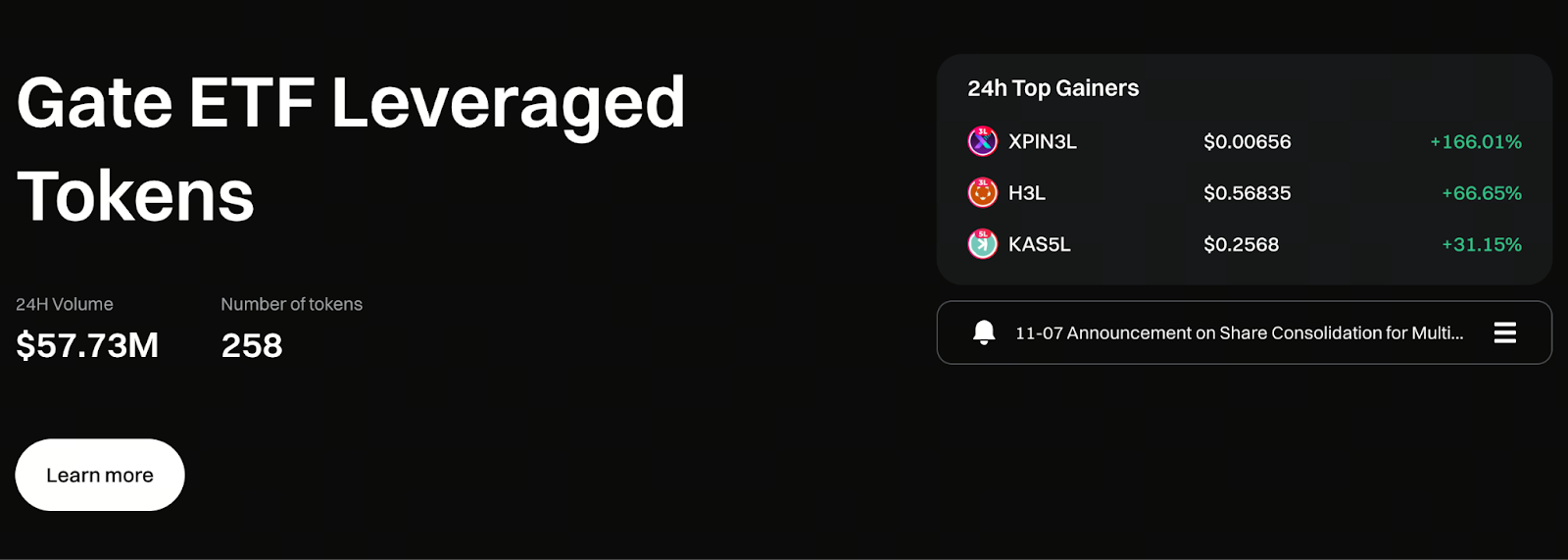
Gate’s leveraged ETF tokens maintain a fixed leverage ratio by relying on underlying perpetual contracts. However, the user experience is intentionally separated from traditional contract trading.

From the user’s perspective, trading these tokens feels just like trading spot tokens. There’s no need to manage margin, manually set leverage, or worry about liquidation risk. The system automatically handles all position calculations and management, so users can focus solely on market direction and timing their trades.

Start trading Gate leveraged ETF tokens now: https://www.gate.com/leveraged-etf

How Is Fixed Leverage Maintained?

To ensure leverage doesn’t spiral out of control, Gate has built multiple control layers into its product structure.

1. Each leveraged ETF is backed by a corresponding perpetual contract position, providing the foundation for leverage.

2. The system rebalances positions daily according to market movements, actively adjusting allocations to keep leverage at the preset target.

3. The entire trading experience is delivered in a spot market format, so users aren’t exposed to contract trading scenarios by mistake.

Gate charges a daily management fee of 0.1% to cover rebalancing, hedging, and contract-related costs.

Why Do Some Traders Choose Leveraged ETFs?

For those who want leveraged exposure without directly trading contracts, leveraged ETFs offer a practical alternative. In clearly trending markets, leverage can significantly amplify gains and improve capital efficiency. Since there’s no risk of margin calls, traders don’t face the psychological stress of forced liquidations. The rebalancing mechanism can naturally increase position size during favorable trends, creating a compounding effect. With straightforward trading logic, leveraged ETFs are often the first leveraged product that newcomers try when they’re not yet familiar with contract trading rules.

Simplicity Doesn’t Eliminate Risk

By nature, leveraged ETFs are high-volatility products. They amplify gains when prices rise, but losses are also multiplied in adverse markets. Frequent rebalancing during sideways or choppy markets can erode returns, and actual performance may fall short of the theoretical multiple. Over time, management and hedging costs are reflected in the token price. For these reasons, leveraged ETFs are not designed for long-term holding—they’re best suited for short-term strategies or clear market trends.

How Management Fees Are Used

To maintain fixed leverage, Gate must operate continuously in the perpetual contract market—opening and closing positions, paying funding rates, and covering slippage during rebalancing. The daily 0.1% management fee funds these essential operations, keeping overall costs in line with industry peers.

Conclusion

Gate’s leveraged ETFs lower the barriers of contract trading by delivering a familiar spot market experience, making it easier for traders to access leveraged opportunities. Leverage is never a risk-reduction tool—it magnifies both gains and losses. Leveraged ETFs only add value when users fully understand rebalancing, cost structures, and market rhythms. Using these products in the right context and managing trade frequency is key to unlocking their benefits, rather than turning them into a source of capital drain.

Author: Allen
Disclaimer
* The information is not intended to be and does not constitute financial advice or any other recommendation of any sort offered or endorsed by Gate.
* This article may not be reproduced, transmitted or copied without referencing Gate. Contravention is an infringement of Copyright Act and may be subject to legal action.

Related Articles

The ve(3,3) Flywheel Explained: How AERO Tokenomics Powers Aerodrome’s DeFi Economy
Beginner

The ve(3,3) Flywheel Explained: How AERO Tokenomics Powers Aerodrome’s DeFi Economy

In the competition for DeFi liquidity, high-inflation mining alone is no longer enough to build lasting advantages. Aerodrome applies the ve(3,3) economic model to redesign token emissions, voting mechanisms, and revenue distribution, creating a liquidity flywheel centered on governance and cash flow. This article examines AERO tokenomics, the veAERO locking mechanism, and protocol revenue models to explain how Aerodrome builds a sustainable DeFi economic system.
2026-03-25 06:41:58
AI-Native Settlement Layers: How United Stables Is Building the Next Financial Rail
Beginner

AI-Native Settlement Layers: How United Stables Is Building the Next Financial Rail

Stablecoins were originally designed as dollar substitutes within exchanges, primarily used for asset pricing and trade settlement. As on-chain financial ecosystems have matured, their role has expanded beyond simple payments to include collateral assets, cross-chain liquidity mediums, and unified settlement units. In particular, as AI systems and automated agents begin to participate directly in economic activity, demand has risen sharply for programmable value units capable of instant settlement. This shift is pushing stablecoins toward the role of foundational financial infrastructure.
2026-03-25 03:16:17
Aerodrome Tokenomics: How ve(3,3) Powers Base's Most Profitable DEX
Beginner

Aerodrome Tokenomics: How ve(3,3) Powers Base's Most Profitable DEX

AERO is the native token of Aerodrome Finance, a core decentralized exchange and liquidity protocol in the Base ecosystem. It is primarily used for liquidity incentives and ecosystem operations. veAERO is a governance NFT that users receive by locking AERO, representing both voting power and the right to share protocol revenue. Through a dual track structure of AERO as a utility token and veAERO as a governance credential, Aerodrome separates liquidity usage value from long term governance power, allowing participants to act as liquidity providers, governance decision makers, and revenue sharers within the same system.
2026-03-25 06:40:31
How Does PAXG Work? In-Depth Overview of the Physical Gold Tokenization Mechanism
Beginner

How Does PAXG Work? In-Depth Overview of the Physical Gold Tokenization Mechanism

PAXG (Pax Gold) is a tokenized asset backed by physical gold, issued by the fintech company Paxos and traded on the Ethereum blockchain as an ERC-20 token. The core concept is to tokenize physical gold on-chain, with each PAXG token representing ownership of a certain amount of gold. This structure enables investors to hold and trade gold in the form of a digital asset.
2026-03-24 19:12:51
How is the price of PAXG determined? Pegging mechanism, trading depth, and influencing factors
Beginner

How is the price of PAXG determined? Pegging mechanism, trading depth, and influencing factors

PAXG (Pax Gold) is a tokenized asset backed by physical gold reserves, launched by fintech firm Paxos and issued as an ERC-20 token on the Ethereum blockchain. The core concept is to digitally represent real-world gold assets, allowing investors to hold and trade gold via the blockchain network. Because each PAXG token corresponds to a specific quantity of physical gold, its price is theoretically expected to closely track the global gold market.
2026-03-24 19:11:40
DePIN Identity Network and Real World Applications: How Humanity Protocol Brings on-chain Identity Into the Physical World
Beginner

DePIN Identity Network and Real World Applications: How Humanity Protocol Brings on-chain Identity Into the Physical World

Most Web3 identity systems remain confined to on-chain environments and struggle to achieve meaningful adoption in real world settings. Through a DePIN architecture and physical verification hardware, Humanity Protocol aims to bring decentralized identity into access control systems, hospitality, public services, and offline events, allowing on-chain identity to function not just as a digital credential, but as foundational infrastructure for real world access.
2026-03-25 07:40:53





