Unlike energy companies that directly extract oil and natural gas, EPD mainly handles energy logistics and infrastructure operations. Whether it is crude oil transportation from shale oil regions or the growth of the natural gas liquids export market, a large share of energy activity depends on midstream infrastructure support. Understanding EPD’s use cases, therefore, is essentially a way to understand how the modern energy supply chain works.
Why Energy Infrastructure Matters
Energy infrastructure is a critical foundation for the modern economy. Oil, natural gas and related chemical feedstocks may be produced in specific regions, but demand is often spread across different cities, industrial parks and even countries. For that reason, safe and efficient transportation and storage have become essential parts of the energy value chain.
Without a well developed pipeline system and storage network, even abundant energy resources cannot easily translate into stable supply. The U.S. shale oil revolution, for example, brought a large increase in production. But what truly helped the United States become a global energy power was not only its ability to develop resources, but also the nationwide buildout of energy infrastructure. Pipelines, storage facilities, processing plants and export terminals together form the modern energy circulation system.
For Enterprise Products Partners, its value comes precisely from these infrastructure assets. By operating key energy nodes, the company enables producers to move resources to consumer markets, while also helping downstream businesses secure a stable energy supply.
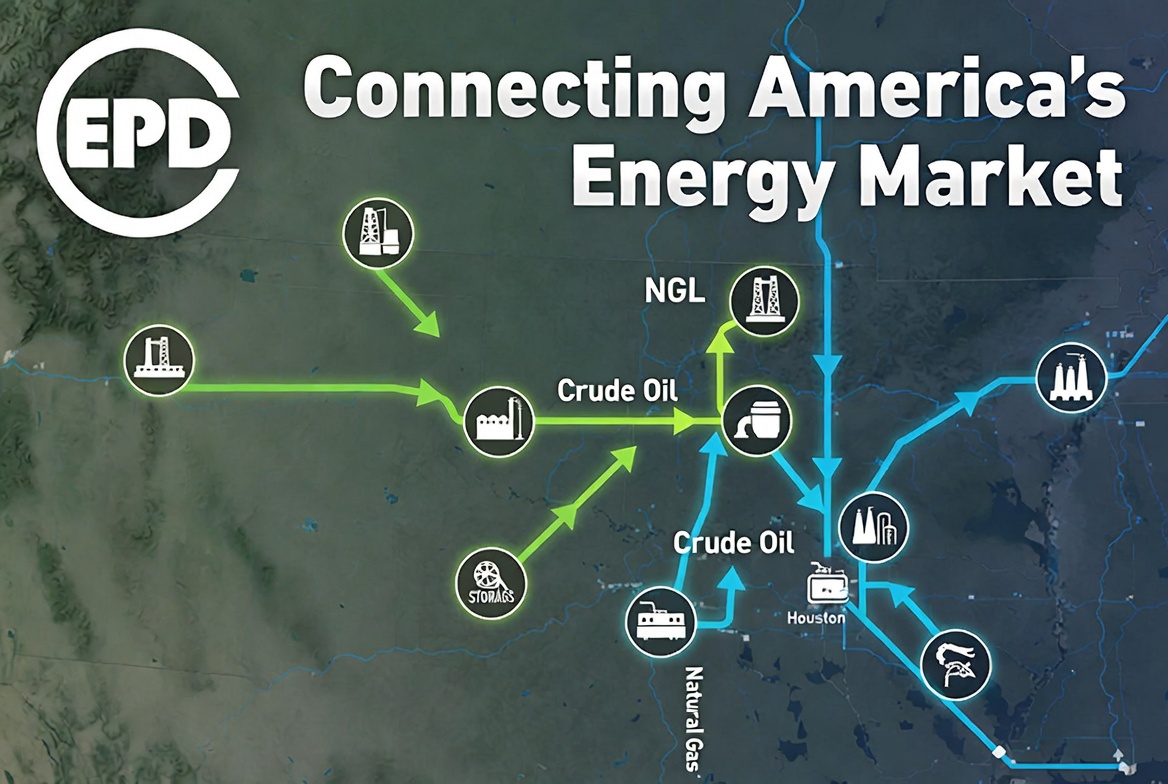
How EPD’s Pipeline Network Works
The pipeline system is one of EPD’s core assets and a key piece of infrastructure supporting the U.S. energy market. Compared with rail, road or maritime transportation, pipelines can move large volumes of energy at lower cost and with greater efficiency, making them the main channel for crude oil and natural gas flows.
EPD’s pipeline network covers several major energy producing regions, including the Permian Basin, Eagle Ford and the Gulf Coast. Large volumes of crude oil and natural gas produced in these areas are transported through pipelines to refining centers, industrial parks and export ports, forming a complete supply chain.
For energy producers, building an independent transportation network is often costly. As a result, they usually work with midstream companies such as EPD. Through unified operations and scaled management, Enterprise Products Partners can improve transportation efficiency and help customers reduce logistics costs. It is this connecting function that makes pipeline networks such an important part of the U.S. energy market.
What Are the Use Cases for Natural Gas Liquids Transportation
Natural gas liquids (NGLs) are an important part of EPD’s business. NGLs mainly include products such as ethane, propane and butane, which are widely used in chemicals, plastics manufacturing, industrial fuels and household energy consumption.
In the chemical industry, ethane is an important feedstock for producing ethylene, which in turn is a key building block for plastics and packaging materials. Propane is widely used in industrial fuel, agricultural production and home heating markets. For this reason, NGLs are not simply energy products. They are also closely linked to modern manufacturing.
EPD has built a complete value chain around natural gas liquids, covering gathering, separation, transportation and export. Through dedicated pipelines and processing facilities, the company moves NGLs from production areas to chemical complexes and export terminals. As U.S. natural gas production has grown, natural gas liquids have become an important part of U.S. energy exports, and EPD is a major participant in this market.
How Storage and Transportation Terminals Support Energy Trade
In addition to pipeline networks, storage and transportation terminals are also an important part of EPD’s infrastructure system. Supply and demand in the energy market are not always synchronized, so large storage facilities are needed to help balance market fluctuations.
For example, refineries may need a continuous supply of crude oil, while production from oilfields may be affected by weather, equipment maintenance or market conditions. Storage and transportation facilities create a buffer between production and consumption, improving supply chain stability.
For international trade, the importance of storage and transportation terminals is even more pronounced. Exporters need to store energy products in advance while waiting for vessel schedules and changes in market demand. Through large storage facilities and logistics management systems, EPD can help customers complete energy transactions and international transportation more efficiently. For this reason, storage and transportation terminals serve not only logistics needs, but also play an important role in the energy trade system.
How Export Facilities Connect the Global Energy Market
For decades, the U.S. energy market was mainly focused on domestic consumption. As the shale oil revolution drove production growth, however, the United States gradually became a major global energy exporter. As energy exports expanded, ports and export terminals became significantly more important.
Enterprise Products Partners owns several key export facilities. These facilities can deliver crude oil, natural gas liquids and petrochemical products to markets in Europe, Asia and Latin America. For international buyers, U.S. energy products have become an important part of the global supply system, while export terminals serve as the bridge between production areas and international markets.
From a business perspective, export facilities not only expand sales channels for U.S. energy companies, but also improve infrastructure utilization. For EPD, growth in international trade means greater transportation demand and broader market opportunities, which is why export operations have become an important part of the company’s long term development.
Why Energy Infrastructure Has Become a Core Industry Asset
Energy infrastructure has long term value because it is difficult to build, requires long investment cycles and is hard to replicate. An interstate pipeline or large energy terminal often takes years of planning and construction, while also requiring complex regulatory approvals.
These high barriers to entry give large energy infrastructure assets a clear competitive advantage. Once a broad transportation and storage network has been established, it is difficult for new competitors to build assets of the same scale in a short period of time. As a result, companies with core infrastructure are often able to maintain their market positions over the long term.
For Enterprise Products Partners, its competitive advantage does not come from a single project, but from the entire network. Pipelines, storage and transportation facilities, processing plants and export terminals create scale effects together, allowing the company to serve multiple energy markets and maintain an important position in the U.S. energy supply chain.
How to Buy EPD (Enterprise Products Partners) Stock
EPD is the ticker symbol for Enterprise Products Partners, which is traded on the New York Stock Exchange (NYSE). Traditionally, investors can buy EPD through a brokerage account that supports U.S. stock trading, allowing them to participate in the development of the U.S. energy infrastructure industry.
Because Enterprise Products Partners’ business is closely linked to crude oil transportation, natural gas liquids exports and the U.S. energy supply chain, it is often viewed as one of the companies to watch when assessing the U.S. energy market. Its operating performance is usually affected by factors such as energy production, infrastructure utilization rates and international trade activity.
As digital asset markets and traditional financial markets gradually converge, more trading tools linked to stock price movements have appeared. For example, some platforms offer CFD products linked to stock prices, allowing users to participate in market movements through price changes without directly holding the underlying stock assets.
Taking Gate TradFi as an example, users can follow different markets within the same account environment, including digital assets, stocks, ETFs, indices and commodities. Some markets also provide Gate CFD products, offering more options for cross market asset management and price tracking.
Regardless of how investors choose to participate in the market, they should fully understand the product structure, trading rules and regulatory requirements in their own region.
Summary
Enterprise Products Partners is an important part of the U.S. energy infrastructure system. Through a transportation network covering crude oil, natural gas, natural gas liquids and petrochemical products, EPD helps move energy from production regions to industrial customers, consumer markets and international trade terminals. Its pipeline systems, storage and transportation facilities, and export network form the company’s core assets, making it a key connector in the U.S. energy supply chain.
FAQs
What is EPD’s main business?
EPD mainly operates energy infrastructure, including crude oil pipelines, natural gas pipelines, natural gas liquids transportation networks, storage facilities and export terminals.
Why is energy infrastructure so important?
Energy infrastructure connects production with consumption. Without transportation and storage networks, energy resources would struggle to reach the market and provide stable supply.
What are natural gas liquids used for?
Natural gas liquids are widely used in plastics manufacturing, chemical production, industrial fuels and household energy consumption, making them an important source of raw materials for modern industry.
How does EPD participate in international energy trade?
EPD transports crude oil, natural gas liquids and petrochemical products to global markets through export terminals, connecting U.S. energy production with international demand.
How is EPD different from an oil company?
Oil companies are mainly responsible for resource exploration and production, while EPD mainly provides transportation, storage and logistics services. It is a midstream energy company.
Why is EPD considered an energy infrastructure company?
Because the company’s core assets are pipelines, storage and transportation facilities, and export terminals. Its main revenue comes from energy transportation and infrastructure services, rather than energy production itself.