In the global fashion and luxury industry, these two types of groups follow distinctly different paths. One builds a luxury matrix by acquiring high-end brands, while the other strengthens economies of scale and channel efficiency by integrating accessible luxury brands. This structural divergence directly shapes their revenue sources, growth models, and market competition strategies.
From an industry perspective, the comparison between CPRI and TPR is more than just a rivalry between two companies—it's a classic case study of "how luxury groups are built," with one driven by brand value and the other by operational efficiency.
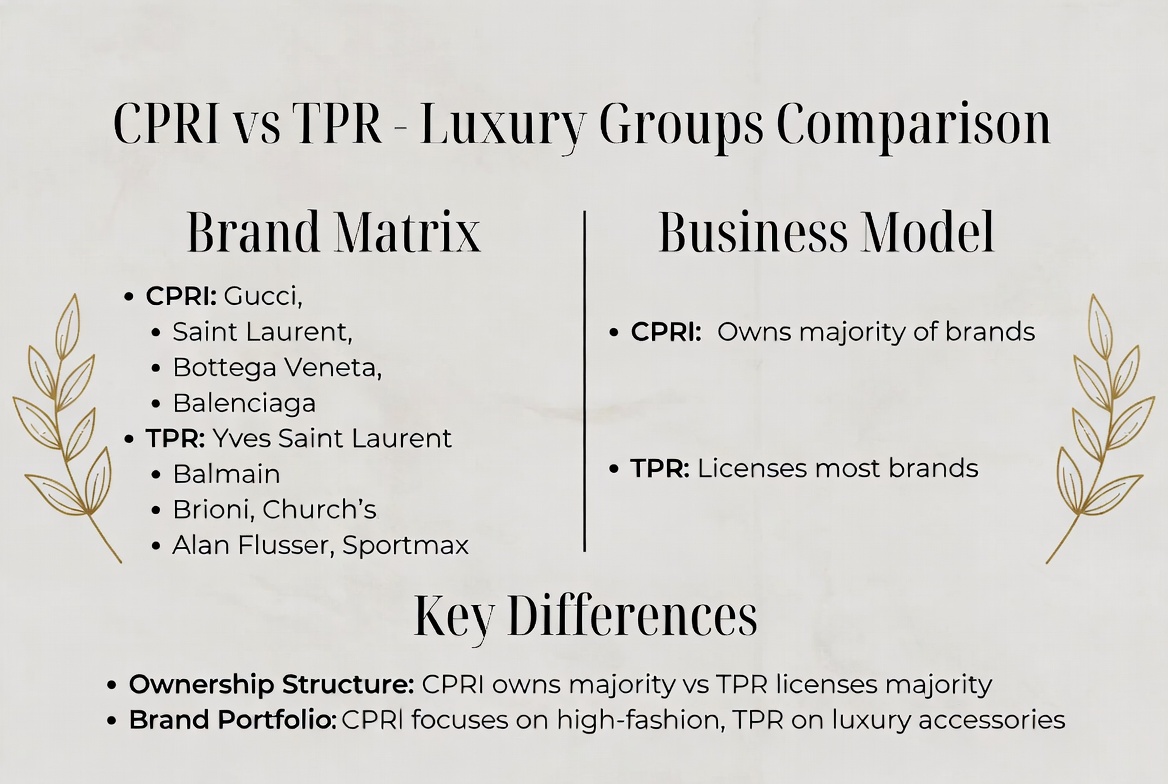
From a business standpoint, both companies are brand management groups, but CPRI emphasizes brand tier expansion, while TPR focuses on deep operational management in the accessible luxury market. This foundational difference determines their subsequent business models and growth trajectories.
CPRI is a group centered on a multi-brand luxury portfolio, with brands including Michael Kors, Versace, and Jimmy Choo, spanning consumer tiers from accessible luxury to high-end luxury. The group participates in the global fashion market through brand operations, retail, and wholesale channels.
TPR (Tapestry) is a fashion group centered on accessible luxury brands, with main brands including Coach, Kate Spade, and Stuart Weitzman. Unlike CPRI, TPR's brand structure is more concentrated in the accessible luxury market, leveraging a unified management system to enhance operational efficiency and brand synergy.
How CPRI's Brand Matrix Is Structured
CPRI's brand system is built on a multi-tier luxury structure. Michael Kors covers the mass-premium market and serves as the group's revenue foundation; Versace represents high-end luxury and plays a key role in elevating brand image; Jimmy Choo focuses on the high-end footwear and accessories market, reinforcing pricing power in its niche.
This structure allows CPRI to serve customer groups with different spending capacities simultaneously, creating internal complementarity through brand differentiation. Each brand is relatively independent in market positioning, product design, and pricing strategy, but shares group resources across supply chain and distribution channels.
Strategically, the significance of this multi-brand structure lies not only in revenue diversification but also in building a "brand tier system," enabling the group to maintain overall stability across different market cycles and gradually extend into higher-end markets.
How TPR's Brand System Operates
TPR's brand system is centered on the accessible luxury market, with Coach as the primary revenue source, Kate Spade providing a younger and trendier positioning, and Stuart Weitzman focusing on the high-end footwear segment. Overall, TPR's brand structure is more concentrated in the accessible luxury tier.
The key characteristic of this structure is high synergy among brands rather than clear stratification. Unlike CPRI's "multi-tier luxury structure," TPR emphasizes unified brand strategy management, improving overall efficiency through optimized design, supply chain, and retail channels.
From a market perspective, TPR's brand system is better suited for scaled operations, achieving strong brand penetration in the accessible luxury market while reducing cost pressure through standardized operations.
Core Differences in Business Models Between CPRI and TPR
CPRI's business model is primarily "multi-brand luxury portfolio-driven," focusing on covering different consumer markets through brand stratification and leveraging brand value to enhance the group's overall pricing power. TPR, on the other hand, is "accessible luxury brand integration-driven," focusing more on operational efficiency and economies of scale.
In terms of revenue structure, CPRI relies more on multi-channel income from brand differentiation, including retail, wholesale, and licensing, while TPR depends more on stable sales performance of core brands in the accessible luxury market. Their growth paths therefore exhibit different paces.
At its core, one creates growth space through "brand expansion," while the other enhances profitability through "efficiency optimization"—this is the fundamental divide between the two business models.
Revenue Structure Comparison: Accessible Luxury vs. Multi-Tier Brand Portfolio
CPRI's revenue structure covers multiple consumer tiers, from Michael Kors's mass-premium to Versace's ultra-high-end luxury, forming a cross-tier revenue system. This structure allows the group to generate income from different consumer markets.
TPR's revenue structure is more concentrated in the accessible luxury market, relying primarily on Coach's stable sales performance. Although the number of brands is smaller, the concentration is higher, which benefits management efficiency and profit margins.
From an industry perspective, this difference reflects two typical models in the luxury industry: one is a "multi-tier expansion model," and the other is a "focused efficiency model."
Global Market Layout Differences: U.S.-Europe Dominance vs. Global Expansion Path
CPRI's market layout is centered on North America while expanding into Europe and Asia, relying particularly on global luxury consumption growth to drive internationalization. Its brand structure determines a bias toward high-end market penetration.
TPR emphasizes unified global operations in the accessible luxury market, achieving scale expansion across multiple regions through standardized brand strategies. Its market entry approach relies more on channel efficiency and brand replication capabilities.
From a globalization path perspective, CPRI resembles "brand-driven expansion," while TPR resembles "operations-driven expansion"—the two paths are entirely different.
M&A-Driven Model Comparison: CPRI Acquiring Luxury Brands vs. TPR Integrating the Accessible Luxury Ecosystem
CPRI's expansion is primarily achieved through acquiring high-end brands, such as Versace and Jimmy Choo, which directly elevates the group's position and brand influence in the luxury market.
TPR's M&A strategy leans more toward integrating the accessible luxury ecosystem, optimizing the overall structure and improving operational efficiency through acquisitions or brand integration, rather than simply raising brand tiers.
From an industry logic standpoint, one is "acquiring upward into luxury," while the other is "integrating horizontally within accessible luxury," reflecting completely different development directions.
Profitability and Growth Logic Differences
CPRI's profitability depends on brand premium and a multi-tier revenue structure, so profit fluctuations are closely tied to brand performance. TPR's profitability relies more on economies of scale and cost control, making it relatively more stable.
In terms of growth logic, CPRI relies more on brand upgrades and international expansion, while TPR relies more on sustained penetration and operational optimization in the accessible luxury market.
This difference causes the two companies to perform differently across market cycles—one is more elastic, the other more stable.
Industry Risks and Cyclical Sensitivity Comparison
CPRI's main risks come from volatility in the high-end consumer market and pressure from brand renewal, especially when luxury demand slows. Additionally, the multi-brand structure increases management complexity.
TPR's risks are mainly concentrated in intensified competition in the accessible luxury market and brand homogenization issues. Consumers have more alternative choices for accessible luxury brands, and price competition is more pronounced.
From a cyclical sensitivity perspective, CPRI is more sensitive to the high-end consumption cycle, while TPR is more sensitive to overall consumer market changes.
Conclusion
CPRI and TPR represent two distinct development paths for luxury groups. CPRI builds a cross-tier market structure through a multi-brand luxury matrix, while TPR enhances operational efficiency through accessible luxury brand integration.
From an industry perspective, this difference essentially reflects two long-term structural models in the luxury industry—"brand value-driven" versus "efficiency-driven"—and provides an important comparative framework for understanding global fashion groups.
FAQ
What is the biggest difference between CPRI and TPR?
CPRI is a multi-brand luxury group, while TPR is an accessible luxury brand integration group. They have structural differences in brand tiers and business models.
Why is TPR mainly focused on the accessible luxury market?
TPR's brand system is centered on Coach. The accessible luxury market is large in scale and offers stable consumption, making it more suitable for scaled operations and efficiency optimization.
Why did CPRI acquire Versace and Jimmy Choo?
By acquiring high-end brands, CPRI can enter higher-tier luxury markets and enhance the completeness of its overall brand matrix.
Which business model is more stable?
CPRI relies more on brand performance fluctuations, while TPR relies more on scale efficiency. Their stability depends on different market conditions.