Buying Berkshire Hathaway (BRK.B) stock with USDT on Gate Stocks usually follows “account and funding prep → search ticker → verify issuer and display name → place order → review fees and holdings.” The instrument is Class B common stock of Berkshire Hathaway Inc.; the page display name is typically BERKSHIRE HATHAWAY Class B, and the trading ticker is BRK.B. Difficulty is beginner-level; time depends on account and funding readiness.
Berkshire Hathaway (BRK.B) explains share classes, holding-company earnings structure, and how to view the name on Gate. Before placing an order, separate company research from page execution: structure research answers what exposure BRK.B represents; the trading workflow answers how to verify and submit an order. Berkshire Hathaway also lists BRK.A; matching ticker and display name reduces wrong-class selection.
What Should Be Prepared Before Buying BRK.B on Gate?
Before buying BRK.B with USDT, confirm account status, identity verification, stock trading permissions, available USDT, product availability, and regional access conditions. Usable features follow what the Gate Stocks page displays. The goal is to rule out basic blockers: unable to trade, funds unavailable, ticker mix-ups, and fee misreads.
| Preparation item |
What to verify |
Typical impact |
| Account permissions |
Whether Stocks / U.S. equity trading is available |
Affects whether an order can be submitted |
| USDT funding |
Whether available USDT is in the stock-usable balance |
Affects order size and tradable quantity |
| Product availability |
Whether the BRK.B page shows a tradable status |
Affects whether the order can be sent |
| Instrument ID |
Display name BERKSHIRE HATHAWAY Class B and ticker BRK.B |
Affects whether the correct stock is selected |
| Fee and order rules |
Trading fees, minimum size, settlement display |
Affects fills and holdings records |
The preparation table separates “can open the page” from “can submit an order.” Search and order entry become executable after account, permissions, funding, product status, and fee rules are clear.
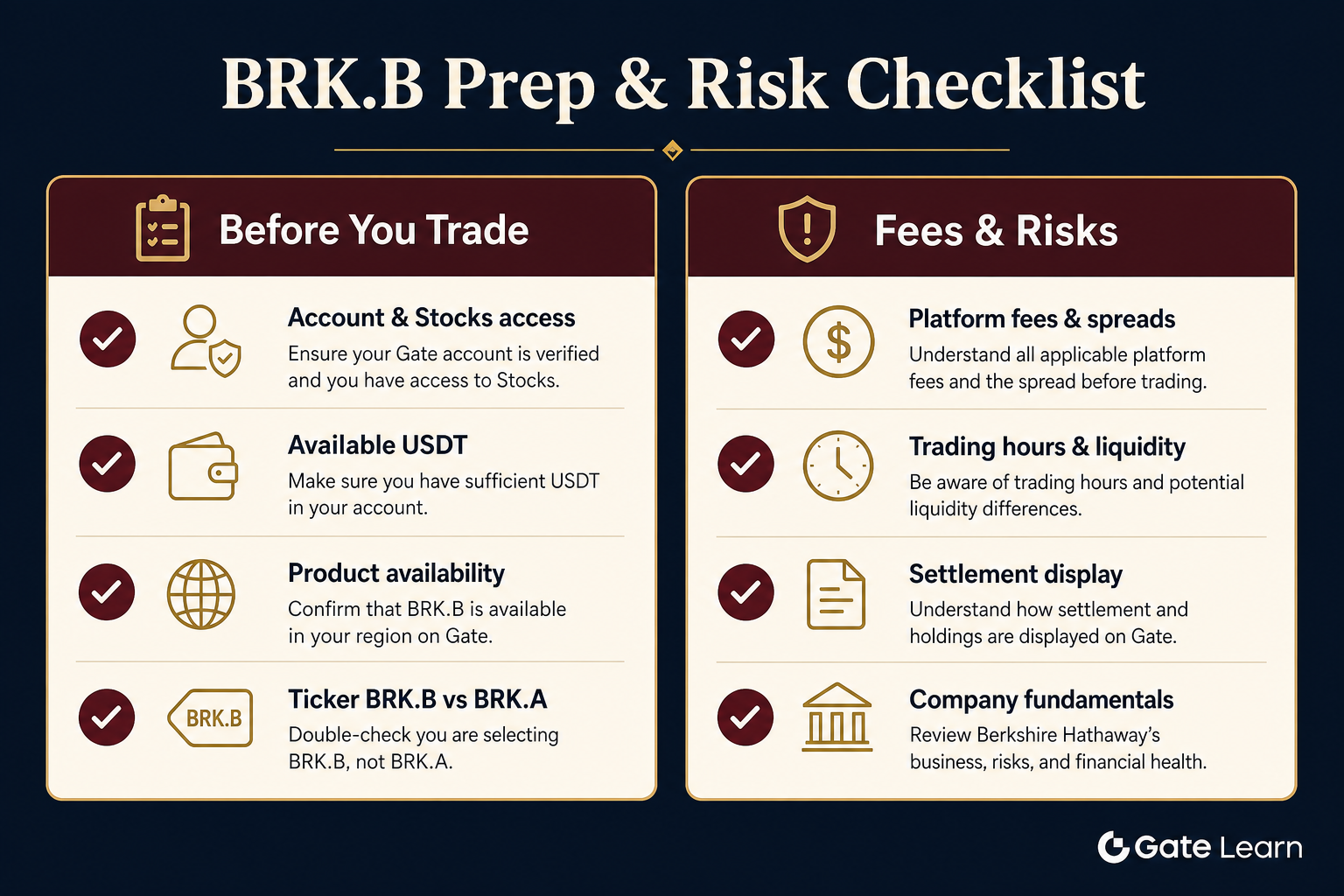 Figure 1. BRK.B prep and risk checklist: account permissions, available USDT, product availability, BRK.B vs BRK.A, fees, and session hours.
Step 1: How to Prepare USDT and a Stock Trading Account?
U.S. stock trading on Gate Stocks usually requires account-status checks, identity verification, stock trading permission confirmation, and USDT that can fund stock orders. Available USDT for stocks and ordinary spot-wallet balances may not use the same page reading; confirm funds are usable for stock orders before trading.
If USDT is still confirming, a transfer is incomplete, or funds are reserved by other orders, buyable quantity may be lower than total account balance. Stock and crypto spot permissions may be managed separately; confirm Stocks is enabled before opening the BRK.B trading page.
Step 2: How to Search Berkshire Hathaway / BRK.B on Gate Stocks?
Open Gate Stocks · BRK.B and enter BRK.B or Berkshire Hathaway in the search box. The page should show BERKSHIRE HATHAWAY Class B and identify the issuer as Berkshire Hathaway Inc. Matching ticker, display name, and issuer is the first control—especially because the same issuer also lists Class A under ticker BRK.A.
If BRK.A or nearby symbols appear, prioritize ticker BRK.B plus display name BERKSHIRE HATHAWAY Class B. Class A and Class B differ in unit size and voting rights; align ticker with display name so share classes are not mixed.
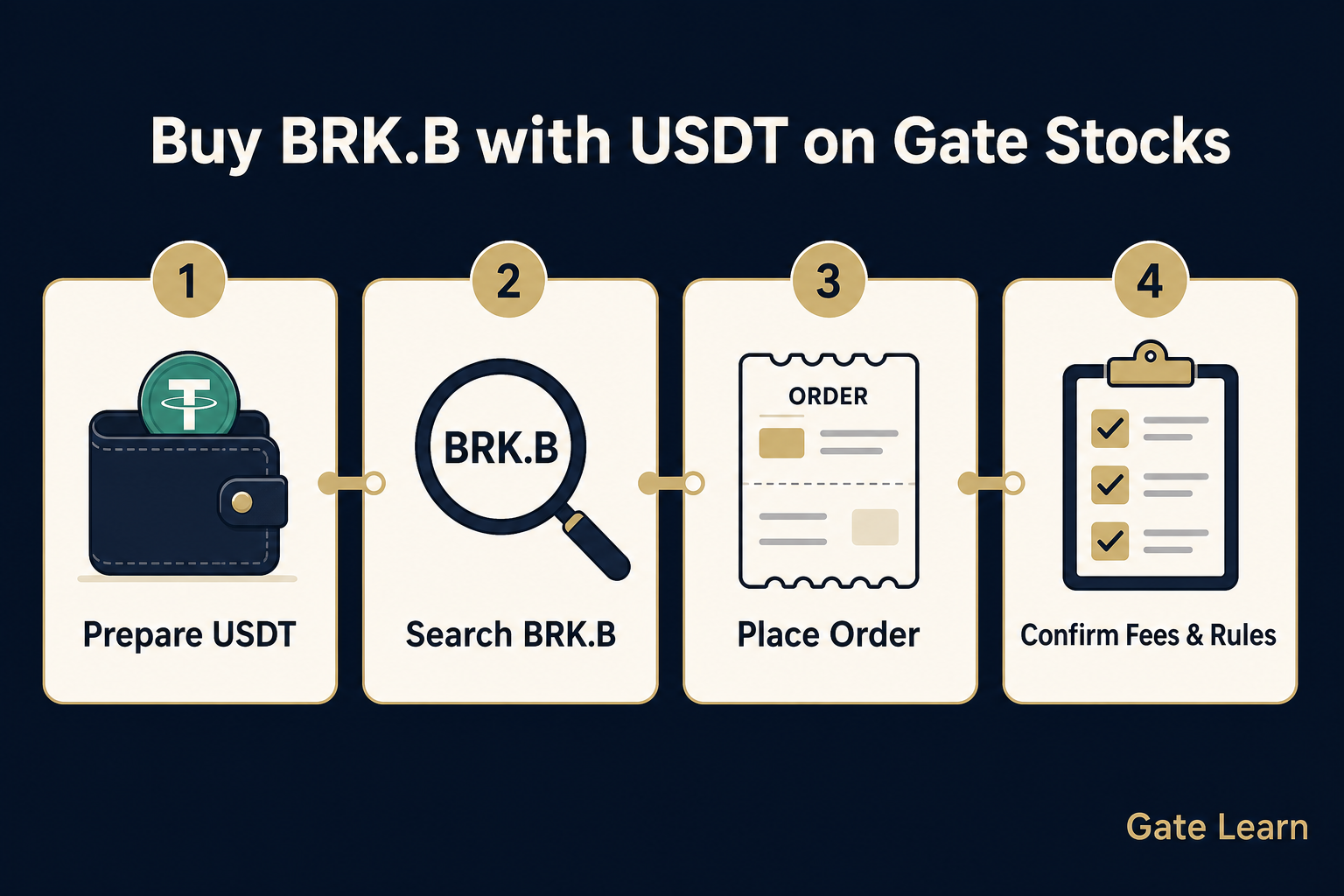 Figure 2. Buy BRK.B with USDT on Gate Stocks: prepare USDT, search BRK.B, place the order, confirm fees.
Step 3: How to Place a Buy or Trade Order for BRK.B?
On the BRK.B trading page, confirm in order: side (buy/sell), order type, quantity or notional, estimated fill amount, fees, and available account balance. Before submit, re-check display name and ticker BRK.B.
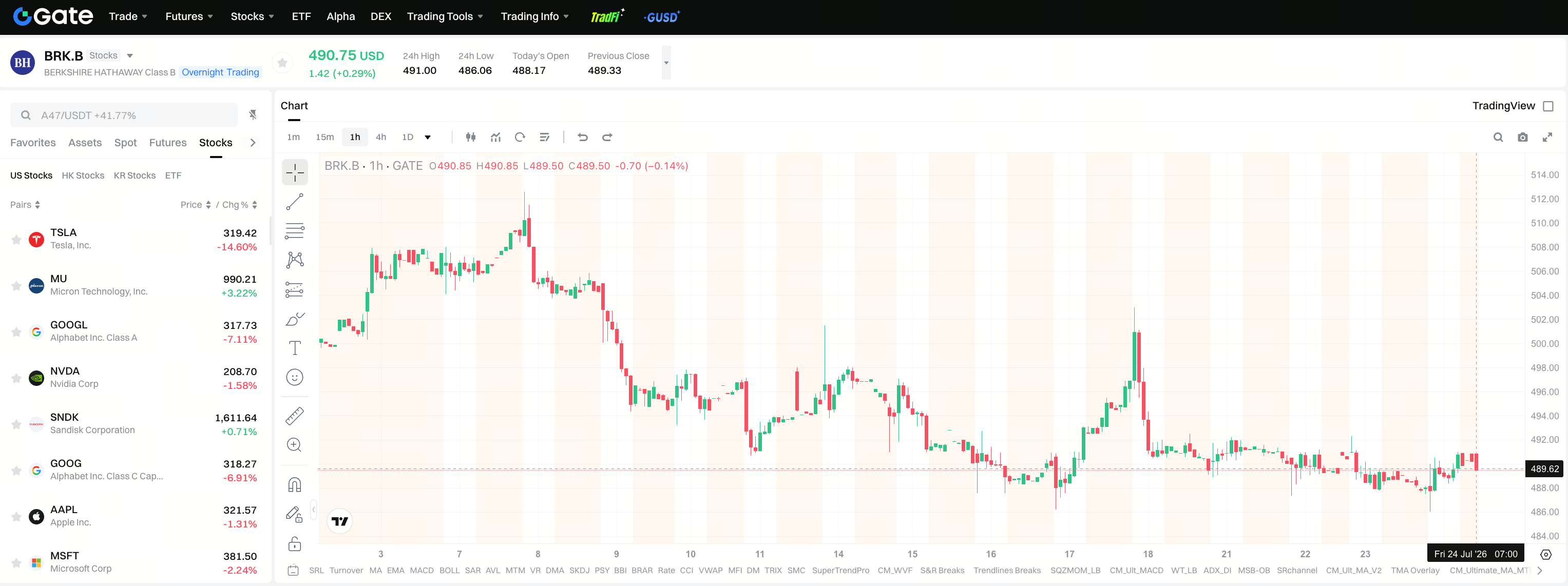
Common order types include Limit and Market. Limit orders emphasize a user-set price condition; Market orders emphasize execution at available market prices. Neither type is universally better; the difference is execution logic, fill speed, and price-control method.
| Order type |
Verification focus |
Possible outcome |
| Limit |
Price, quantity, time-in-force |
May remain unfilled if price is not triggered |
| Market |
Available balance, liquidity |
Fill price may differ from the estimate |
| Partial fill |
Filled quantity, remaining size |
Holdings and available balance update together |
Before submit, the confirmation dialog, fee notices, and order side are the last verification points. After submission, check open orders, fill history, or holdings against average fill price, quantity, fees, and ticker BRK.B.
Which Fees and Order Rules Should Be Confirmed When Trading BRK.B?
Stock trading pages usually show trading fees, spreads, execution price, minimum trade size, session hours, and related notices. Product and region rules can differ, so fees and order rules follow page display.
Separate platform trading fees, bid–ask spreads, and execution costs: fees affect net fill cost, spreads and liquidity affect Market-order results, and minimum size constrains submitable quantity. Berkshire Hathaway has historically not paid a regular cash dividend; that fact is not the same cost line as platform trading fees. Market orders may fill away from the estimate when liquidity is thin; Limit orders may sit unfilled if price conditions are not met.
What Risks Should Be Understood Before Buying or Trading BRK.B?
Trading-workflow risk and company-structure risk need separate framing. Workflow risks include selecting BRK.A by mistake, misreading order types, unclear fee rules, session limits, and liquidity changes. Structure risks come from insurance underwriting cycles, operating-subsidiary conditions, equity portfolio swings, and USDT funding versus stock pricing display differences.
| Check dimension |
Typical content |
Purpose of the check |
| Platform fees and spreads |
Trading fees, spreads, minimum size |
Separate execution cost from company structure |
| Instrument ID |
BRK.B vs BRK.A |
Avoid buying the wrong share class |
| Session and liquidity |
Trading hours, available depth |
Understand sources of fill uncertainty |
| Company fundamentals |
Insurance, subsidiaries, equity portfolio |
Understand exposure source, not order steps |
BRK.B is Class B common stock of Berkshire Hathaway Inc.; a “Buffett” label alone is not a complete check. Risk notes identify variable sources and are not buy or sell advice.
Summary
Buying Berkshire Hathaway (BRK.B) stock with USDT on Gate Stocks is standardized process execution: prepare account and USDT, search ticker BRK.B, verify display name BERKSHIRE HATHAWAY Class B, choose an order type, confirm fee rules, then review holdings after the fill. Keep operational checks and instrument understanding separate.
FAQ
How to Buy BRK.B with USDT on Gate?
Confirm Stocks trading permissions and that USDT sits in a balance usable for stock orders, then search ticker BRK.B on Gate Stocks and verify display name BERKSHIRE HATHAWAY Class B. Choose an order type, submit, and after the fill review ticker, quantity, and fees in holdings and order history.
How Is Buying U.S. Stocks on Gate Different From a Traditional Broker?
Gate Stocks retrieves U.S. equity tickers in a unified account and completes order and holdings display with USDT funding readings; traditional brokers usually center on fiat accounts, broker settlement, and local market rules. Account systems and fee fields can differ.
What Should Be Prepared Before Buying BRK.B?
Confirm Stocks permissions, USDT usable for stock orders, BRK.B product availability and regional access, plus fees, minimum size, and settlement display.
What Are the Risks of Trading BRK.B?
Main risks include market and valuation swings, insurance and subsidiary operating cycles, equity-portfolio concentration, and execution risks such as selecting BRK.A by mistake or misreading order rules. Risk notes do not constitute buy or sell advice.
What Are BRK.B Minimum Size, Sell Availability, and Trading Hours?
Minimum purchase size, sell availability, session hours, and order validity follow fields on the Gate Stocks BRK.B page; different accounts and regions may show different usable states. Re-check minimum size, side, and session notices before submit.
What Type of Instrument Is BRK.B?
BRK.B is the trading ticker for Class B common stock of Berkshire Hathaway Inc., a U.S.-listed diversified holding company. It is a U.S. equity stock, not a crypto token and not an ETF share. On Gate Stocks, the display name is typically BERKSHIRE HATHAWAY Class B.