
Bitcoin has just been through a savage run. It went up past $100,000 in late 2025, and then it’s been on a long, painful correction. The decline hurts, but to anyone paying even the slightest bit of attention to market cycles, it’s been almost white-noise predictable. Now, a rarely discussed indicator is flashing a signal that has marked every major cycle bottom in Bitcoin’s history.
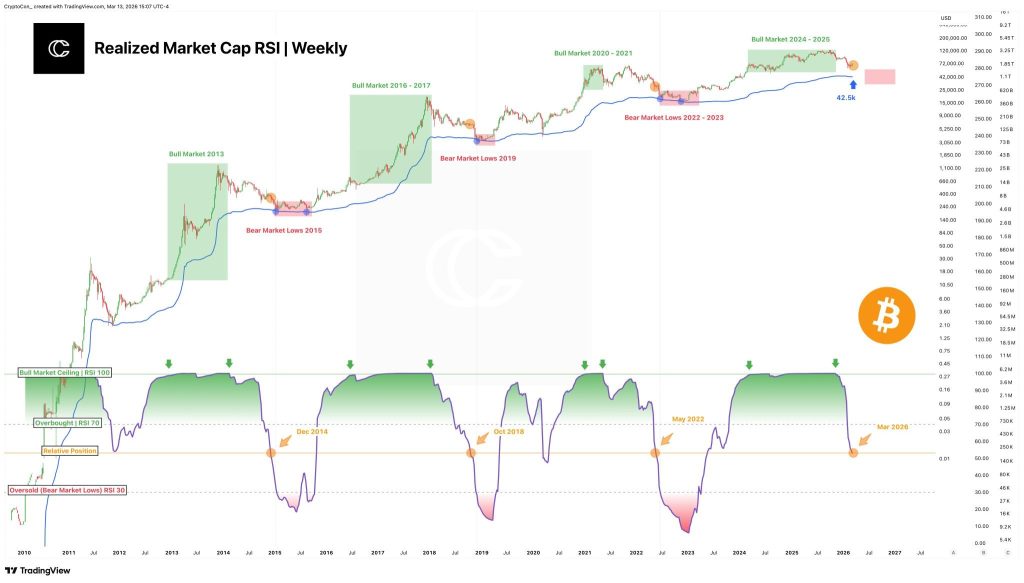
CryptoCon shared this analysis on X, pointing to the Weekly RSI of Bitcoin’s Realized Market Cap. This metric tells a similar story to better-known indicators like Puell Multiple and MVRV. The BTC price is close to cycle bottom levels, though slightly off.
- Understanding the Realized Market Cap RSI
- The Target Level That Matters for Bitcoin
- Where We Are in the Cycle
- What This Means for the BTC Price
Understanding the Realized Market Cap RSI
The realized market cap differs from standard market cap by valuing each Bitcoin at the price it last moved, not the current spot price. This gives a clearer picture of aggregate cost basis across all holders. Applying RSI to this metric on the weekly timeframe reveals when the market is at extreme levels of fear and capitulation.
The chart shows this indicator tracing clear cycles since 2010. Each time the weekly RSI of realized market cap has touched certain levels, the BTC price has been at or near a major cycle bottom. The pattern is remarkably consistent across more than a decade of market history.
The current reading shows the indicator approaching these historic bottom zones but not quite there yet. This aligns with the broader market picture, where the BTC price has stabilized but not yet shown the kind of explosive reversal that typically follows final capitulation.
The Target Level That Matters for Bitcoin
CryptoCon identifies a specific price level where the realized market cap moving average suggests the bottom could form. That level is $42,500, and it is decreasing slightly over time. This represents a potential downside target if the BTC price continues its correction before finding final support.
The significance of this level comes from its track record. The realized market cap moving average has caught every cycle bottom precisely, from the 2011 lows through the 2015, 2018, and 2022 bottoms. Each time the BTC price touched this moving average, it marked the end of the bear market.
Source: X/@CryptoCon
A move to $42,500 from current levels near $68,000 would represent roughly a 38% decline, a drop that would fit the historical pattern of bear market depths.
Where We Are in the Cycle
The current reading shows the BTC price close to cycle bottom levels but slightly off. This suggests either the bottom is near and price will drift lower to meet the moving average, or the moving average will decrease over time and meet price at current levels.
The RSI of realized market cap is not yet at the extreme lows seen at previous cycle bottoms. There is room for further downside before reaching the levels that marked the 2018 and 2022 capitulation events.
Kaspa (KAS) Leads Bitcoin, Monero, and Others as Favorite Proof Of Work Crypto_**
What This Means for the BTC Price
For traders, the main focus will be on the price level of $42,500, which could be an area to accumulate. If the price of BTC goes lower than this, it could be entering an area that has traditionally marked the end of bear markets.
The BTC price currently sits well above this level. The indicator is close but not there. The coming weeks will determine whether price drifts lower or time catches up. For now, the signal is worth watching. The realized market cap RSI has called every major bottom in Bitcoin’s history. It is now flashing that same setup again.
Aviso legal: La información de esta página puede proceder de terceros y no representa los puntos de vista ni las opiniones de Gate. El contenido que aparece en esta página es solo para fines informativos y no constituye ningún tipo de asesoramiento financiero, de inversión o legal. Gate no garantiza la exactitud ni la integridad de la información y no se hace responsable de ninguna pérdida derivada del uso de esta información. Las inversiones en activos virtuales conllevan riesgos elevados y están sujetas a una volatilidad significativa de los precios. Podrías perder todo el capital invertido. Asegúrate de entender completamente los riesgos asociados y toma decisiones prudentes de acuerdo con tu situación financiera y tu tolerancia al riesgo. Para obtener más información, consulta el
Aviso legal.
Artículos relacionados
Datos de Polymarket: la probabilidad de que Bitcoin vuelva a subir a 100.000 dólares en lo que queda del año es del 40%
Gate News report indicates that on March 15, Polymarket prediction market data shows that the probability of Bitcoin rising to $100,000 within the year is 40%, the probability of rising to $90,000 is 53%, and the probability of rising to $80,000 is 76%. Additionally, the probability of BTC falling to $50,000 within the year is 61%.
GateNewsHace56m
Autor de 'Padre Rico, Padre Pobre': Bitcoin subirá después del 'Gran Crash' - U.Today
Robert Kiyosaki advierte sobre un colapso económico inminente, sugiriendo que es una oportunidad de compra. Destaca las reservas de efectivo de Warren Buffett y cree que los precios del oro, la plata y Bitcoin aumentarán después del colapso, a pesar de enfrentar críticas sobre sus afirmaciones de inversión.
UTodayhace1h
Los ETF de Bitcoin al contado impulsan las entradas a una racha de cinco días, la primera en 2026
Los ETF de Bitcoin al contado de EE.UU. registraron su primer período consecutivo de cinco días de entradas en 2026, acumulando aproximadamente $767.32 millones para la semana e indicando un renovado apetito de los inversores por productos de exposición física en medio de un volátil panorama macroeconómico. Las entradas netas del viernes alcanzaron $180.33 millones, extendiendo una tendencia que comenzó
CryptoBreakinghace1h
DWF Labs: El final de la temporada de altcoins tradicionales, los fondos institucionales se giran hacia BTC, ETH y RWA
Andrei Grachev de DWF Labs señaló que la "temporada de altcoins" tradicional está desapareciendo gradualmente debido a cambios en la estructura del mercado criptográfico, ya que el capital institucional prefiere Bitcoin y Ethereum, lo que expone a los altcoins a mayores riesgos y salidas de fondos. En los últimos 13 meses, la capitalización de mercado de altcoins ha caído más de 2090 millones de dólares.
GateNewshace2h


