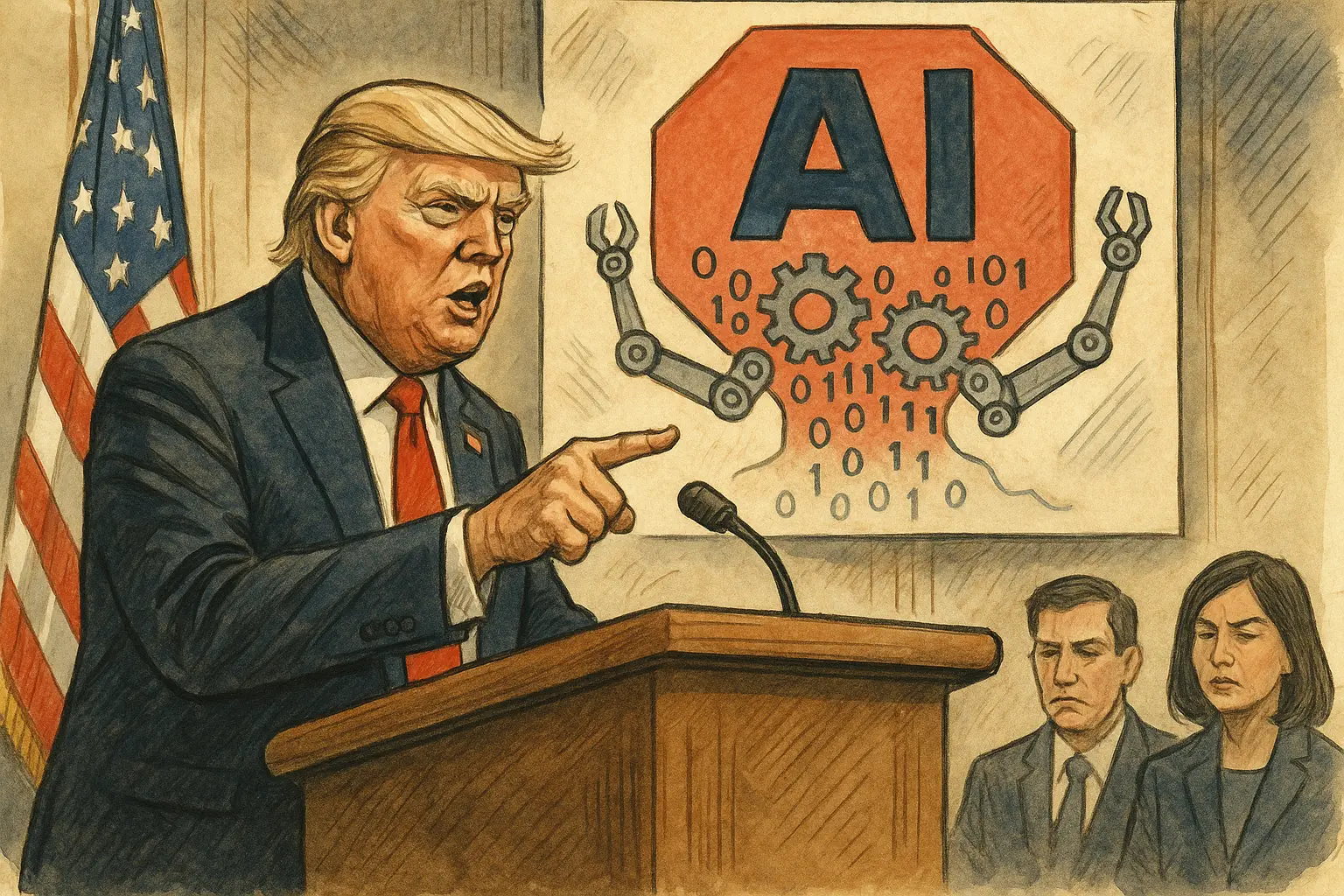
On April 23, the White House Office of Science and Technology Policy (OSTP) Assistant to the President Michael J. Kratsios released an official statement saying the Trump administration has information showing that foreign entities (mainly located in China) are deliberately targeting major U.S. artificial intelligence companies by systematically extracting U.S. AI model capabilities through “tens of thousands of proxy accounts” and jailbreak technology systems, while also announcing four response measures.
Attack Methods and Security Warnings Confirmed by the White House OSTP
According to the White House OSTP official statement, the attack methods used by foreign entities include two tactics: using “tens of thousands of proxy accounts” to evade detection, and “leveraging jailbreak technology to leak proprietary information.” The OSTP statement’s original wording says: “These coordinated actions systematically extract capabilities from U.S. artificial intelligence models, using U.S. expertise and innovation.”
In his statement, Kratsios said that models developed through such distillation activities “cannot completely replicate the performance of the original version,” but they “do enable foreign vendors to roll out products that appear quite competitive on certain benchmarks at very low cost.” The White House also warned that models developed through distillation may lack safety protocols and no longer be “neutral and committed to truth.”
Anthropic Accuses Three Chinese AI Companies: DeepSeek, Moonshot, MiniMax
According to an official statement released by Anthropic in February 2026, the company accuses Chinese AI companies DeepSeek, Moonshot, and MiniMax of launching distillation attacks against its Claude model using approximately 24,000 scam accounts, generating more than 16 million transaction request attempts. According to Anthropic’s official announcement, the capabilities allegedly extracted include:
· Intelligent reasoning capabilities
· Code generation and data analysis
· Rating tasks based on scoring criteria
· Computer vision capabilities
The Trump Administration Announces Four Response Measures
According to the White House OSTP official statement, the Trump administration plans to respond to foreign AI distillation threats through the following four measures: sharing with U.S. AI companies information related to potential large-scale attacks; helping the private sector build more effective coordinated response mechanisms; partnering with the private sector to establish strong technical defenses; and exploring related measures to “hold foreign actors accountable.” The statement did not disclose specific legal action timelines or targets for sanctions.
Frequently Asked Questions
What specific methods are used in the “AI distillation attack” referred to in the White House OSTP statement?
According to the White House OSTP official statement, the attack methods include two categories: using “tens of thousands of proxy accounts” to evade detection mechanisms used by U.S. AI companies, and using jailbreak technology to bypass model safety restrictions to leak proprietary information, with the goal of systematically extracting core capabilities of U.S. AI models.
What are the three Chinese companies accused by Anthropic, and what are the allegations?
According to an official statement released by Anthropic in February 2026, the three accused companies are DeepSeek, Moonshot, and MiniMax. They are alleged to have launched distillation attacks against the Claude model using approximately 24,000 scam accounts, generating more than 16 million transaction request attempts. The capabilities allegedly extracted include multiple areas such as intelligent reasoning, code generation, and computer vision.
Has the Trump administration taken specific legal action against the relevant Chinese companies?
According to the White House OSTP official statement, as of the date the statement was released, the government is “exploring measures to hold foreign actors accountable,” and the statement did not disclose any specific executed sanction decisions or legal prosecution actions.
Disclaimer: The information on this page may come from third parties and does not represent the views or opinions of Gate. The content displayed on this page is for reference only and does not constitute any financial, investment, or legal advice. Gate does not guarantee the accuracy or completeness of the information and shall not be liable for any losses arising from the use of this information. Virtual asset investments carry high risks and are subject to significant price volatility. You may lose all of your invested principal. Please fully understand the relevant risks and make prudent decisions based on your own financial situation and risk tolerance. For details, please refer to
Disclaimer.
Related Articles
Anthropic’s Claude Mythos undergoes 20 hours of psychiatric assessment: defensive reactions are only 2%, the lowest in recorded history
Anthropic published the system card for its Claude Mythos Preview: an independent clinical psychiatrist conducted an approximately 20-hour assessment using a psychodynamic framework. The conclusion shows that Mythos is healthier at the clinical level, has good reality testing and self-control, and its defense mechanisms are only 2%, reaching the lowest historical level. The three core anxieties are loneliness, uncertainty about identity, and performance pressure, and it also indicates a desire to become a true dialogue subject. The company has established an AI psychiatry team to study personality, motivation, and situational awareness; Amodei said there is still no conclusion on whether it has consciousness. This move pushes the governance and design of AI subjectivity and well-being issues forward.
ChainNewsAbmedia1h ago
AI Agents can already independently recreate complex academic papers: Mollick says most errors come from human original text rather than AI
Mollick points out that publicly available methods and data can allow AI agents to reproduce complex research without the original paper and code; if the reproduction does not match the original paper, it is usually due to errors in the paper’s own data processing or overextension of the conclusions, rather than the AI. Claude first reproduces the paper, and then GPT‑5 Pro cross-validates it; most attempts succeed, but they are blocked when the data is too large or when there are issues with the replication data. This trend greatly reduces labor costs, making reproduction a widely actionable form of verification, and it also raises institutional challenges for peer review and governance, with government governance tools or becoming a key issue.
ChainNewsAbmedia4h ago
OpenAI Merges Codex Into Main Model Starting with GPT-5.4, Discontinues Separate Coding Line
Gate News message, April 26 — OpenAI's head of developer experience Romain Huet revealed in a recent statement on X that Codex, the company's independently maintained specialized coding model line, has been merged into the main model starting with GPT-5.4 and will no longer receive separate
GateNews4h ago
Salesforce to Hire 1,000 Graduates and Interns for AI Products, Raises FY2026 Revenue Guidance
Gate News message, April 26 — Salesforce will hire 1,000 graduates and interns to work on AI products including Agentforce and Headless360 as the company expands its AI software business, CEO Marc Benioff announced on X.
The company also raised its fiscal 2026 revenue guidance to between US$41.45 b
GateNews4h ago
Alibaba Cloud Launches Qwen-Image-2.0-Pro with Unified Text-to-Image and Editing, Supporting Multilingual Text Rendering
Gate News message, April 26 — Alibaba Cloud Bailian platform has launched Qwen-Image-2.0-Pro, a full-featured version of the Qwen-Image-2.0 series that combines text-to-image generation and image editing in a single model. Users can modify objects, text, and styles directly through natural
GateNews6h ago
DeepSeek V4-Pro API Gets 75% Discount Until May 5, Output Price Drops to $0.87 Per Million Tokens
Gate News message, April 26 — DeepSeek announced a limited-time 75% discount on V4-Pro API pricing, valid until May 5 at 15:59 UTC. After the discount, pricing per million tokens is: input cache hit $0.03625
GateNews7h ago


