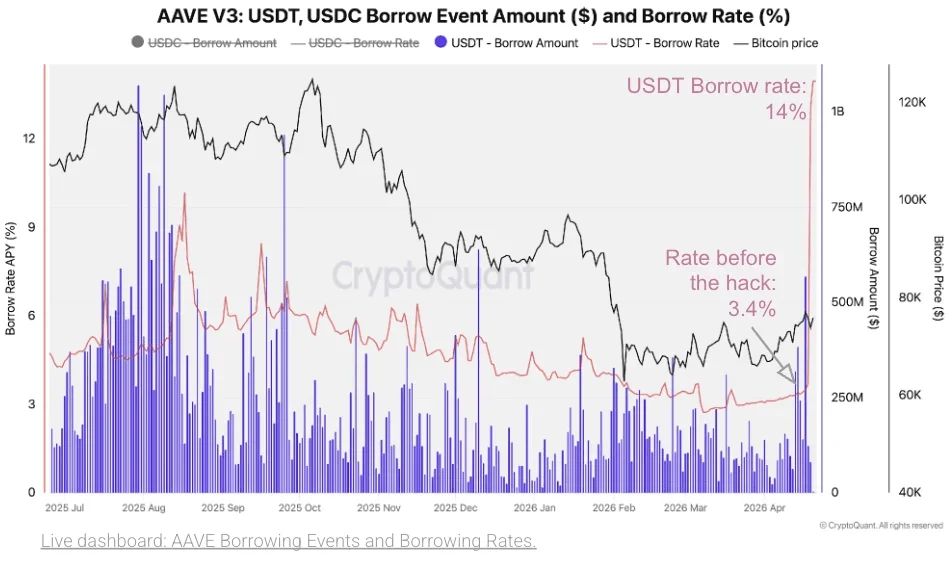
According to CryptoQuant’s assessment on April 23, the KelpDAO exploit that occurred last week created potential bad debt risk for Aave of between $124 million and $230 million within 72 hours, as TVL plunged 33%. The borrowing interest rates for USDT and USDC surged from 3.4% to 14%, while the ETH borrowing rate rose to the highest level since January 2024 at 8%.
Attack Mechanism: 83% of the rsETH supply concentrated on Aave amplifies the contagion effect
The attacker extracted unsecured rsETH from KelpDAO’s infrastructure and exchanged it for WETH and stablecoins on Aave, exploiting a critical vulnerability in the cross-chain bridge. The reason this contagion effect was so severe lies in the fact that Aave’s aETHrsETH contract holds about 83% of the circulating rsETH supply, making it the single protocol most heavily affected. CryptoQuant noted that Aave’s massive rsETH position caused risk contagion effects to far exceed the scope of the initial exploit.
Interest Rate Surge: A confirmation signal of systematic stress, not isolated volatility
(Source: CryptoQuant)
The lending interest rates across Aave V3’s three major markets rose in sync after the attack, showing the typical characteristics of stress across the system:
USDT and USDC lending rates: surged from 3.4% (the normal level before the attack) to 14%, reflecting a bank run-like squeeze in which users rushed to borrow stablecoins and exit the protocol.
ETH lending rates: climbed to 8% (the highest record since January 2024 according to CryptoQuant), then stabilized at around 5%, still more than double the 2% level before the attack.
The synchronized surge in interest rates across the three major markets formed what CryptoQuant described as a “typical DeFi liquidity crisis”: as depositors withdraw funds, borrower demand increases, available liquidity drops sharply, and rates reset to a much higher level.
USDe Contagion Shock: One of the largest-scale short-term redemption events in history
As the yield-bearing stablecoin USDe, the fourth-largest asset on Aave (with protocol deposits totaling $412 million), suffered a severe blow. Over three days, USDe’s total supply fell from $5.8 billion to $5.0 billion, a decrease of $800 million (a 14% drop). CryptoQuant called this one of the largest short-term redemption events for USDe in history.
This pressure compounded from two sources: risk-hedging sentiment cascading from the Aave crisis, and persistent negative funding rates on ETH and BTC perpetual contracts, which compressed USDe’s delta-neutral strategy returns and accelerated holders’ desire to redeem. As the world’s fifth-largest stablecoin (behind USDT, USDC, USDS, and DAI), USDe’s large-scale contraction further confirms a broader trend of significant liquidity withdrawal across the DeFi ecosystem.
Frequently Asked Questions
How does CryptoQuant quantify the specific bad-debt risk to Aave from this event?
CryptoQuant estimates that Aave faces potential bad-debt risk of between $124 million and $230 million. The quantification basis is that Aave’s aETHrsETH contract holds about 83% of the circulating rsETH supply, and then—together with the degree of rsETH depegging—it calculates the minimum and maximum bad-debt risk under two different loss-allocation scenarios.
Why was the surge in Aave lending and borrowing interest rates identified as a hallmark of systematic stress?
CryptoQuant pointed out that after the same event, the interest rates in Aave’s three major markets—USDT, USDC, and ETH—rose sharply in sync, rather than as isolated volatility in individual markets. The simultaneous surge across the three major markets indicates that the protocol’s available liquidity across the entire Aave system shrank in sync, which is a systematic manifestation of liquidity stress at the protocol level.
Why did USDe suffer large-scale redemptions during this crisis?
USDe’s redemption pressure compounded two factors: first, the spread of market risk-hedging sentiment triggered by the Aave crisis to USDe holders; second, persistent negative funding rates on ETH and BTC perpetual contracts, which compressed USDe’s delta-neutral strategy returns and sharply reduced the financial attractiveness of continuing to hold USDe, thereby accelerating large-scale redemptions.
Disclaimer: The information on this page may come from third parties and does not represent the views or opinions of Gate. The content displayed on this page is for reference only and does not constitute any financial, investment, or legal advice. Gate does not guarantee the accuracy or completeness of the information and shall not be liable for any losses arising from the use of this information. Virtual asset investments carry high risks and are subject to significant price volatility. You may lose all of your invested principal. Please fully understand the relevant risks and make prudent decisions based on your own financial situation and risk tolerance. For details, please refer to
Disclaimer.
Related Articles
Solana Meme Coin Memecoin Breaks $12.23M Market Cap, Surges 37.3% in 24 Hours
Gate News message, April 26 — Memecoin, a Meme token on Solana, has surged 37.3% over the past 24 hours and breached a market capitalization of $12.23 million today, according to on-chain data monitoring.
BlockBeats notes that Meme coin trading carries substantial volatility and is largely driven b
GateNews1h ago
Bitcoin Breaks Through $78,000, Up 0.75% in 24 Hours
Gate News message, April 26 — Bitcoin surged through $78,000, currently trading at $78,102.89 with a 24-hour gain of 0.75%.
GateNews2h ago
ETH Liquidation Cascade: $499M in Short Positions at Risk If Ether Breaks $2,417
Gate News message, April 26 — According to Coinglass data, if Ethereum breaks above $2,417, cumulative short position liquidations across major centralized exchanges would reach $499 million. Conversely, if ETH drops below $2,213, cumulative long position liquidations would reach $499 million.
GateNews3h ago
PLA Plummets 47.8% in 30 Minutes, Dropping Below $0.12
Gate News message, April 26 — PLA (PlayDapp) price crashed 47.8% in just 30 minutes today, falling to $0.1225. The token, which hit a day high of $0.2347, now trades at $0.122512 with a market cap of approximately $305 million. Trading volume remains notably low, reflecting reduced investor
GateNews3h ago
LAB Token Surges 18.8% as Core Team Address Transfers 18M LAB to Major Exchange
Gate News message, April 26 — According to on-chain data, a core LAB team-associated address transferred 18 million LAB tokens to a major CEX deposit address in two transactions on April 25, worth approximately $15.39 million. The transfer represents 7.81% of LAB's circulating supply of 230.4 millio
GateNews4h ago
Apecoin Insider Turns $174K Into $2.45M in One Day With 14x Trade on Both Sides of 80% Surge
An anonymous wallet with no prior trading history turned $174,000 worth of ether into $2.45 million by trading Apecoin on both sides of an 80% price surge in a single day.
Key Takeaways:
Wallet 0x0b8a converted $174,000 in ETH into a leveraged Apecoin long, exiting near the top for a $1.79M
Coinpedia4h ago


