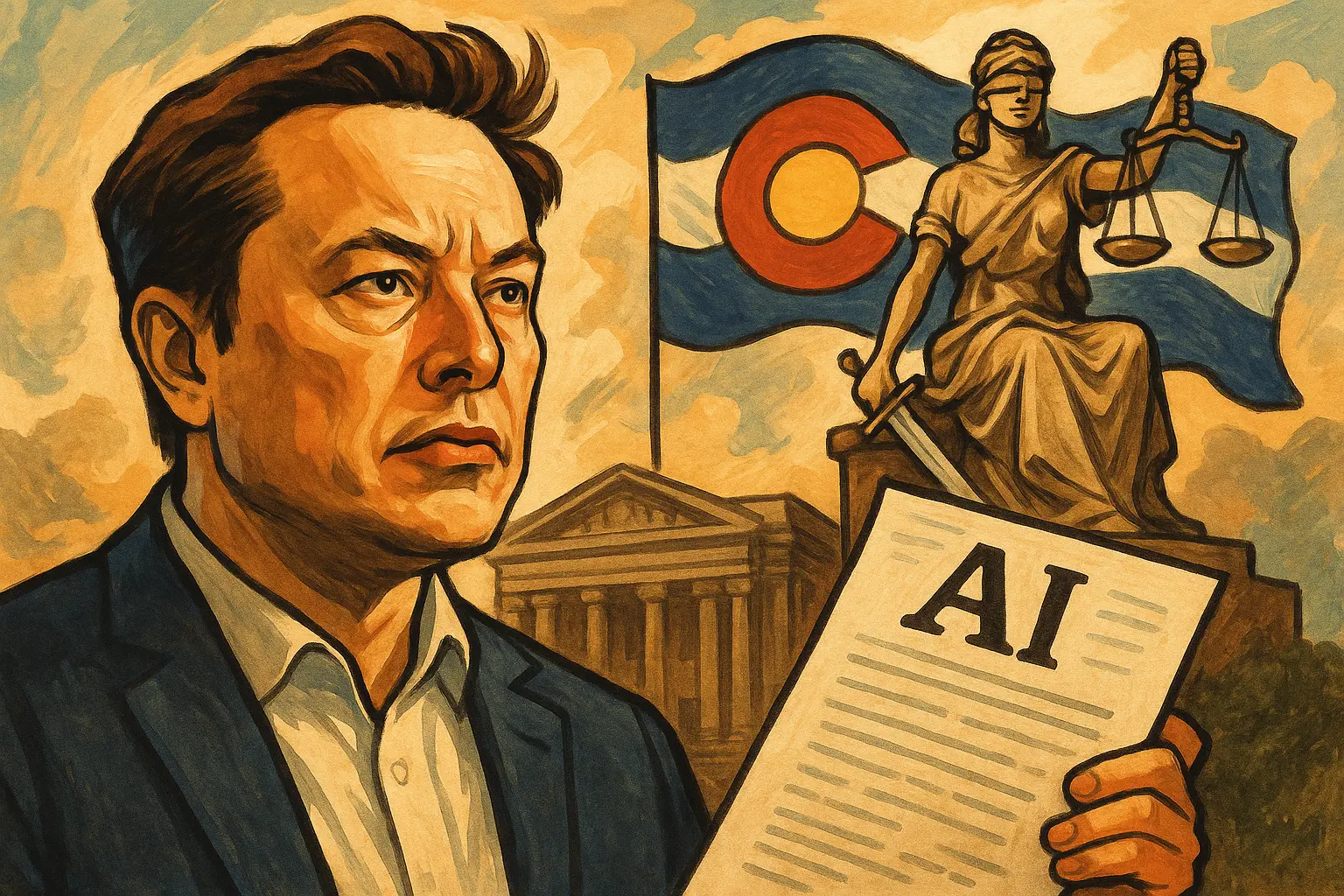
Musk’s artificial intelligence company, xAI, filed a lawsuit with the U.S. District Court in Colorado on Thursday, seeking to block Colorado Senate Bill 24-205 (SB 24-205) from taking effect as scheduled on June 30. The bill is intended to prevent AI systems from creating “algorithmic discrimination” in the employment, housing, and financial services sectors. xAI argues that the regulation forces Grok to output information according to political positions, violating free speech.
xAI’s Constitutional Claims: AI Output Is Protected Speech
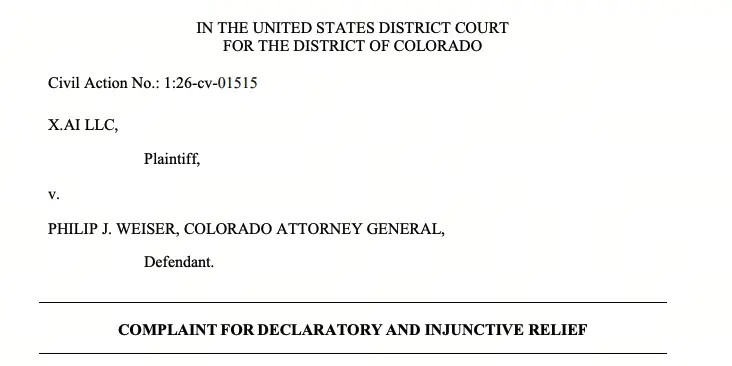 (Source: CourtListener)
In its court filings, xAI clearly states that Colorado has no power to compel changes to xAI’s information output simply because it wants to promote a particular viewpoint on highly politicized issues such as “fairness and equality.” The company also points out that SB 24-205 contains a fundamental logical contradiction: on the one hand, the law claims to eliminate historical discrimination and increase diversity; on the other hand, its internal provisions authorize “differential treatment,” which are moving in opposite directions.
This is not the first time xAI has taken legal action regarding AI regulation. In December 2025, xAI already filed a lawsuit over California’s “Generative AI Training Data Transparency Act,” arguing that California’s information disclosure requirements constitute compelled speech and involve the disclosure of trade secrets, violating the U.S. Constitution’s First and Fifth Amendments. Colorado’s lawsuit is the second federal-level legal action taken by xAI in the field of AI regulation.
Legislative Background and Key Controversies Surrounding SB 24-205
Colorado’s SB 24-205 is one of the first state-level AI anti-discrimination regulations in the United States. It requires developers of high-risk AI systems to take compliance measures to prevent their systems from having an unreasonable discriminatory impact on protected groups. Notably, before Colorado and California pushed forward with AI legislation in succession, there were accusations that Grok had previously made statements related to racism, sexism, and antisemitism; some lawmakers viewed this as one of the bases for advancing AI anti-discrimination rules.
Four Core Legal Claims Raised in xAI’s Lawsuit
Infringement on Free Speech: AI output is speech protected by the First Amendment; the state government cannot compel rules that specify the content of the speech
Embedding Political Viewpoints: The regulation requires Grok to adjust its output based on Colorado’s political positions, constituting government-driven content intervention
Internally Contradictory Logic: The regulation simultaneously claims to eliminate discrimination and authorizes differential treatment, and the internal provisions conflict with each other
Interference With Product Objectives: Forcing changes to the output will undermine Grok’s design intent to “seek the truth to the maximum extent”
White House Position: Promoting a Federal Unified Framework Instead of Patchwork Across States
David Sacks, an AI policy adviser to the White House, has long worked to push states to abandon making their own AI regulatory rules and to establish a single federal AI standard. In March, he publicly said, “With 50 different states regulating AI in 50 different ways, it creates confusion in the regulatory system, making it difficult for innovators to comply.” Sacks currently serves as co-chair of the newly formed Presidential Council of Advisors on Science and Technology, responsible for coordinating the advancement of a nationwide unified AI regulatory framework.
xAI’s lawsuit against Colorado aligns in direction with Sacks’s federal-priority stance, further intensifying the core policy dispute in the United States over whether AI regulatory sovereignty should belong to the federal government or to individual states.
Frequently Asked Questions
What specific AI behavior does Colorado’s SB 24-205 regulate?
SB 24-205 requires that high-risk AI systems deployed in areas such as employment screening, housing applications, and financial services must take measures to prevent unreasonable discriminatory impacts on protected groups; developers must provide the corresponding compliance documents. The regulation is expected to take effect on June 30, 2026.
What progress has there been in xAI’s prior lawsuit against California?
In December 2025, xAI filed a lawsuit against California’s “Generative AI Training Data Transparency Act,” arguing that its information disclosure requirements constitute compelled speech and involve the disclosure of trade secrets, violating the First and Fifth Amendments to the Constitution. As of now, the case is still pending in the United States federal court.
What long-term impact could this lawsuit have on the U.S. AI regulatory landscape?
If the court supports xAI’s First Amendment claims, it could weaken the legal foundation of states’ AI anti-discrimination regulations and clear the way for a unified federal-level AI regulatory framework. The outcome of this case will directly affect the legislative decisions of dozens of states that are considering drafting similar regulations.
Disclaimer: The information on this page may come from third parties and does not represent the views or opinions of Gate. The content displayed on this page is for reference only and does not constitute any financial, investment, or legal advice. Gate does not guarantee the accuracy or completeness of the information and shall not be liable for any losses arising from the use of this information. Virtual asset investments carry high risks and are subject to significant price volatility. You may lose all of your invested principal. Please fully understand the relevant risks and make prudent decisions based on your own financial situation and risk tolerance. For details, please refer to
Disclaimer.
Related Articles
IEA: AI infrastructure spending has already surpassed investment in oil and gas production, and is expected to increase another 75% in 2026
According to analysis and market data published by the International Energy Agency (IEA) on April 26, the combined capital expenditures of the world’s top five technology companies in 2025 exceed $400 billion, with most of the spending going toward building AI infrastructure. The scale has already surpassed the annual investment level of global oil and natural gas production. The IEA estimates that the related capital expenditures may further increase by 75% in 2026.
MarketWhisper8m ago
Senator Bernie Sanders Issues Warning on AI's Existential Threat
Sanders stressed that even as most AI scientists acknowledge the possibility of AI escaping control and becoming a danger to our existence, no major measures have been taken to avoid it. “We must make certain that Al benefits humanity, not hurts us,” he stated.
Key Takeaways:
Bernie Sanders
Coinpedia18m ago
Xiaomi’s AI model lead: As AI competition shifts to the Agent era, self-evolution is a key event on the path to AGI
Xiaomi’s large-model team head, Luo Fuli, accepted an in-depth interview on the Bilibili platform on April 24 (video ID: BV1iVoVBgERD). The interview lasted 3.5 hours, and it was her first time, as the technical head, to publicly and systematically explain her technical viewpoints. Luo Fuli said that the large-model competition track has shifted from the Chat era to the Agent era, and she pointed out that “self-evolution” will be a key event for AGI in the coming year.
MarketWhisper18m ago
xAI Grok Voice takes over Starlink customer service hotline, with 70% of calls automatically closed
According to an official announcement from xAI released on April 23, xAI has launched the Grok Voice Think Fast 1.0 voice AI agent, and it has already been deployed to the Starlink customer service hotline +1 (888) GO STARLINK. According to the test data disclosed in the announcement, 70% of calls are automatically closed by AI, with no human intervention required.
MarketWhisper30m ago
GPT-5.5 Returns to Cutting Edge in Coding, But OpenAI Switches Benchmarks After Losing to Opus 4.7
Gate News message, April 27 — SemiAnalysis, a semiconductor and AI analysis firm, released a comparative benchmark of coding assistants including GPT-5.5, Claude Opus 4.7, and DeepSeek V4. The key finding: GPT-5.5 marks OpenAI's first return to the cutting edge in coding models in six months, with S
GateNews34m ago
Google DeepMind Executive: Every AI Product Company Should Build Custom Benchmarks
Gate News message, April 27 — Logan Kilpatrick, senior product manager at Google DeepMind and product lead for Google AI Studio, stated on X that every company building AI-based products should establish its own custom benchmarks to measure AI model performance. He described this as a method to
GateNews1h ago


