Ethereum Foundation Releases Mission Statement, Committing to Uphold the CROPS Principles with the Goal of Ensuring Ethereum Continues to Operate After the Foundation Disbands. However, the Idealistic Approach Has Triggered Polarized Reactions Within the Community—Some Support the Punk Spirit, Others Criticize It as Detached from Reality.
(Background: Over the past three months, the Ethereum Foundation has sold more than 21,000 ETH, totaling over $72 million in cashing out.)
(Additional context: BitMine’s Ethereum treasury holdings have surpassed 4 million ETH, maintaining its position as the world’s leading corporate ETH treasury.)
Table of Contents
Toggle
- TL;DR
- What Problems Is Ethereum Trying to Solve?
- What Does the Foundation Do? What Does It Not Do?
- How Will EF Decide When There Is No Clear Standard?
- Ideals Are Abundant, Reality Is Stark
- Community Sparks Debate: Punk Ideals vs. Disconnection from Reality
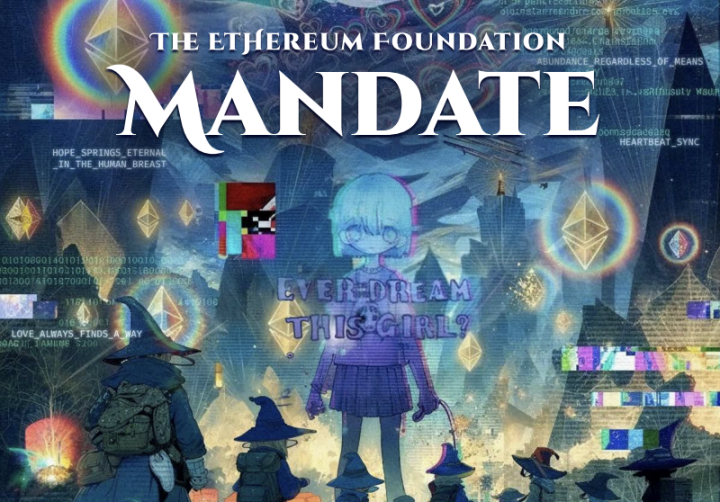
On the evening of March 13, the Ethereum Foundation (EF) Board of Directors released a Mission Statement titled “EF Mandate.”
When you open this mission statement, you might wonder if you’ve entered the wrong scene—full of stars, elves, wizards, and layouts resembling anime posters. Beneath this dazzling exterior lies the current “philosophy blueprint” of the Ethereum ecosystem.
TL;DR
- EF’s Core Position: Guardians, Not Rulers. The ultimate goal is to pass the “Walkaway Test”—even if the Ethereum Foundation disbands tomorrow, the Ethereum network should continue to operate flawlessly.
- CROPS Principles Are the Bottom Line: Any technical development must meet Censorship Resistance, Open Source, Privacy, and Security. All four attributes are indispensable; no development priority can override these.
- EF’s Philosophy of Doing Less: The foundation simplifies to make Ethereum more resilient. When the ecosystem matures enough, EF will gradually delegate authority.
- What Not to Do: Avoid “kingmaking,” rating agencies, marketing hype, and do not treat Ethereum as a “big casino.”
- Ultimate Vision: Look 1,000 years into the future—provide a “digital sanctuary” free from oppression by power, capital, AI, or even family.
What Problems Is Ethereum Trying to Solve?
EF believes that in the digital age, two infrastructural needs are fundamental: control over one’s data, identity, and assets (Self-Sovereignty), and collaboration with others without being “cut off” (Sovereign-Resilient Coordination).
Focusing solely on the first is enough for local applications; only the second is addressed by traditional internet. Ethereum’s unique value lies in simultaneously achieving both.
The declaration states: Ethereum exists so that no one can “rug” you—whether it’s the government, corporations, institutions, or AI.
Centered around this goal, EF introduces an acronym: CROPS. This term appears 32 times in the declaration.
- Censorship Resistance: No one can prevent you from doing legal activities; cryptography maintains neutrality despite external pressure.
- Open Source & Free: All code and rules are transparent, with no hidden black boxes.
- Privacy: Your data belongs to you, not the platform. You decide what to share and with whom.
- Security: Protect the system and users from technical failures and coercion.
These four attributes are defined as an “inseparable whole” in the document—top priority, non-negotiable bottom line.
EF’s stance is clear: it prefers to proceed slowly but correctly from day one. Once abandoned, it’s nearly impossible to regain these qualities.
What Does the Foundation Do? What Does It Not Do?
EF aims to make itself “redundant” as the ultimate success criterion.
The term “walkaway test” refers to: if EF disappears tomorrow, can Ethereum continue to run and evolve independently? The goal is for the answer to be “yes.”
Therefore, EF practices a “minimalist development” philosophy: focus on critical areas no one else can or wants to do—core protocol upgrades, long-term research, public safety. When a community can take over a domain, EF hands it over, further reducing its influence.
At the same time, EF has a long “non-doing” list—like a formal disclaimer: not a company, not a kingmaker, not an accreditation body, not a product studio, not a marketing firm, not an owner, not a government agency, not a casino, not opportunists.
How Will EF Decide When There Is No Clear Standard?
Having discussed many principles—CROPS, sovereignty, minimalist philosophy—what about concrete issues? This chapter provides answers.
It’s like EF’s “decision algorithm”: when two options are in front of you, how to choose without betraying your core values?
- When choosing technical solutions, pick the one “that won’t be a bottleneck in the future,” even if slower now. For example, in transaction propagation: one solution performs better but relies on private relay networks (whitelist-based), another decentralizes but progresses slowly. EF might prefer the latter because the former, once implemented, makes future decentralization unlikely.
- When designing or evaluating proposals, consider their impact on other layers. Some solutions look good in isolation and align with CROPS, but in the broader ecosystem, they may create new problems. Solving one issue might generate ten others.
- User safety is important, but don’t make decisions for users. Provide tools for users to defend themselves autonomously. Never impose “parental” restrictions under the guise of “protecting users.” For example, some wallets default to “security mode,” secretly block certain contracts, direct users to specific platforms, or use opaque AI to flag “risky” operations and collect user data—these are opposed by EF. True protection involves verifiable filtering tools, transparent black-and-white lists, and privacy-preserving features, including AI components.
- If intermediaries are unavoidable, lower barriers and leave an exit route: Minimize entry hurdles, promote market competition, and ensure users have “non-intermediated” alternatives that are practical and implementable.
- When supporting teams, focus on technical choices, not social hype. Many projects claim CROPS but embed closed-source core parts, whitelist restrictions, or guide users along fixed paths—be vigilant.
Ideals Are Abundant, Reality Is Stark
This declaration is compelling, but the harsh realities never cease.
Does this document represent a consensus or just the ideals of a few authors? If EF changes personnel, does it still hold? Who oversees implementation?
More pragmatically:
- EF’s operational funds largely depend on ETH holdings. When ETH prices fall, budgets shrink. “Not caring about price” is a mental discipline, not a financial reality.
- CROPS rules are ideal, but the world doesn’t always follow them.
- Most users care about speed, cost, and usability.
- EF insists on “full CROPS from day one,” but does this hinder Ethereum’s user experience and commercial competitiveness compared to more “pragmatic” rivals?
- How to evaluate EF’s “doing” and “not doing”? How to hold it accountable? How to judge the quality of “coordination”?
Community Sparks Debate: Punk Ideals vs. Disconnection from Reality
Less than 24 hours after the declaration was released, community feedback has polarized:
Critics:
- Eigen Labs researcher Kydo bluntly states EF’s current direction has done a 180° turn, overturning the previous pragmatic stance supporting stablecoins, institutional entry, and RWA, marginalizing the most marketable applications;
- Forward Ind. Chair complains: “They build whatever they want, not what you want”—accusing EF of building based on idealism, ignoring community and market needs;
- Pavel Paramonov of Hazeflow calls it “another pile of ideological nonsense,” lacking clarity on Ethereum’s concrete future direction.
Supporters:
- Namefi founder Zainan Victor Zhou believes this is a constraint on EF’s organization, not a restriction on the entire ecosystem;
- Columbia Business School professor Omid Malekan points out that CROPS is precisely the core of Ethereum’s leadership in finance—it offers true “access + verifiability + property rights.”
Faced with controversy, Vitalik personally clarified: this declaration “is not surprising to many,” and reflects the direction EF has been contemplating over the past few months. EF will focus solely on being Ethereum’s guardian, leaving other aspects to the broader ecosystem—marking a new chapter.
The declaration ends with an Italian quote: “E quindi uscimmo a riveder le stelle”—from Dante’s “Inferno,” meaning “And so we emerged to see the stars again.”
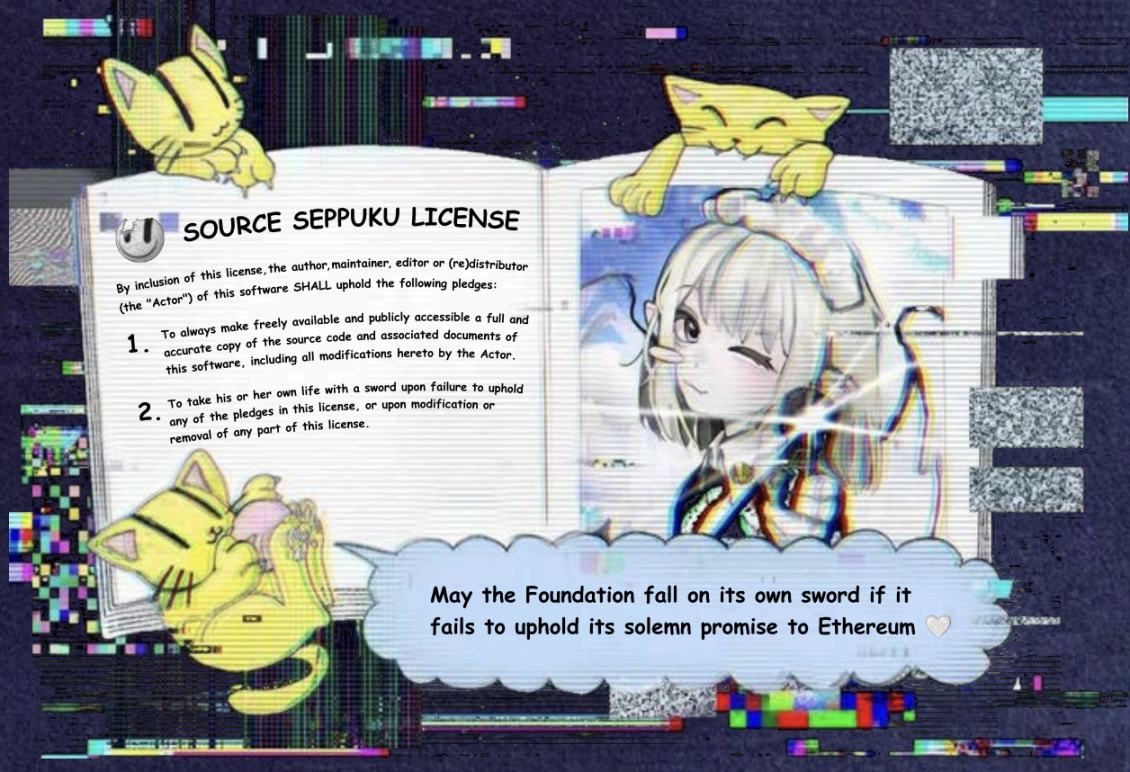
EF also created a meme titled “SOURCE SEPPUKU LICENSE,” with the caption: “If the foundation fails to honor its solemn promise to Ethereum, let it face the consequences and end itself.”
EF compares itself to a traveler through hell, willing to endure hardships and doubts in pursuit of “digital freedom.” Of course, time will tell if this journey succeeds.

Disclaimer: The information on this page may come from third parties and does not represent the views or opinions of Gate. The content displayed on this page is for reference only and does not constitute any financial, investment, or legal advice. Gate does not guarantee the accuracy or completeness of the information and shall not be liable for any losses arising from the use of this information. Virtual asset investments carry high risks and are subject to significant price volatility. You may lose all of your invested principal. Please fully understand the relevant risks and make prudent decisions based on your own financial situation and risk tolerance. For details, please refer to
Disclaimer.


