Strategy Inc.’s bitcoin-backed preferred equity STRC crossed a notable milestone this week after Chairman Michael Saylor announced the instrument had delivered one of the strongest risk-adjusted performance metrics in the market.
Saylor Promotes STRC as Digital Credit With Sharpe Ratio Over 3
Strategy Inc. issued the preferred security STRC—short for Strategy Inc. Variable Rate Series A Perpetual Stretch Preferred Stock—on the Nasdaq in July as part of its expanding lineup of bitcoin-linked credit instruments.
On March 11, 2026, Saylor wrote on the social media platform X: “STRC just achieved a Sharpe Ratio greater than 3. Digital Credit is engineered for superior risk-adjusted returns.” His post included a chart showing STRC’s Sharpe Ratio at 3.08, placing it above well-known assets including Alphabet Inc. Class C, Nvidia Corporation, Tesla Inc., and the widely tracked SPDR S&P 500 ETF Trust.
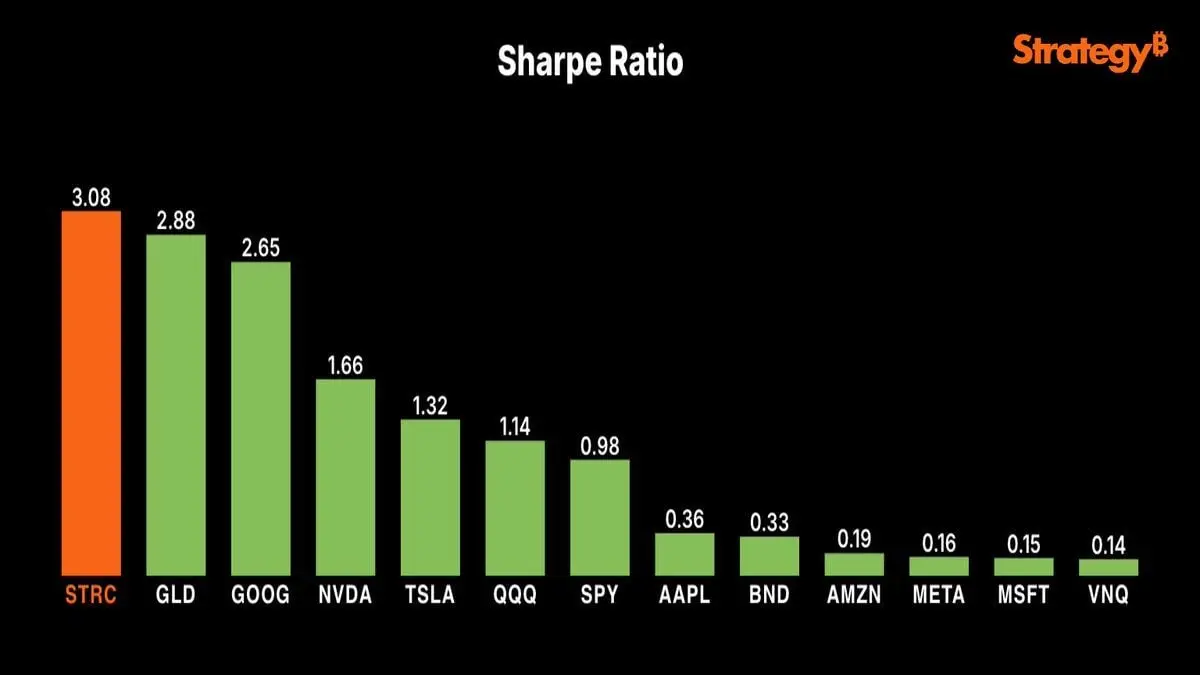 Image source: Chart shared by Saylor on X on Wednesday afternoon.
The metric may sound technical, but the Sharpe Ratio is one of the most widely used tools for measuring investment performance relative to risk. In simple terms, it evaluates how much return an investment generates compared with the volatility investors must endure to achieve it.
Image source: Chart shared by Saylor on X on Wednesday afternoon.
The metric may sound technical, but the Sharpe Ratio is one of the most widely used tools for measuring investment performance relative to risk. In simple terms, it evaluates how much return an investment generates compared with the volatility investors must endure to achieve it.
The calculation subtracts the risk-free rate—typically the yield on short-term U.S. Treasury securities—from an asset’s return, then divides that result by the asset’s standard deviation of returns. The higher the figure, the more efficiently an investment delivers gains relative to risk.
In practical terms, analysts often consider a Sharpe Ratio above 1 respectable, above 2 very strong, and anything above 3 exceptional. STRC’s reported level is near 3.08, therefore, placing it in rare territory among traded securities, especially those producing double-digit yields.
Understanding how STRC achieved that score requires a look at Strategy’s unusual corporate playbook. The company holds the largest corporate treasury of bitcoin—about 738,731 BTC as of early March—using the digital asset as the backbone for a family of preferred equity securities the firm calls Digital Credit.
STRC sits at the top of that lineup. The perpetual preferred carries a $100 par value and trades close to that mark—roughly $100.10 as of March 11—while delivering an effective yield around 11.5%, paid monthly through a variable dividend designed to keep the share price hovering near par.
 Strategy Inc. Variable Rate Series A Perpetual Stretch Preferred Stock (STRC) on March 11, 2026. Image source via tradingview.com.
Strategy describes the structure as a kind of financial refinery. The company keeps bitcoin on its balance sheet and issues preferred securities that convert the asset’s long-term appreciation into relatively stable income streams. The approach aims to separate—or “strip”—the dramatic price swings commonly associated with bitcoin from the yield investors receive.
Strategy Inc. Variable Rate Series A Perpetual Stretch Preferred Stock (STRC) on March 11, 2026. Image source via tradingview.com.
Strategy describes the structure as a kind of financial refinery. The company keeps bitcoin on its balance sheet and issues preferred securities that convert the asset’s long-term appreciation into relatively stable income streams. The approach aims to separate—or “strip”—the dramatic price swings commonly associated with bitcoin from the yield investors receive.
In that structure, STRC investors receive income tied indirectly to bitcoin’s performance without riding every market swing, while holders of Strategy’s common shares absorb more of the volatility and upside potential. The preferred stock also sits higher in the capital stack than common equity, giving it priority in liquidation scenarios.
Other preferred series in the Digital Credit lineup target different investor appetites. STRD offers higher yields but with greater volatility, while STRF provides fixed cumulative dividends, and STRK incorporates convertible features tied to equity performance. Among them, STRC has consistently recorded the lowest volatility—roughly 2.5% to 3.4% over recent periods—helping drive its leading Sharpe Ratio.
Recent returns illustrate the dynamic. STRC has posted roughly 3.2% year-to-date gains, about 1.4% over the past month and 8.2% over six months, while maintaining a trading band that rarely strays far from its $100 anchor price. Its beta relative to the S&P 500 sits near 0.34, indicating relatively low correlation with the broader equity market.
The structure also carries tax nuances. Dividends from STRC often qualify as return of capital, allowing investors to defer taxes until shares are sold. However, the classification depends on Internal Revenue Service (IRS) rules and individual tax circumstances.
Despite its stability relative to other crypto-linked assets, risks remain. STRC is a perpetual preferred security with no maturity date and relies on Strategy’s balance sheet—dominated by bitcoin—as collateral support. Dividends adjust monthly and could theoretically change under severe financial stress, and preferred securities can become less liquid than common stocks during market turbulence.
Still, the strong Sharpe Ratio highlighted by Saylor reflects the strategy’s central pitch: transform bitcoin’s long-term growth potential into a steady income instrument with comparatively muted volatility.
If the concept continues to deliver metrics like a Sharpe Ratio above 3, Strategy’s Digital Credit model could become one of the more unconventional financial engineering experiments to gain traction in both traditional markets and the digital asset sector.
FAQ 🔎
- **What is the Sharpe Ratio in investing?**The Sharpe Ratio measures how much return an investment produces relative to the volatility or risk taken to achieve those gains.
- **What is STRC preferred stock?**STRC is a bitcoin-backed perpetual preferred equity issued by Strategy Inc. that pays a variable monthly dividend designed to keep shares trading near $100.
- **Why is a Sharpe Ratio above 3 significant?**In finance, a Sharpe Ratio above 3 is considered exceptional because it indicates unusually strong returns relative to risk.
- **How does STRC generate yield from bitcoin?**Strategy holds bitcoin on its balance sheet and issues preferred securities like STRC that convert the asset’s long-term appreciation into income-style dividends for investors.
Disclaimer: The information on this page may come from third parties and does not represent the views or opinions of Gate. The content displayed on this page is for reference only and does not constitute any financial, investment, or legal advice. Gate does not guarantee the accuracy or completeness of the information and shall not be liable for any losses arising from the use of this information. Virtual asset investments carry high risks and are subject to significant price volatility. You may lose all of your invested principal. Please fully understand the relevant risks and make prudent decisions based on your own financial situation and risk tolerance. For details, please refer to
Disclaimer.


