Author: Coinfound
By March 2026, the global digital financial market stands at a critical crossroads of regulatory restructuring and industry revaluation. Hong Kong is about to issue its first licenses for fiat-backed stablecoin issuers. This is not just a routine licensing approval but a landmark event signaling that Hong Kong’s digital financial infrastructure is entering a real-world operational phase.
On the surface, this is regulatory implementation; but on a deeper level, it signifies Hong Kong’s attempt to answer a more strategically important question: In the context of accelerating US-China digital financial competition and tightening global compliance frameworks, how can Hong Kong build a trustworthy system through its stablecoin regime that supports cross-border payments, enterprise-level treasury management, and RWA tokenized settlements?
CoinFound believes that understanding the significance of the “night before licensing” is not just about who will receive the first licenses, but about what kind of stablecoin market Hong Kong aims to reshape with this system.
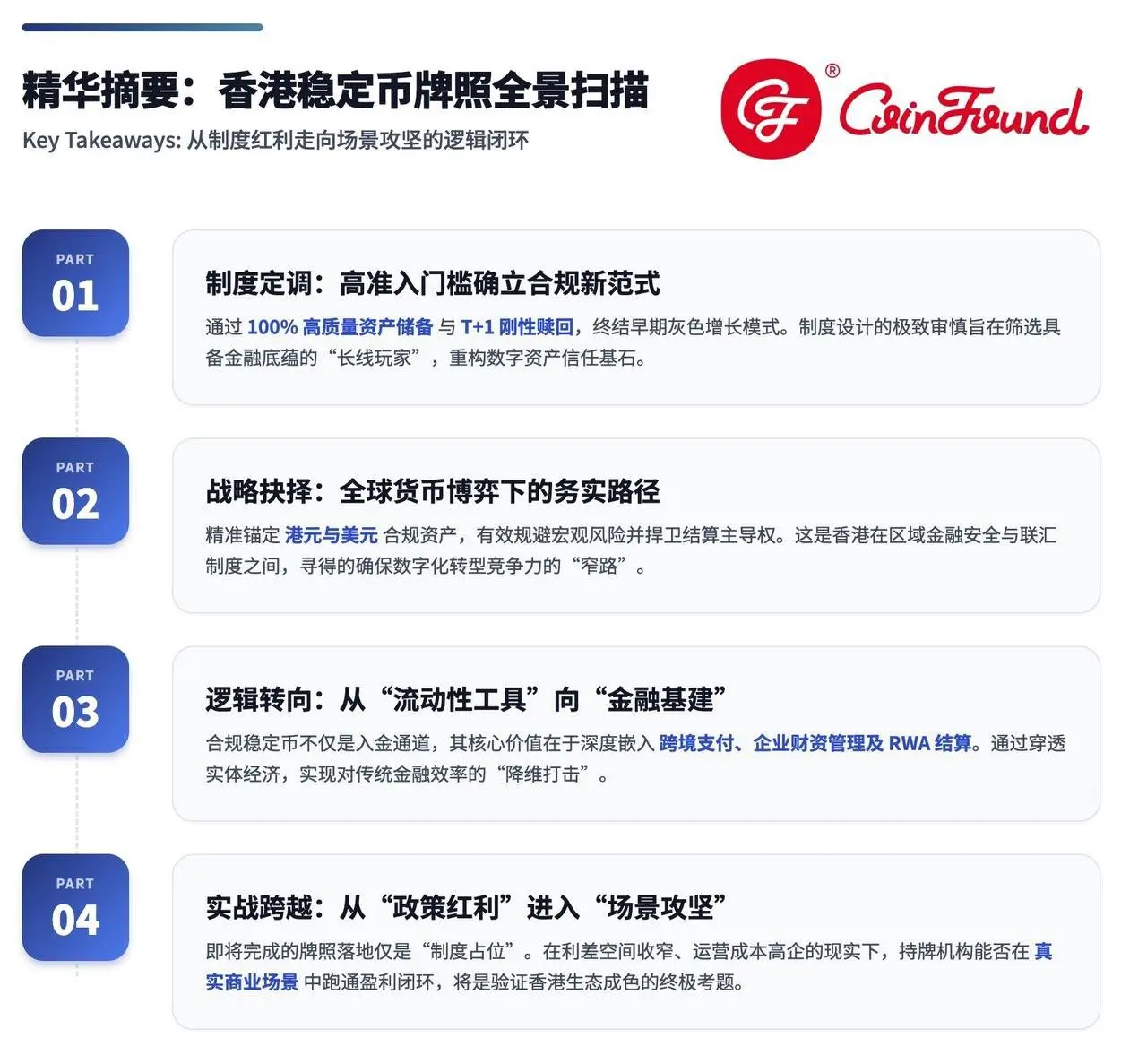
01 Policy Setting: High Entry Barriers Not to Limit Innovation, but to Filter True Long-Term Players
The licenses Hong Kong is about to issue are not a simple green light for the stablecoin industry. On the contrary, they represent a systemic end to early gray-area growth models.
From the current regulatory guidance, the number of licensed institutions will be very limited, with review focus heavily on core indicators: real-world application scenarios, reserve asset quality, anti-money laundering capabilities, cross-border compliance, and overall operational robustness. This indicates that Hong Kong does not intend to flood the market with licenses to generate hype but aims to use very high compliance standards to select a few participants with genuine financial expertise, risk management capabilities, and long-term execution ability.
This regulatory approach essentially redefines the industry concept of stablecoins. They are no longer viewed merely as a trading medium attached to crypto markets but are repositioned within the framework of financial infrastructure. The logic is clear: if a digital currency tool is to serve as a means of payment, clearing, settlement, asset delivery, and corporate treasury, then regulatory standards cannot remain at the “internet product” level but must reach “bank-grade financial instrument” standards.
Therefore, 100% high-quality liquid reserve assets, T+1 rigid redemption, transparent AML, strict capital requirements, and substantive local management are not just compliance requirements but also part of the systemic screening mechanism. At this stage, Hong Kong wants fewer but more stable participants, not more projects.
02 Strategic Orientation: Why Hong Kong Chooses HKD/USD Instead of a More Aggressive Currency Narrative
If one only interprets Hong Kong’s stablecoin strategy as “embracing Web3,” it underestimates the strategic depth of this policy wave.
From a global perspective, the US has strengthened the institutional advantage of dollar-pegged stablecoins through relevant legislation, further consolidating the US dollar’s dominance in digital settlement. Meanwhile, Mainland China maintains a highly cautious and strictly bounded stance on unapproved offshore RMB stablecoins. Against this macro backdrop, Hong Kong has not chosen an aggressive exploratory path but a more pragmatic one: focusing on compliant stablecoins anchored to the HKD and USD.
This is not a contraction but a more mature institutional focus.
Hong Kong’s constraints are clear. On one hand, it must maintain its role as an international financial hub and stabilize its linked exchange rate system; on the other hand, it must preserve digital settlement dominance and pricing power in regional financial security and global digital asset competition. Therefore, the true goal of its stablecoin strategy is not to create a new currency concept but to provide a robust, sustainable, and regulated digital value tool for cross-border trade, corporate fund transfers, and RWA settlement amid complex geopolitical and economic environments.
In other words, Hong Kong’s approach is not “radical innovation” but “pragmatic avoidance of virtuality.” It is not betting on concepts but securing the most immediate, practical capabilities in digital financial restructuring.
03 From Payment Tool to Financial Infrastructure: Where Is the True Power of Stablecoins?
Markets often underestimate the value of stablecoins, viewing them as mere on-ramp channels for virtual asset exchanges or on-chain settlement tokens. But under a compliant framework, the imagination space for stablecoins extends far beyond.
CoinFound believes that the future strategic value of compliant stablecoins in Hong Kong will mainly manifest in the following three layers.
First Layer: Reshaping Cross-Border Payments and Clearing Efficiency
Traditional cross-border payments rely on SWIFT and layered correspondent banking systems, which suffer from long chains, high costs, slow transfers, and limited operating hours. Compliant stablecoins can naturally bypass intermediaries, enabling peer-to-peer on-chain transfers and smart contract settlements for lower costs and faster value transfer.
For a financial hub like Hong Kong, with dense international trade and cross-border capital flows, this efficiency upgrade is not marginal but a fundamental infrastructure-level transformation. If stablecoins can be widely used in real trade and cross-border e-commerce scenarios, their significance will far surpass internal crypto asset flows.
Second Layer: Enterprise-Level Programmable Treasury Management
The value of stablecoins is not just in “fast transfers” but also in “programmability.”
In enterprise treasury scenarios, real-time fund transfers across time zones, currencies, and institutions are costly and friction-prone. The advent of programmable money allows funds to be embedded with complex business logic—such as cash-on-delivery, split payments, conditional settlements, automated reconciliation, and supply chain finance—via stablecoins and smart contracts.
This means stablecoins are not just payment tools but could evolve into core components of enterprise financial operations, becoming essential in future digital treasury management systems.
Third Layer: Key Bridge for RWA Tokenization Markets
If asset tokenization is about bringing “goods” onto the chain, stablecoins solve the problem of bringing “money” onto the chain.
The core challenge of RWA (Real-World Asset) tokenization is not just digitizing assets but establishing a complete, compliant, stable, and smart contract-compatible value medium to enable atomic delivery and settlement. Without such a medium, tokenized assets remain superficial and cannot form a truly functional market.
In this sense, stablecoins are the bridge connecting fiat systems, institutional finance, and on-chain asset pools. Without stablecoins, RWA is just a track; with stablecoins, RWA can run a real trading train.
04 After Regulatory Reshaping, the Real Test Begins: Licensing Is Not Equal to Winning
For Hong Kong’s stablecoin ecosystem, licensing is merely the starting line in a systemic sense, not the end of commercial success.
The next challenge is the ultimate test.
First, profitability. Traditional offshore stablecoin models often rely on reserve yields in high-interest environments, but under strict compliance and asset segregation frameworks, this space is shrinking significantly. Meanwhile, licensed institutions must bear ongoing high costs for AML, cybersecurity, audits, risk management, and operational teams. Balancing absolute prudence with business efficiency will be a key question for the first licensees.
Second, network effects. Stablecoins are not a race that can be won solely through regulation; they face real-world competitors:
- Competing with mature electronic payment networks in local retail payments;
- Competing with mainstream USD stablecoins for liquidity in global digital asset markets;
- Competing or collaborating with bank-tokenized deposits and existing clearing systems in institutional settlement and RWA markets.
This means Hong Kong’s compliant stablecoin cannot rely solely on “licensing” for market success. It must win user migration through real scenario value: lower costs, faster settlement, better programmability, and stronger compliance certainty.
Finally, the ecosystem’s cold start problem. High barriers attract high-quality participants but also slow ecosystem expansion. Without massive subsidies, high-interest incentives, or aggressive marketing, whether Hong Kong’s stablecoin ecosystem can generate genuine demand from trade, cross-border payments, enterprise treasury, and RWA settlement will be a more critical long-term variable than licensing.
05 Conclusion: The True Proposition of Hong Kong Stablecoins Is Not “Who Gets Licensed First,” but “Who Can Build Stablecoins Into Infrastructure”
Hong Kong in March 2026 is at a very delicate juncture.
On one side, the global rules for digital currencies are accelerating their reconstruction; on the other, the local stablecoin regime is about to transition from sandbox to real-world deployment. At this point, issuing the first licenses is important, but more crucial is the clear signal it sends to the market: Hong Kong has decided to no longer see stablecoins as peripheral tools of the crypto market but as an integral part of the financial infrastructure of the digital age.
This means Hong Kong is attempting to establish a new trust standard:
Not by high yields for growth, nor by regulatory arbitrage for scale, but through rule of law, financial compliance, and real commercial scenarios to redefine the boundaries and value of “stablecoins” in the digital asset era.
From cross-border payments, to enterprise treasury, to RWA settlement, the ultimate success of Hong Kong’s stablecoin ecosystem depends on two questions:
First, can the system continuously provide certainty?
Second, can the market generate genuine demand and profit cycles on top of that certainty?
The night before licensing marks the end of an old phase.
What truly matters is not who gets approved, but who can, amid high thresholds, high costs, and fierce competition, develop stablecoins into a truly sustainable, liquid, settlement-ready, and embedded infrastructure network that connects to the real economy.
This is the real beginning of Hong Kong’s stablecoin story.


