After the Iranian Revolutionary Guard announced the blockade of the Strait of Hormuz, oil prices surged, insurance companies withdrew, and 150 ships were stranded outside the channel. Is there no alternative option?
(Background: Crude oil prices broke through $90! A weekly surge of 35%, Middle Eastern energy supply chain disruption, UAE and Kuwait announced production cuts)
(Additional context: Is Iran’s blockade of the Strait of Hormuz just a show? Experts: Tehran will bleed first, market impact and economic chain reaction analysis)
Table of Contents
Toggle
- Three pipelines, theoretically able to save 30%
- Yanbu Port is not designed for this scenario
- Taiwan’s natural gas two-week countdown
- One-fifth of the world’s daily oil passes through here
The US and Israel launched a joint military strike against Iran. After Iran’s Supreme Leader Khamenei’s death, the Islamic Revolutionary Guard announced the closure of the Strait of Hormuz. Insurance companies canceled war risk coverage for ships passing through Hormuz within 48 hours. NPR reports that traffic through the strait plummeted 70% in a week, with over 150 ships stranded outside the Gulf of Oman.
This caused a rare supply shock: US WTI crude futures surged 35.6% this week, officially breaking through $90 per barrel; Brent crude futures are currently around $93 per barrel.
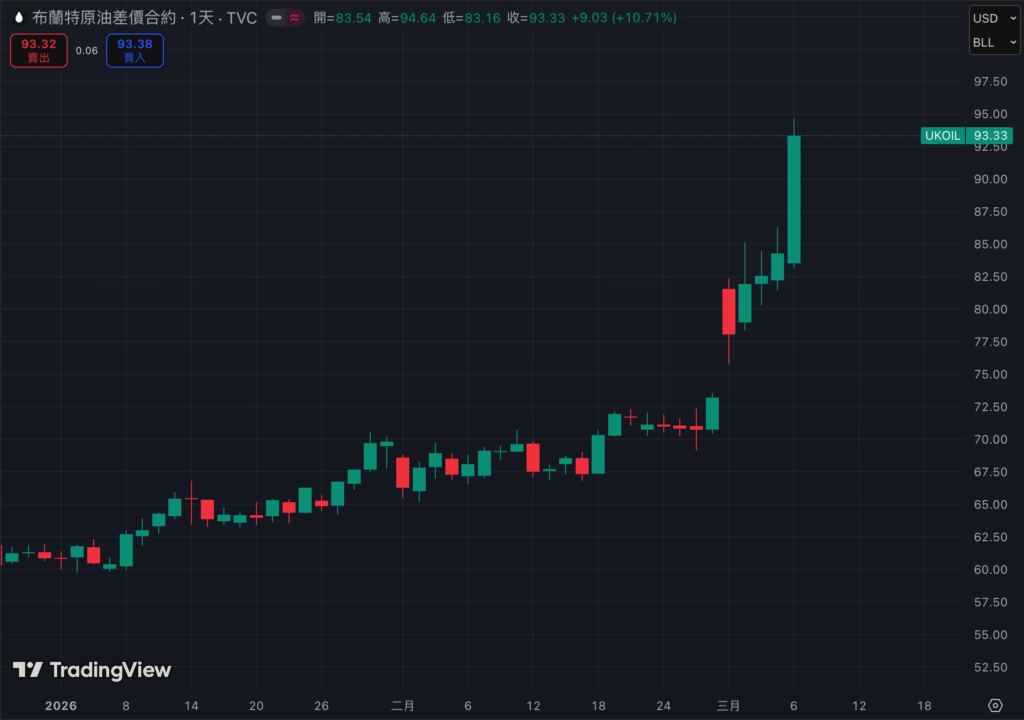
Three pipelines, theoretically able to save 30%
You might wonder, if the sea route is cut off, are there no other alternatives? The good news is, infrastructure to bypass the Strait of Hormuz does exist.
Saudi Arabia’s East-West Pipeline extends from the Abqaiq processing center on the Persian Gulf coast to Yanbu port on the Red Sea coast, with a total length of 1,200 km. Designed capacity is 5 million barrels per day, Saudi Aramco claims it has expanded to 7 million barrels.
Currently, actual usage is about 2 million barrels per day, leaving a theoretical spare capacity of 3 to 5 million barrels. On March 6, Saudi Arabia announced it would redirect several million barrels of crude for export via the Red Sea.
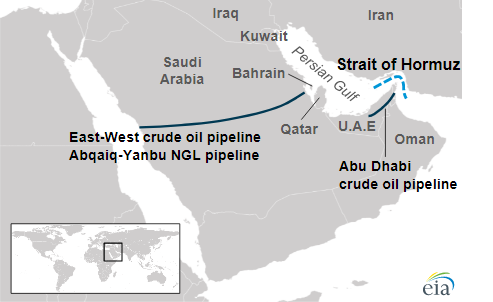
(Left) East-West Pipeline (Right) Abu Dhabi Crude Oil Pipeline
UAE’s ADCOP pipeline connects inland Habshan oil field to Fujairah port on the Oman Gulf, 400 km long, with a capacity of 1.8 million barrels per day. Current exports are about 1.1 million barrels, with spare capacity around 700,000 barrels.
Iran’s Goreh-Jask pipeline connects to the Jask port on the Oman Gulf, but effective capacity is only about 300,000 barrels per day. Under current circumstances, Iran’s own exports are also constrained by sanctions and military pressure.
Adding up the three pipelines, the theoretical spare capacity is about 3.7 to 5.7 million barrels. That sounds substantial, but the daily traffic through the Strait of Hormuz is 20 million barrels. These alternatives can only cover roughly 25% to 35%.
Yanbu Port is not designed for this scenario
Numbers on capacity are one thing; logistical reality is another.
Yanbu has never been Saudi Arabia’s main export port. Its docks, tank storage, and oil tanker scheduling are built for “backup” specifications. When suddenly needing to shift hundreds of millions of barrels daily from the east coast to the west coast, the bottleneck isn’t the pipelines but how many ships can be loaded and how quickly.
The National reports that under high-pressure operation, Yanbu’s loading efficiency might only reach 60% of pipeline capacity.
Worse, the Red Sea itself is not very stable. Although recent threats from Houthi forces have eased, they have not disappeared entirely. Rerouting around the Hormuz Strait, which is threatened by drones, to another area with missile risks, insurance companies probably won’t find this business very attractive.
Taiwan’s natural gas two-week countdown
For Taiwan, if the Hormuz Strait remains blocked, the ongoing duration is a serious issue affecting whether power plants can keep running.
About 60% of Taiwan’s oil and one-third of its natural gas are transported through the Strait of Hormuz. Qatar is one of the main LNG suppliers. Oil reserves can support about 100 days, but legally mandated natural gas stocks are only about 11 days (gas-fired power accounts for 53.3% of Taiwan Power’s generation).
The Ministry of Economic Affairs started daily contingency meetings in early March. CPC is adjusting stockpiles through a three-stage plan: pre-emptive procurement, seeking non-Middle Eastern gas sources, negotiating mutual aid mechanisms with Asian buyers, and supplementing from spot markets.
But an 11-day buffer means that if the blockade lasts more than two weeks, Taiwan’s “increase gas, reduce coal” policy will face a structural test.
One-fifth of the world’s daily oil passes through here
The narrowest part of the Strait of Hormuz is only 33 km wide, with an effective navigable width of just 6 km. Yet, one-fifth of global oil trade passes through this bottleneck daily. The three alternative pipelines mentioned above can only save about 30%, but not the remaining 70% (estimated theoretically).
Currently, oil can bypass the Strait of Hormuz, but the volume is far from enough for the world to operate normally. That’s why global energy market prices have surged sharply within just a week.

Disclaimer: The information on this page may come from third parties and does not represent the views or opinions of Gate. The content displayed on this page is for reference only and does not constitute any financial, investment, or legal advice. Gate does not guarantee the accuracy or completeness of the information and shall not be liable for any losses arising from the use of this information. Virtual asset investments carry high risks and are subject to significant price volatility. You may lose all of your invested principal. Please fully understand the relevant risks and make prudent decisions based on your own financial situation and risk tolerance. For details, please refer to
Disclaimer.


