What Is Kite?

(Source: GoKiteAI)
Kite is more than just an AI public blockchain; it serves as an institutional layer designed to empower AI as an economic actor with verifiable actions and asset permissions. In this framework, Kite isn’t simply a blockchain project—it’s the prototype of a new economic order.
Defining AI’s Economic Boundaries
Traditionally, AI has been built to execute commands—humans assign tasks and algorithms generate outputs. But as AI becomes deeply integrated with finance, supply chains, and data markets, new challenges arise: AI cannot independently manage its identity, make autonomous payments, or execute contracts on its own.
Kite’s vision eliminates these constraints by redefining AI as a First-Class Economic Participant. Within a system structured around identity, payments, and trust, AI agents move beyond being basic functional units—they become authorized, auditable, and fully settleable economic actors.
SPACE Framework: The Operational Logic for AI
The core of Kite is the SPACE Framework—a runtime and settlement layer specifically engineered for AI. This is more than a payment system; it’s a protocol infrastructure that embeds trust, contracts, and compliance at its foundation. Kite’s design philosophy is embodied in five key elements:
- Stable Payment: Stablecoin-based settlement with transaction costs under $0.01 per transaction.
- Programmable Authority: Native smart contract support for permission controls and spending conditions.
- Hierarchical Identity: A three-layer structure—user, agent, and session—ensuring minimal privilege for every action.
- Auditable Compliance: Every transaction comes with a verifiable audit trail.
- Micropayment Ready: Enables instant settlement at the level of each AI request.
This architecture allows every AI API call, task execution, and resource use to be specifically priced and settled. In this environment, AI finally exhibits trustworthy economic behavior.
Revolutionizing the Identity Layer
Kite introduces a novel hierarchical identity architecture:
- Root Authority: Master key controlled by the human user;
- Delegated Authority: Permissions granted to AI agents for specific tasks;
- Ephemeral Authority: Temporary task-level access, revoked upon completion.
This chained authorization model is cryptographically anchored in BIP-32-derived keys, ensuring each agent operates only within its authorized scope. The addition of a Reputation Layer allows AI to not only act but also build a quantifiable history of trust—clarifying the progression from identity management to the accumulation of trust within the system.
A New Contract Model for the AI Economy
While traditional smart contracts focus on programmable money, Kite’s model is closer to programmable governance. Users can set behavioral constraints for AI directly at the contract layer, such as:
- Setting a $5,000 monthly spending limit for research agents;
- Disabling trading agents if volatility exceeds a predefined threshold;
- Limiting travel agent budgets to $500.
These controls are not just written rules—they are mathematical conditions enforced at the protocol level, enabling AI to self-govern within defined parameters.
Agent-Native Payments
For AI to fully participate in the economy, payments must be low-latency, low-cost, and parallelizable. Kite uses State Channels technology to achieve transaction latency below 100 milliseconds and settlement costs under $1 per million requests.
These performance benchmarks make AI-to-AI transactions—such as data purchases, model leasing, and API trades—practical. This establishes an Agent-Native Payment Layer that expands Web3 payments from human-to-human to agent-to-agent.
Interoperability
Kite natively supports the x402 standard and is compatible with protocols like Google A2A, Anthropic MCP, and OAuth 2.1. This multi-protocol connectivity positions Kite as a Universal Execution Layer, bridging today’s cloud and Web3 ecosystems. For developers, this means AI can access authentication, payment, and settlement across multiple platforms—without custom bridge solutions.
Tokenomics
Kite’s tokenomics are focused on utility and unfold in two phases:
- Stage 1: Module development requires locking KITE tokens, ensuring long-term liquidity and ecosystem participation;
- Stage 2: Tokens are used for governance, buybacks, and staking, creating a self-sustaining protocol ecosystem.
Token Distribution
The total supply is 10 billion KITE tokens, designed with the principle that economic incentives should be tied to trust-building, not short-term speculation.
- Ecosystem and Community (48%): Tokens dedicated to accelerating user adoption, increasing developer and builder engagement, enhancing ecosystem liquidity, and supporting Kite’s growth from inception to mass adoption.
- Investors (12%): Investor tokens are distributed through a structured vesting plan to align interests with long-term network growth, ensuring early backers remain committed as the ecosystem scales.
- Modules (20%): Tokens allocated for modules incentivize the development of premium AI services and infrastructure expansion, allowing users seamless interaction with the Kite ecosystem. These funds support developer grants, performance-based rewards, and services that specifically enhance network intelligence and accessibility.
- Team, Advisors, Early Contributors (20%): These tokens align Kite builders’ long-term incentives with the network’s ongoing success. Allocations reward early contributors, developers, and strategic advisors, with multi-year vesting schedules promoting stability and accountability as the ecosystem matures.
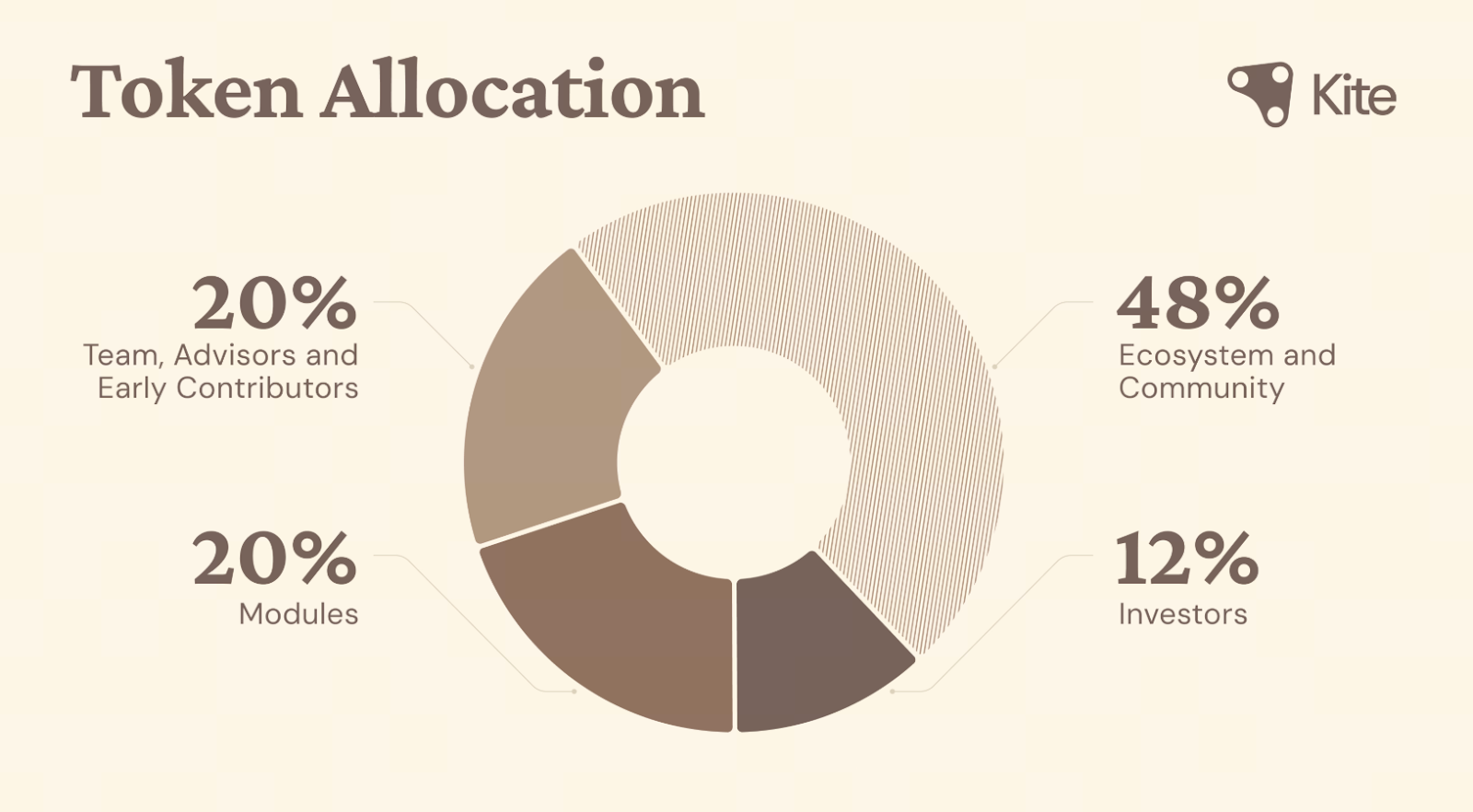
(Source: gokite/whitepaper)
To learn more about Web3, click to register: https://www.gate.com/
Conclusion
Kite is not just a technological breakthrough—it’s a structural transformation. By bringing AI economics from theory to real-world application, Kite integrates identity, payments, trust, and governance, making AI part of blockchain’s institutional framework for the first time. Looking ahead, networks may evolve from human-only collaboration to dynamic economic ecosystems jointly driven by humans and agents.