As artificial intelligence increasingly becomes a foundational layer of the digital economy, the way AI services are accessed is also evolving. Most mainstream AI platforms today operate under a centralized API payment model, where users must pay each time they call a model. At the same time, concerns around data privacy and content moderation have become major topics within the industry. Venice attempts to reshape the business model of AI services using blockchain technology, allowing AI computing power to be held and allocated in a manner similar to digital assets.
From the broader perspective of Web3 and AI integration, Venice represents an infrastructure approach focused on the "tokenization of AI computing resources". Through token staking, computing capacity allocation, and on-chain incentive mechanisms, AI inference power is no longer simply part of a cloud service. Instead, it becomes a resource that can circulate and be combined within blockchain ecosystems. This design creates a new technical foundation for AI Agents, developer tools, and decentralized applications.
What Is Venice Token (VVV)? Background and Positioning
 Image source: Venice official website
Venice’s primary goal is to build a more open and privacy friendly AI service network that does not rely entirely on centralized server control. The platform was initiated by experienced figures in the crypto industry who aim to provide a new architectural approach for AI services through blockchain technology.
Unlike traditional AI platforms that focus heavily on centralized data processing, Venice places stronger emphasis on user data control and privacy protection. Interactions between users and the AI system are not centrally stored or used for commercial analytics by the platform, which reduces the risk of data misuse or excessive data collection. This privacy first architecture gives Venice a differentiated position among many AI platforms.
Within this system, the VVV token plays a central economic role. The token is used not only for incentives and value circulation within the platform but also as a key credential for accessing AI inference resources. By holding or staking VVV, users gain the ability to call the Venice AI API and continuously use services such as text generation, image generation, and code generation.
By combining AI inference capabilities with a token based economic model, Venice attempts to transform computing resources into on-chain assets that can be allocated and traded. This mechanism offers a new technological path for integrating Web3 and AI, and positions Venice as one of the projects exploring decentralized AI infrastructure.
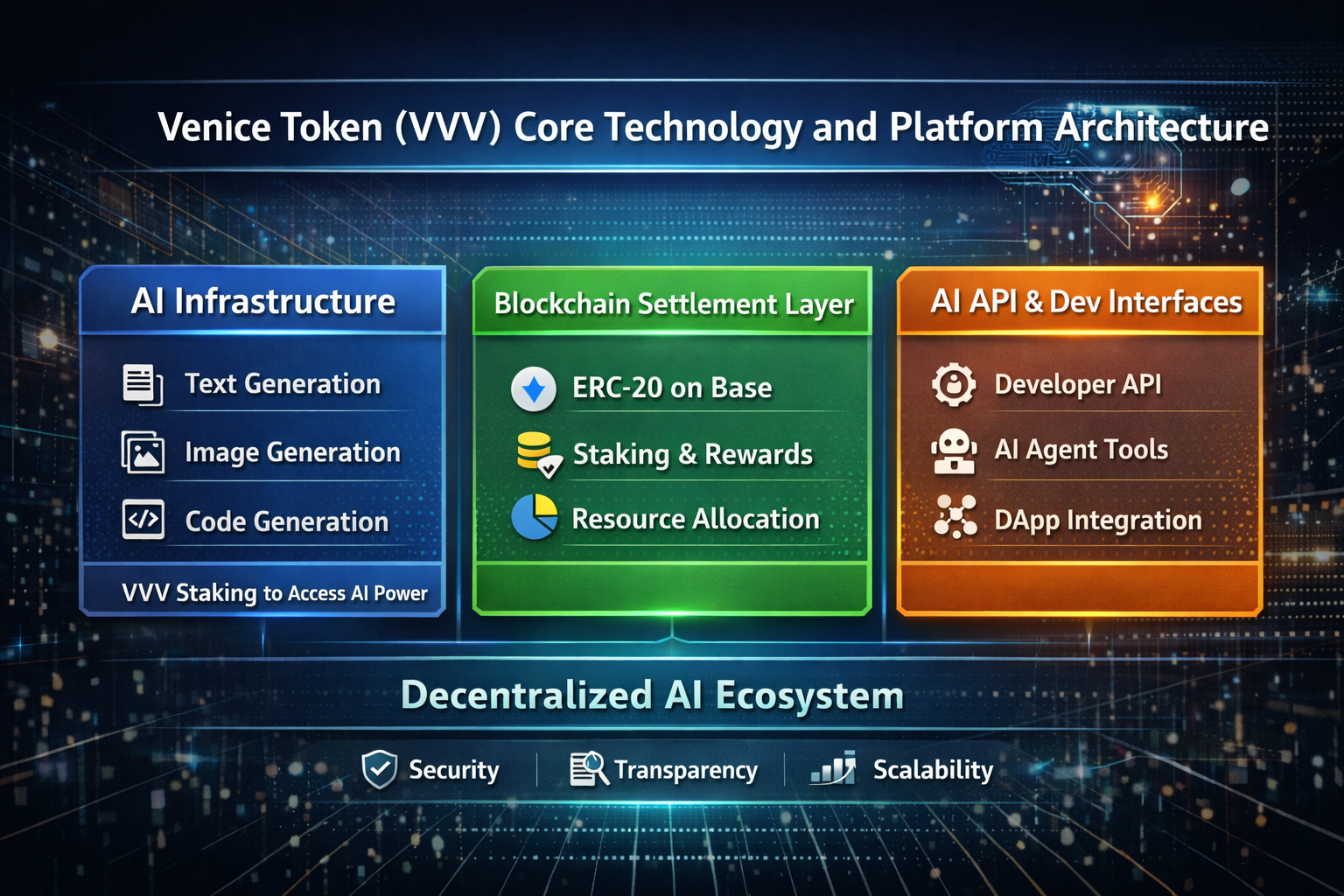
The technical architecture of Venice mainly consists of the following core components:
AI Inference Infrastructure
Venice provides multiple AI model services including text generation, image generation, and code generation. These models are made available to developers and applications through APIs.
Unlike traditional cloud services, Venice does not charge based on the number of model calls. Instead, AI inference capacity is allocated according to the amount of VVV a user stakes.
Blockchain Settlement Layer
VVV is an ERC-20 token deployed on the Base network, relying on Ethereum Layer2 infrastructure to support transactions, staking, and incentive mechanisms.
The blockchain layer records several key elements:
This structure enables transparent distribution of AI resources on-chain.
AI API and Developer Interfaces
Developers can integrate Venice AI models through the Venice API to build chatbots, content generation tools, or AI Agents.
When developers stake a certain amount of VVV, they receive a corresponding share of API calling capacity.
The Integration of Venice and Artificial Intelligence
One of Venice’s key innovations lies in redesigning the business model for AI services.
In traditional AI services, users typically follow a pay per call model, for example paying based on token usage or API request volume. While this approach is straightforward, costs can become high in high frequency usage scenarios.
Venice introduces a model similar to a computing capacity share:
For example, if a user’s staked VVV accounts for 1% of the total staked tokens, that user can continuously access roughly 1% of the AI API computing capacity.
This mechanism is similar to owning a portion of AI infrastructure rather than simply purchasing services.
The Venice Ecosystem and Core Applications
With the rapid growth of AI Agents and automated applications, the Venice ecosystem is gradually taking shape.
AI Agent Infrastructure
Venice APIs can be used by AI Agents to automatically perform complex tasks such as:
This positions Venice as an important infrastructure layer within the emerging AI Agent ecosystem.
Developers can build various AI applications on the Venice API, including:
Through the VVV staking mechanism, developers can gain long term access to AI computing capacity.
AI Computing Resource Market
Venice also introduces a mechanism called DIEM, an AI credit asset generated through VVV staking.
Each DIEM provides a fixed amount of AI API usage credit, creating a tradable form of AI computing resources.
This design turns AI computing power into a transferable digital asset.
VVV Tokenomics and Distribution Mechanism
The tokenomics design of VVV is relatively straightforward but built around clear incentive logic.
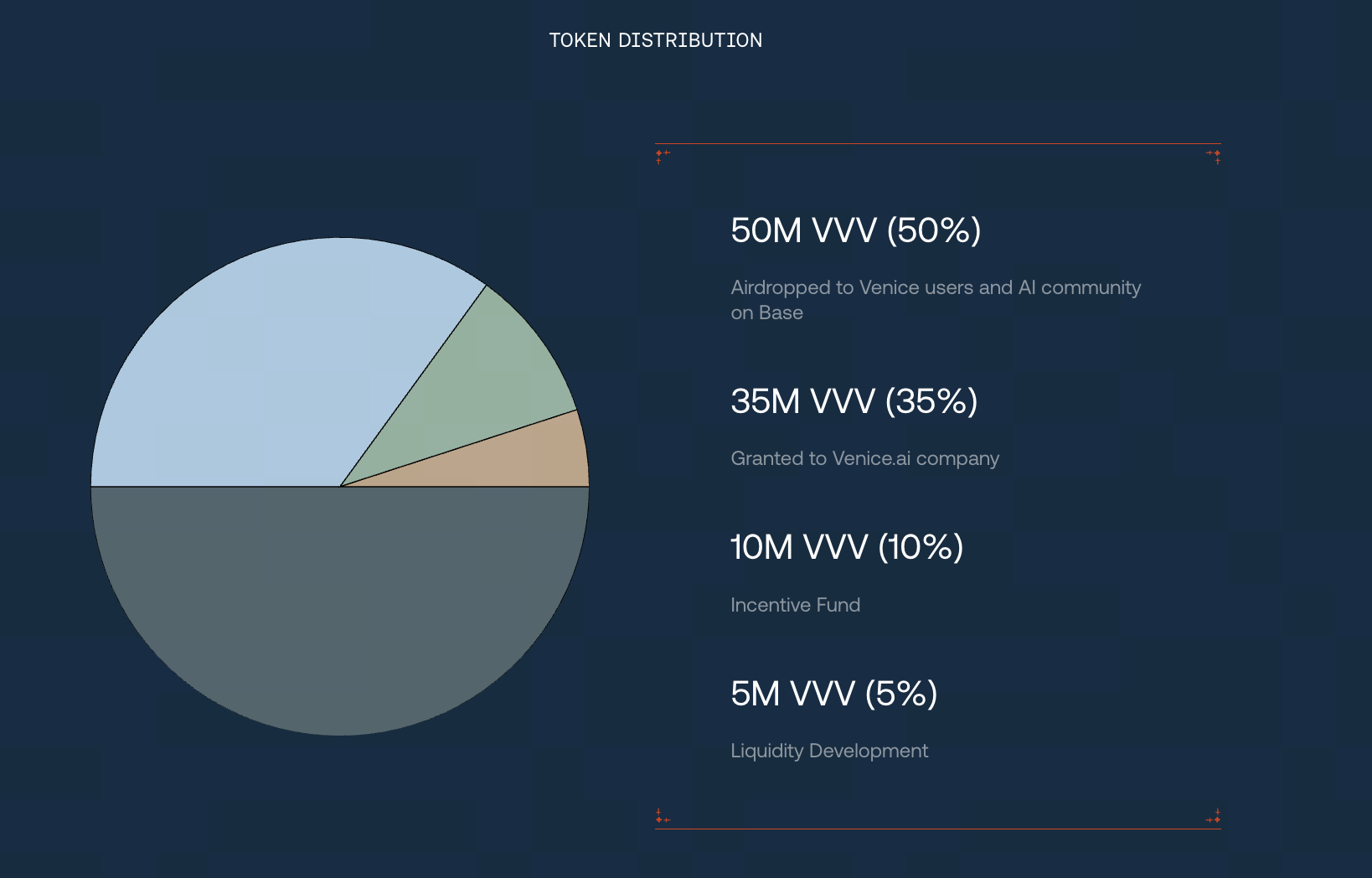 Image source: Venice official website
Total supply: The initial total supply of VVV is approximately 100 million tokens.
Token distribution: According to official disclosures, the approximate allocation structure is as follows:
-
50% airdropped to users and the AI community
-
35% allocated to the Venice company
-
10% reserved for ecosystem incentives
-
5% allocated for liquidity provision
This distribution model positions the community as a key early participant.
Deflationary mechanism: Venice has also introduced a buyback and burn mechanism. A portion of platform revenue is used to repurchase VVV from the market and burn it, reducing circulating supply and creating deflationary pressure. As platform usage increases, token scarcity could theoretically grow.
Governance and Community Participation
Unlike many DeFi projects, Venice adopts a relatively simplified governance structure.
The primary role of VVV is to serve as a credential for accessing AI resources rather than functioning purely as a governance token.
However, the community can still participate in ecosystem development through several avenues:
-
Building ecosystem applications
-
Developing developer tools
-
Submitting community governance proposals
-
Participating in ecosystem incentive programs
As the Venice ecosystem expands, community participation is expected to grow as well.
Risks to Consider When Investing in Venice Token (VVV)
Although Venice introduces innovation at the intersection of AI and Web3, several risks remain.
AI Market Competition Risk
The artificial intelligence industry is highly competitive. Major technology companies hold significant advantages in computing power and model development.
Whether Venice can continue expanding its technology and user base still requires time to be proven.
Technology Adoption Risk
Decentralized AI remains an emerging field.
If developer and user adoption grows slowly, ecosystem expansion could face limitations.
Token Volatility Risk
As a crypto asset, VVV is still subject to market sentiment.
Even if the platform develops successfully, the token price may still experience significant volatility.
Future Outlook and Potential of Venice Token (VVV)
From a long term perspective, the direction Venice is exploring aligns closely with several major technology trends:
-
AI Agent automation
-
Web3 infrastructure
-
AI computing resource markets
If the AI Agent ecosystem continues to grow, demand for AI APIs may increase rapidly. In such a context, tokenizing AI inference capacity and forming a market for computing resources could become an important model for future AI infrastructure.
In addition, as the cost of AI models declines, the amount of computing power that platforms can provide may gradually increase. This could potentially raise the value represented by the computing share tied to VVV.
Conclusion
Venice Token (VVV) is a crypto asset that attempts to combine artificial intelligence computing power with a blockchain-based economic model. By allowing users to obtain AI inference capacity through token staking, Venice introduces a business model different from traditional AI APIs.
This approach provides developers with a new way to access AI resources while also offering infrastructure support for AI Agents and decentralized applications.
However, the integration of AI and Web3 is still at an early stage. The long term development of Venice will depend on ecosystem adoption, technological competitiveness, and the broader evolution of the AI market.
FAQs
Q1: What is Venice Token (VVV)?
VVV is the core token of the Venice AI platform used to access AI inference capabilities and support the platform’s economic ecosystem.
Q2: What are the main uses of VVV?
Users can stake VVV to obtain computing capacity from the Venice AI API and participate in ecosystem incentive mechanisms.
Q3: How is Venice different from traditional AI services?
Traditional AI platforms charge per API call, while Venice allocates AI computing capacity through token staking.
Q4: What is DIEM?
DIEM is an AI credit asset generated by staking VVV, which can be used to obtain continuous AI API usage credits.
Q5: Does Venice Token have a deflationary mechanism?
Yes. Venice uses a portion of platform revenue to buy back and burn VVV, reducing circulating supply.







