As blockchain use cases continue to expand, developers’ demands for underlying infrastructure are also changing rapidly. Traditional public chain development usually relies on smart contract platforms, such as deploying applications on Ethereum. While the barrier to entry is relatively low, developers are constrained by the rules of the underlying chain, including its consensus mechanism, execution environment, and performance limits.
As multi-chain architecture increasingly becomes an industry trend, Substrate gives developers a more flexible way to build at the chain level. As an important part of the Polkadot ecosystem, Substrate not only allows developers to create highly customized blockchains, but also enables those chains to connect to the Polkadot network for shared security and cross chain interoperability.
What Is Substrate?
Substrate is a modular blockchain development framework developed by Parity Technologies and designed to help developers quickly create customized blockchains. Unlike deploying smart contracts on an existing public chain, Substrate allows developers to build a complete blockchain from the ground up and tailor its operating logic to their needs.
This means developers can freely choose the consensus mechanism, governance model, transaction fee structure, and execution environment instead of being bound by the rules of an existing blockchain platform. Substrate provides a large number of reusable modules, so developers do not need to write all of the underlying blockchain code from scratch, which greatly reduces development complexity.
More importantly, blockchains built with Substrate can connect seamlessly to the Polkadot network and become part of its parachain ecosystem, gaining access to shared security and cross chain interoperability.
Why Is Substrate Important to Polkadot?
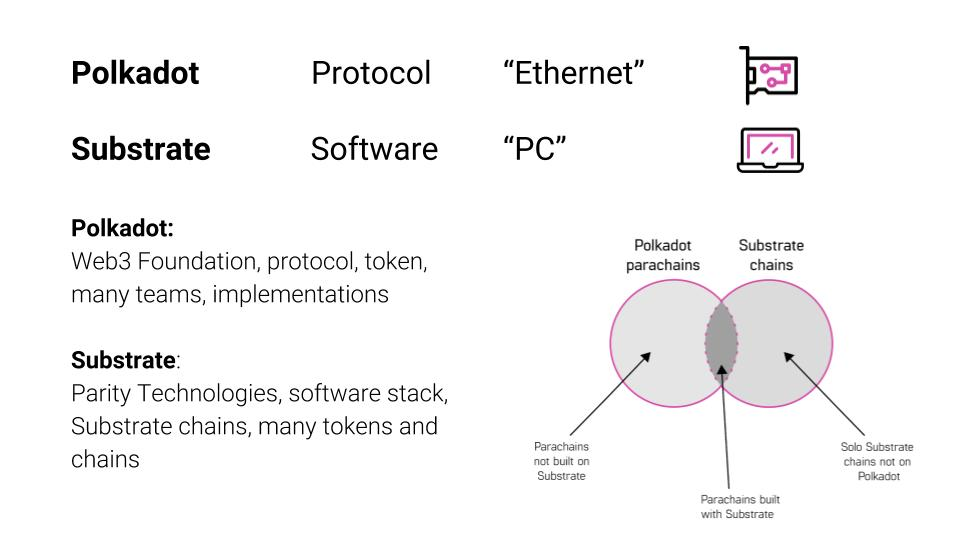
Polkadot’s core goal is to build a network that supports interoperability across multiple chains. To achieve that, different blockchains need to be built quickly and integrated into a unified ecosystem. Substrate is the development framework designed for exactly this purpose.
With Substrate, developers can create dedicated blockchains based on their own business needs, then connect them to the Polkadot (DOT) network as parachains. This model allows each chain in the Polkadot ecosystem to maintain its own independent functionality while still benefiting from shared network security and cross chain capabilities.
In other words, Substrate is the foundational tool that supports Polkadot’s ability to scale. Without Substrate, it would be much harder for Polkadot to expand its parachain ecosystem efficiently or build a highly flexible multi-chain network.
How Does Substrate Work?
The core idea behind Substrate is modular development. It breaks the main functions of a blockchain into multiple composable modules, such as account systems, governance modules, consensus modules, and transaction modules. Developers can choose and combine these modules based on their business needs to quickly build their own blockchain.
This modular design significantly improves development efficiency. Developers do not need to build every underlying function from scratch, and can instead customize their chain on top of existing components. At the same time, Substrate also allows developers to write custom logic to support more complex chain level functionality.
In addition, Substrate is compatible with Polkadot’s network standards by default, which makes it easier for chains built with it to connect to the Polkadot relay chain and interoperate with other parachains.
How Is Substrate Different From Smart Contract Development?
Traditional smart contract development usually means deploying applications on an existing public chain, such as running contracts on Ethereum (ETH). This approach allows for faster development, but developers cannot change the rules of the underlying chain and can only build within the established framework.
Substrate, by contrast, provides chain level development capabilities. Developers can directly define how the blockchain operates, such as choosing the consensus mechanism, setting the governance model, or optimizing performance parameters. This gives them much more freedom to build blockchain networks that better fit their own business needs.
In that sense, smart contract development is more like “renting a platform,” while Substrate is like “building your own platform.”
What Are the Core Advantages of Substrate?
Substrate’s biggest advantage is flexibility. Developers can build customized blockchains based on their specific needs instead of being limited by the rules of a single platform. This makes it especially well suited for blockchain projects that require unique performance characteristics, governance logic, or business models.
Another major advantage is development efficiency. Through its modular components, Substrate simplifies the complex process of blockchain development and allows teams to bring products to market more quickly.
In addition, chains built with Substrate can connect to the Polkadot network and gain access to shared security and cross chain interoperability. This model of “independent chain plus shared network resources” preserves flexibility while reducing the cost of building security from scratch.
Why Is Substrate the Core Framework for Polkadot Parachain Development?
Polkadot parachains need to meet a common set of network standards so they can operate in coordination with the relay chain and other parachains. Substrate was designed from the beginning to meet this need, which is why it has become the core tool for Polkadot parachain development.
After building a chain with Substrate, developers can integrate it into the Polkadot network more smoothly and obtain shared security through the relay chain. This not only reduces development and maintenance costs, but also improves the efficiency of parachain deployment.
From an ecosystem perspective, Substrate allows Polkadot to scale more application specific chains quickly. That is important for increasing overall ecosystem activity and strengthening demand for the DOT token.
What Challenges Does Substrate Face?
Although Substrate is powerful, it comes with a relatively steep learning curve. Compared with deploying smart contracts, building a full blockchain requires stronger technical expertise, so development teams need to invest more resources.
In addition, while Substrate offers a high degree of flexibility, that extra freedom also brings greater development complexity. Developers need a deeper understanding of chain architecture, security mechanisms, and governance logic.
For that reason, Substrate is better suited to projects with clear chain level requirements and may not be the right choice for every blockchain use case.
Conclusion
As a modular blockchain development framework, Substrate gives developers the ability to build customized blockchains and connect them seamlessly to the Polkadot (DOT) network. It not only increases flexibility in blockchain development, but also provides critical support for the expansion of the Polkadot parachain ecosystem.
As a key part of Polkadot’s multi-chain architecture, Substrate allows developers to balance chain level autonomy with shared network resources. That is the fundamental reason it has become the core development framework of the Polkadot ecosystem.
FAQs
What is the difference between Substrate and smart contract development?
Smart contracts are built as applications on existing public blockchains, while Substrate allows developers to build a complete blockchain directly.
Why is Substrate important to Polkadot?
Because Substrate supports the fast creation of parachains that can connect to Polkadot, making it an essential piece of infrastructure for expanding the Polkadot ecosystem.
What are Substrate’s main advantages?
Its main advantages include modular development, high flexibility, and access to Polkadot’s shared security network.
Do all Polkadot parachains use Substrate?
Most Polkadot parachains are built on Substrate because it offers the strongest compatibility with the Polkadot network.







