As users explore ways to expand how assets can be expressed on the Bitcoin network, its traditionally transaction-focused structure is being repurposed. Ordinals has emerged as a key entry point for understanding Bitcoin NFTs and the broader inscription ecosystem.
This topic generally involves three layers: the numbering system, how data is written, and how assets are structured. Together, these form the foundation of how Ordinals operates.
What Is Ordinals (ORDI)
The Ordinals protocol assigns a unique number to each satoshi, allowing individual satoshis to be tracked and identified. This also enables them to carry additional data, expanding how they can be used within the Bitcoin network.
From a technical perspective, each satoshi is numbered according to the order in which it is mined into blocks. This makes it possible to trace and distinguish each unit. By embedding data into transactions, specific satoshis can carry extra information, forming what are known as “inscriptions.”
Structurally, Ordinals does not modify Bitcoin’s core rules. Instead, it interprets existing transaction data to express assets. This means it operates entirely on the native Bitcoin network.
The significance of this design is that Bitcoin can now do more than transfer value. It can also store and represent richer forms of digital content.
How the Ordinals Protocol Works
Ordinals relies on two key mechanisms: satoshi numbering and data attachment.
First, satoshis are indexed based on block and transaction order. Then, data is written into transaction inputs using a specific format, binding that data to a particular satoshi.
From a structural standpoint, this process does not require additional tokens or sidechains. All information is recorded directly in Bitcoin blocks and validated and stored by network nodes.
This approach enables a fully on-chain method of recording data, ensuring that assets are verifiable and tamper-resistant.
How Inscriptions Are Created and Stored on Bitcoin
Inscriptions are digital assets formed by writing data onto satoshis.
Mechanically, users initiate an “inscribe” operation using specialized tools, embedding data such as text or images into a transaction. This data is then included in a block and permanently stored on-chain.
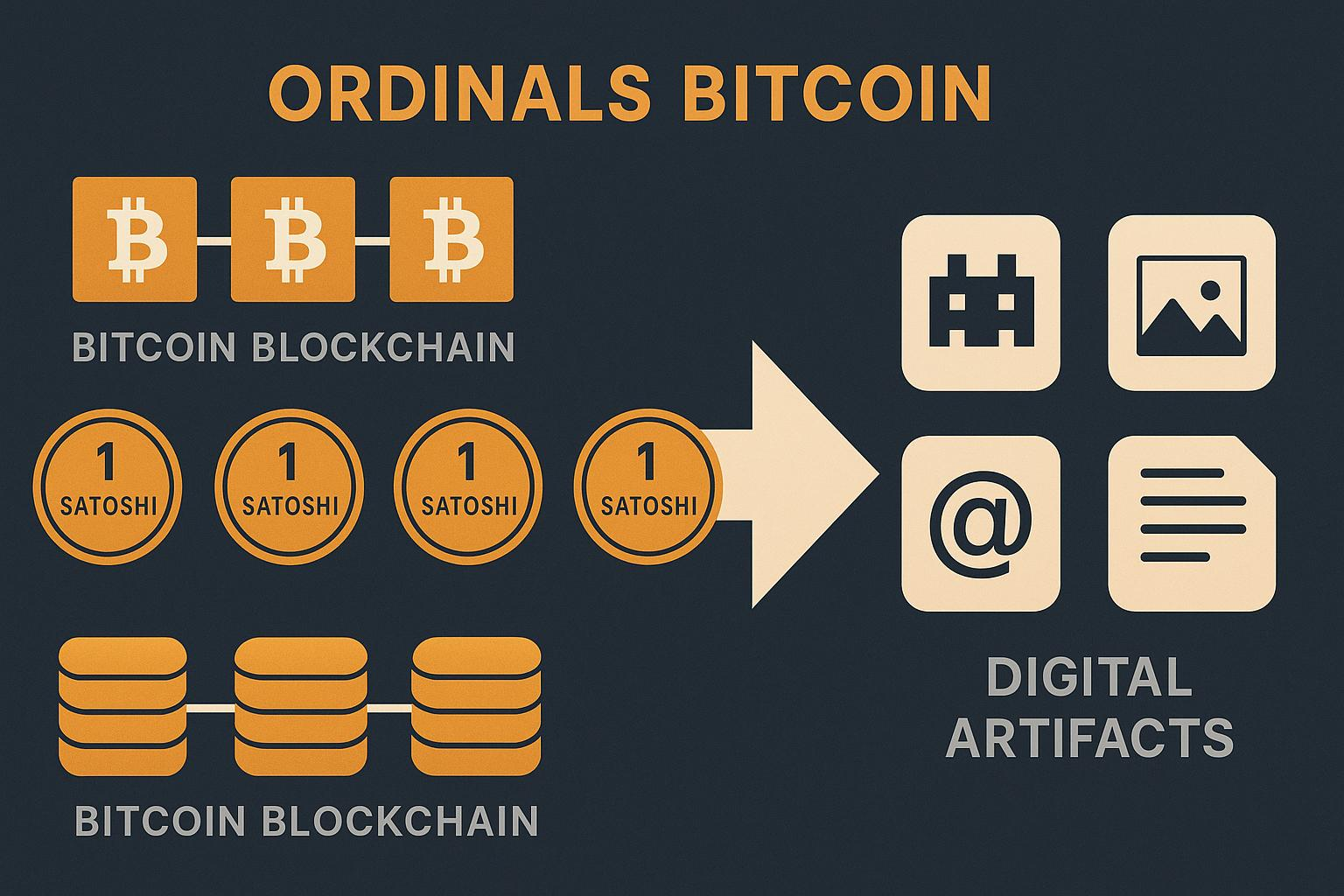
Structurally, inscriptions are directly attached to Bitcoin transactions rather than stored in external systems. This gives them full on-chain properties.
The importance of this design lies in removing reliance on off-chain storage, improving data integrity and verifiability for NFT-like assets.
What Role ORDI Plays in the Ordinals Ecosystem
ORDI is a token created using the inscription standard, designed to represent fungible assets within the ecosystem.
From a mechanism standpoint, ORDI defines issuance and transfer rules through inscriptions, allowing it to be traded on the Bitcoin network.
Structurally, ORDI does not participate in the operation of the network itself. Instead, it functions as an asset type within the ecosystem, complementing inscription-based NFTs.
Its role is significant because it introduces tokenization into the Ordinals ecosystem, expanding it beyond just NFTs to a broader range of asset types.
What Are the Use Cases of Ordinals
Ordinals is primarily used in digital assets and content expression.
Mechanically, users can create NFTs, tokens, or other data-based assets through inscriptions and trade them in marketplaces.
Structurally, these applications rely on Bitcoin’s security and immutability, making them suitable for use cases such as collectibles, identity markers, and data recording.
This expands Bitcoin from a purely payment network into a more versatile asset platform.
How Ordinals Differs from Traditional NFTs
Ordinals vs Traditional NFTs differ significantly in how data is stored and implemented.
Mechanically, traditional NFTs often store metadata off-chain, while Ordinals writes data directly onto the blockchain.
Structurally, Ordinals does not rely on smart contracts. Instead, it uses Bitcoin’s transaction structure to represent assets. This makes it simpler but also more limited in functionality.
The key takeaway is that Ordinals prioritizes data integrity, while traditional NFTs emphasize flexibility and extensibility.
How Ordinals Relates to the Bitcoin Network
Ordinals is built entirely on top of the Bitcoin network.
Mechanically, it uses existing transaction and scripting structures to write data without altering consensus rules.
Structurally, it depends on nodes to interpret transaction data, making it an application-layer protocol within the Bitcoin ecosystem.
This means its security is directly inherited from Bitcoin itself.
Advantages and Limitations of Ordinals
Ordinals offers both innovation and constraints.
Mechanically, its main advantage is fully on-chain data storage. Its limitation lies in restricted block space, which limits data capacity.
Structurally, the lack of smart contract support reduces its ability to handle complex applications compared to other blockchain systems.
As a result, Ordinals is better suited for simple asset representation rather than advanced use cases.
Summary
By numbering satoshis and attaching data to them, Ordinals gives Bitcoin the ability to represent digital assets, forming an ecosystem centered around inscriptions.
FAQ
What is Ordinals? It is a protocol for creating inscription-based assets on Bitcoin.
What is the relationship between inscriptions and NFTs? Inscriptions are a form of fully on-chain NFT representation.
How is ORDI created? It is generated through inscription-defined token rules.
Does Ordinals change Bitcoin’s rules? No. It only uses existing structures to implement new functionality.
What kind of data can Ordinals store? Mainly small data types such as text and images.