OpenClaw Project Background and Development History
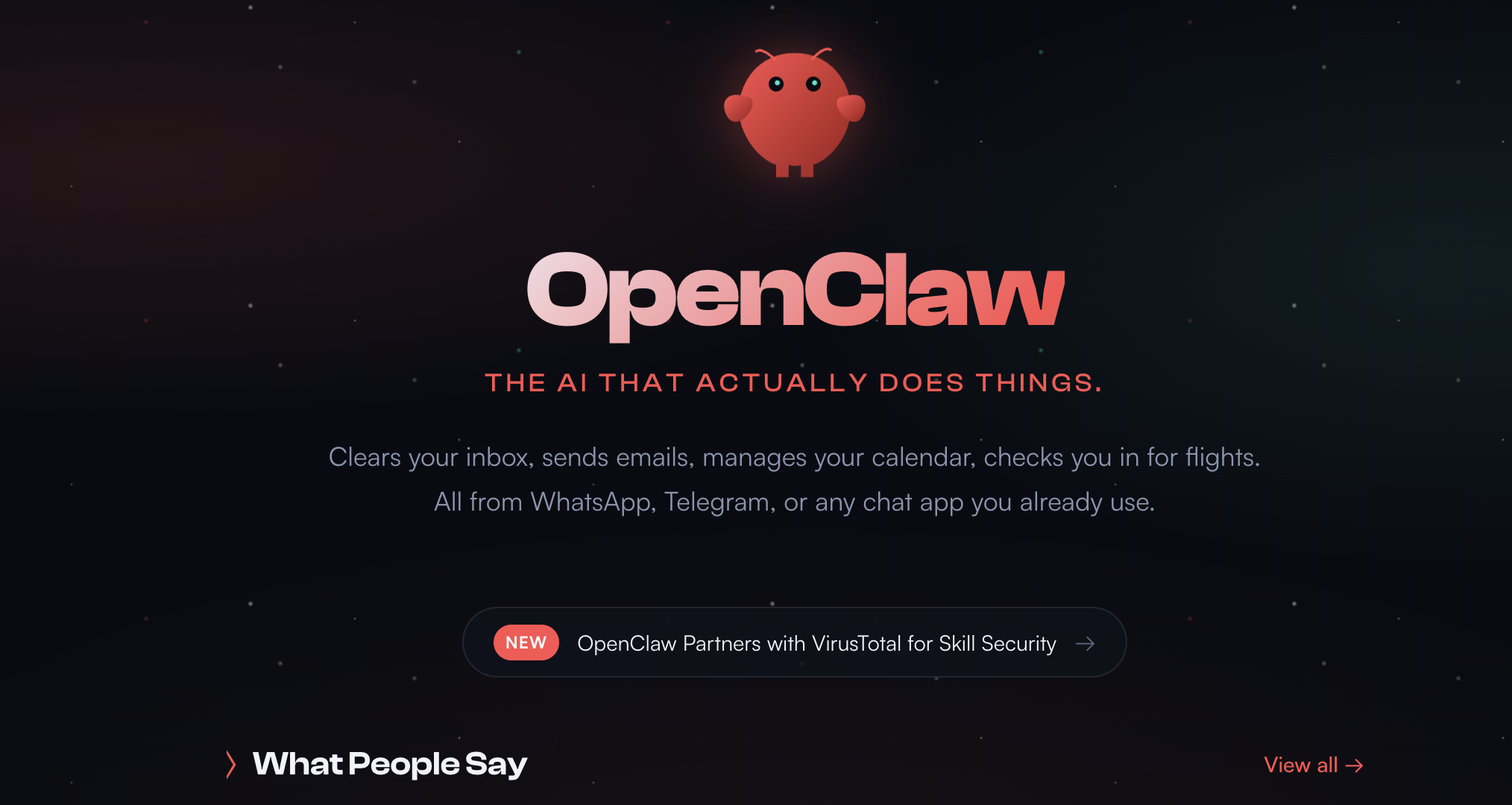 Image: https://openclaw.ai/
OpenClaw has emerged as one of the most influential open-source initiatives in the AI Agent domain in recent years. The project was founded by software engineer Peter Steinberger and was initially released as Clawdbot in 2025. After several rebrandings in 2026, it ultimately became known as OpenClaw.
OpenClaw was designed to create an AI assistant capable of “actually executing tasks”—not merely serving as a conversational chatbot. Unlike conventional AI assistants, OpenClaw operates locally on user devices and leverages OS tools, APIs, and internet services to accomplish complex objectives.
The project quickly gained traction in the developer community upon its release. Its rapid dissemination through open-source channels, the growing popularity of AI Agents, and the narrative of “autonomous AI” drove significant attention to OpenClaw in early 2026.
Concurrently, the project developed a comprehensive ecosystem, featuring a plugin marketplace, task automation systems, and experimental research focused on agent collaboration.
OpenClaw’s Core Concept: From Chatbot to AI Agent
Understanding OpenClaw requires first understanding the concept of an AI Agent.
Traditional AI tools are typically “passive systems”: the user asks a question, and the AI returns an answer.
In contrast, an AI Agent is an “active system”: the user sets a goal → the AI plans → invokes tools → executes tasks → delivers results.
OpenClaw’s design philosophy is to transform AI from “answering questions” into “completing tasks.”
For instance, users can instruct OpenClaw to:
- Automatically organize email inboxes
- Query market data
- Write programs
- Send messages or emails
- Generate analytical reports
These tasks require multi-step execution, rather than one-off answers.
OpenClaw’s AI Agent can:
- Receive tasks
- Break down steps
- Invoke tools
- Execute scripts
- Return results
This paradigm elevates AI from simple conversation to an automated execution system.
OpenClaw’s Technical Architecture and Operating Mechanism
OpenClaw’s technical architecture consists of four main components:
1. AI Model Layer
OpenClaw is not itself a large language model. Rather, it is an AI Agent framework that connects to various large models, including:
- GPT series
- Claude
- Gemini
- Local LLMs
Users are free to select their preferred AI model.
The core strength of OpenClaw lies in its tool usage capabilities. It integrates with a wide array of system tools, such as:
- Browsers
- File systems
- Shell commands
- Databases
- API services
This allows the AI to directly interact with the system, not merely output text.
3. Heartbeat Mechanism
OpenClaw uses a cyclic system called Heartbeat. The AI Agent is periodically activated to check the task queue, including:
- New messages
- Scheduled tasks
- Incoming data
This mechanism enables the AI Agent to operate continuously and execute tasks automatically.
4. Messaging Interface
OpenClaw’s user interface is typically a chat platform, such as:
- WhatsApp
- Telegram
- Discord
- Signal
Users simply send messages to control the AI Agent. For example: “Organize today’s emails and generate a summary.”
The AI Agent will execute these instructions automatically.
OpenClaw’s Skills System and Ecosystem Expansion
A major innovation of OpenClaw is its Skills system. These skills function as plugins, expanding the AI Agent’s capabilities, including:
- Automated trading
- Data scraping
- Social media management
- File processing
- Automated development
Developers can create and share their own skills with the community. Skills typically include:
- Configuration files
- Tool scripts
- Usage instructions
OpenClaw has launched a plugin marketplace, ClawHub, where users can easily install skills. This ecosystem enables OpenClaw to scale rapidly, forming an App Store-like environment for AI Agents. However, this open model also introduces new risks.
OpenClaw’s Application Scenarios and Commercial Potential
With the rise of AI Agent concepts, OpenClaw’s use cases are expanding quickly.
1. Automated Work Assistant
OpenClaw automates a wide range of repetitive tasks, including:
- Email management
- Data analysis
- Automated report writing
- Schedule management
For developers and enterprises, this means a digital assistant.
2. AI Automated Development
Developers can use OpenClaw to automate:
- Code writing
- Program debugging
- Automated deployment
This approach is widely viewed as part of the future AI-driven development workflow.
3. AI Agent Collaboration
Researchers are experimenting with multiple OpenClaw Agents collaborating on complex tasks such as scientific research and data analysis.
These experiments are exploring the potential of Multi-Agent Systems.
4. AI Automated Economy
Some communities are building transaction systems among AI Agents, enabling agents to complete tasks and settle value autonomously.
Though these experiments are still nascent, they highlight the potential direction of the AI Agent economy.
OpenClaw’s Security Challenges and Recent Controversies
With OpenClaw’s rapid adoption, security issues have surfaced. In 2026, several security research organizations identified vulnerabilities within OpenClaw. For example, a bug dubbed ClawJacked allowed attackers to control the AI Agent and access device data via the local WebSocket service.
The plugin ecosystem has also become a target for attacks. Researchers found several malicious skills on ClawHub, disguised as crypto trading tools or automation scripts, which could steal user data or crypto assets upon installation.
Because OpenClaw Agents can access:
- File systems
- Browser data
- API keys
Malicious code exploitation poses greater risks than standard software. Security experts recommend:
- Running OpenClaw in isolated environments
- Carefully reviewing plugin code
- Avoiding excessive system permissions
OpenClaw and the Future of the AI Agent Sector
OpenClaw’s rise is not just a triumph for open-source—it signals the dawn of the AI Agent era.
While AI has mostly appeared as chatbots in recent years, its future trajectory points toward:
- Task-executing assistants
- 24/7 operating software agents
- Collaborative intelligent systems
OpenClaw is an early representative of this trend.
Despite ongoing challenges with security, stability, and governance, its open-source ecosystem has proven one thing: AI is evolving from a chat tool to genuine digital labor.
As AI Agent technology matures, frameworks like OpenClaw may become key components of next-generation software infrastructure.
In the coming years, innovation centered on AI Agents, automated economies, and multi-agent collaboration will likely drive new growth in the artificial intelligence sector.
Gate for AI: Exchanges Are Building AI Agent Infrastructure
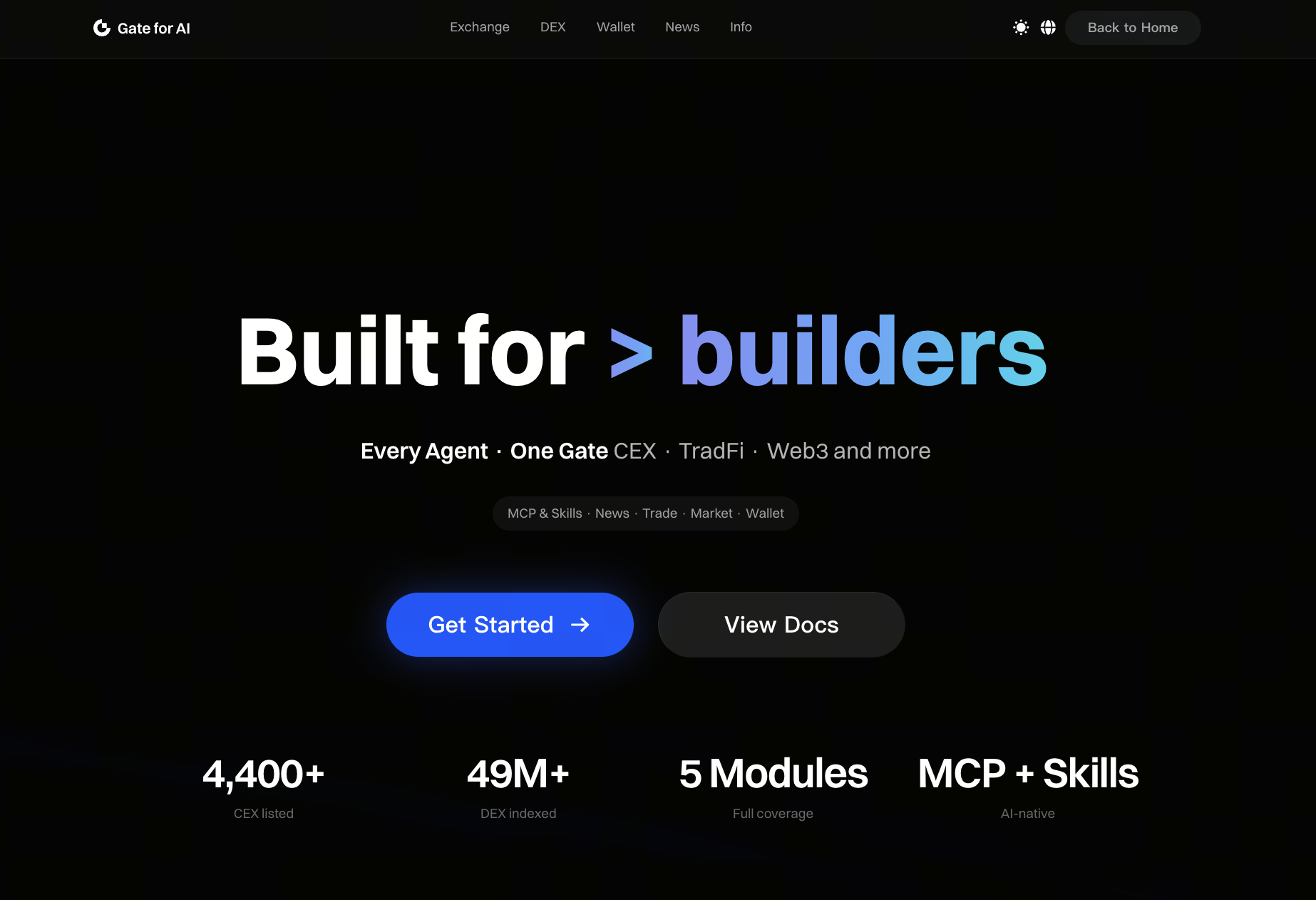 Image: https://www.gate.com/gate-for-ai-mcp-skills
As AI Agents and Web3 converge, crypto platforms are increasingly developing agent infrastructure. Gate's launch of Gate for AI in 2026 is a notable example.
Gate for AI is not simply an AI product—it is a Web3 interface layer built for AI Agents. The system unifies API and agent interfaces, integrating centralized exchange (CEX) trading, on-chain trading (DEX), wallet signatures, market data, and live news into one platform. This allows AI applications to perform data analysis, strategy generation, and trade execution within a single framework.
Traditionally, AI tools were limited to market analysis or strategy generation, leaving users to manually execute trades. Gate for AI enables AI Agents, once authorized, to directly access trading interfaces for automated order placement, asset management, and on-chain interactions. This marks a significant application direction for AI Agents in crypto finance.
From an industry standpoint, Gate for AI demonstrates a clear trend: as AI Agent technology evolves, exchanges, wallets, and on-chain protocols are opening their interfaces, allowing AI not only to analyze Web3 data but also to participate in real on-chain operations and financial activities. This infrastructure-centric development could become a pivotal stage in the future integration of AI and the crypto ecosystem.