As blockchain ecosystems rapidly evolve, networks like Ethereum, BNB Chain, Avalanche, and Solana are becoming increasingly siloed, leading to asset fragmentation, liquidity isolation, and collaboration challenges. LayerZero delivers a configurable, highly secure cross-chain messaging infrastructure that provides a unified foundational communication layer for decentralized applications (dApps) in the multi-chain era.
A deep understanding of LayerZero’s technical architecture and DVN security model not only clarifies the underlying logic of omnichain interoperability, but also offers insight into how Omnichain Fungible Tokens (OFT) are redefining asset standards for the future of multi-chain applications.
Background and Development of the LayerZero Project
 Image source: LayerZero official website
LayerZero was originally launched by LayerZero Labs with the mission to become the foundational communication protocol for blockchain interoperability, building out omnichain infrastructure. Its core design eliminates isolation between blockchains, enabling distributed applications to collaborate across chains without relying on conventional asset custodial or synthetic mechanisms.
In the early days of blockchain, the absence of a universal communication standard between chains led to fragmented ecosystems and restricted the free flow of assets and data. LayerZero addressed this pain point by introducing lightweight nodes and decentralized verification to facilitate efficient cross-chain messaging. As the protocol has matured, LayerZero has expanded its network support and has been integrated by a growing number of projects.
Recently, LayerZero has made significant progress in ecosystem integration, technical iteration, and the development of cross-chain standards. It now serves as a foundational communication layer for numerous DeFi, NFT, gaming, and cross-chain asset protocols, enabling seamless native asset transfers across chains.
Why Blockchains Require Cross-Chain Interoperability Protocols
Blockchains are inherently independent distributed ledgers, with each network featuring its own data architecture, consensus mechanism, and state management. This leads to the “on-chain island” effect, where isolation not only limits asset liquidity, but also impedes cross-chain application collaboration and user experience improvements.
Early cross-chain solutions often depended on centralized custodians or intermediary assets (like wrapped tokens), introducing security vulnerabilities and high trust assumptions. LayerZero was designed to minimize these trust requirements, establishing a more decentralized, versatile cross-chain communication protocol that empowers the Web3 ecosystem with flexible, secure interoperability.
Cross-chain protocols have become essential infrastructure for fostering multi-chain collaboration—enabling asset sharing, state synchronization, and cross-chain smart contract invocation—driving the emergence of innovative cross-chain application models.
Core Architecture and Technical Principles of LayerZero
The LayerZero protocol architecture centers on lightweight verification, secure message delivery, and modular components. It consists of Endpoint smart contracts deployed on each chain, external verification components (Oracles and Relayers), and configurable security logic.
When a cross-chain message is initiated, the source chain’s Endpoint compiles the message payload and target chain information, then activates the external verification process. Oracles supply block header data and Relayers deliver transaction proofs. LayerZero’s verification logic at the destination chain’s Endpoint executes business logic only after confirming bi-directional verification, ensuring both message security and consistency.
This architecture eliminates the centralized trust points present in traditional cross-chain bridges, enabling a configurable decentralized verification model and granting LayerZero high levels of security and flexibility.
Ultra Light Node (ULN) Mechanism Explained
A core innovation of LayerZero is the Ultra Light Node (ULN). Unlike traditional full or light nodes that maintain complete chain states, ULN only requests block header data as needed, then relies on dual verification from Oracles and Relayers to validate messages.
Key advantages of this approach:
- Extremely low resource consumption: No need to maintain full chain history—necessary proofs are retrieved only when required.
- High security: Verification is based on trusted block headers and proofs, without dependence on third-party custodial pools.
- Scalability: Supports integration with additional chains without significantly increasing protocol maintenance overhead.
The Ultra Light Node mechanism is the critical technology enabling LayerZero’s efficient cross-chain interactions.
How LayerZero Enables Secure Cross-Chain Messaging
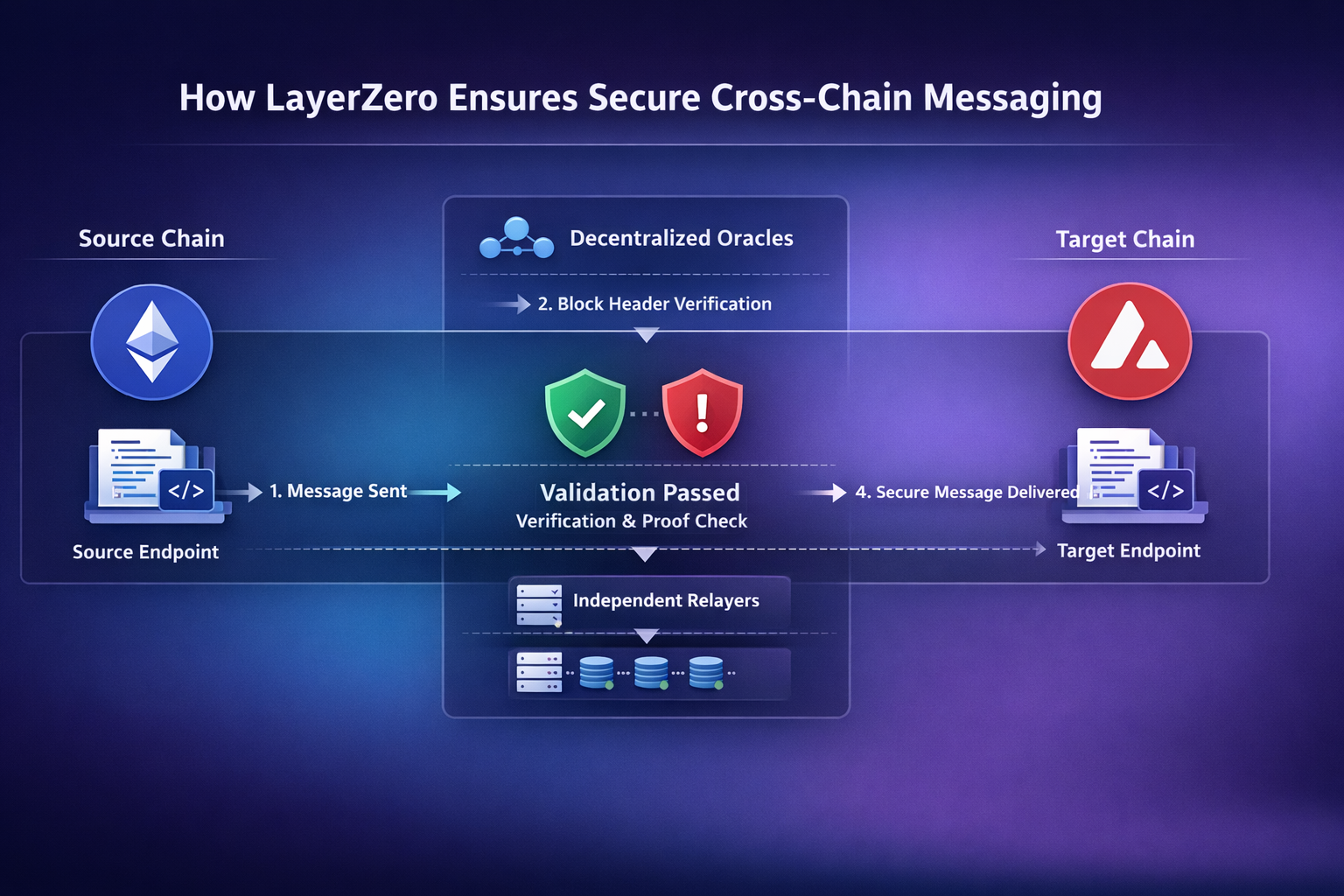
Security is paramount for cross-chain protocols. LayerZero boosts resilience against attacks through an independent verification and execution separation mechanism and a Decentralized Verification Network (DVN). Verification and execution are handled independently by different participants, making it economically unfeasible for an attacker to compromise message authenticity unless they control multiple validators simultaneously.
LayerZero also allows applications to balance security and operating costs by selecting the appropriate verification configuration. This flexibility allows the protocol to support both enterprise-level financial applications and lightweight cross-chain interactions.
How LayerZero Differs from Other Cross-Chain Protocols
LayerZero’s core advantages over traditional cross-chain bridges include:
- No custodial asset requirement: Unlike some bridges that require assets to be locked in centralized contracts or pools, LayerZero supports native asset transfers across chains.
- General-purpose message delivery: Enables transfer of not only assets, but also arbitrary data—including smart contract call parameters.
- Modular verification: Security stack can be customized for different application scenarios.
Compared to other general-purpose cross-chain protocols, LayerZero emphasizes configurable decentralized verification and broad interoperability.
LayerZero Ecosystem and Core Applications
The LayerZero ecosystem has a strong presence in DeFi, NFTs, cross-chain asset bridges, gaming, and more. Leading use cases such as Stargate Finance (a cross-chain liquidity protocol), Omnichain Fungible Tokens (OFT), and cross-chain NFTs all leverage LayerZero’s messaging layer.
These projects harness LayerZero’s cross-chain communication to enable unified asset flows, cross-chain contract calls, and multi-chain governance, demonstrating the protocol’s real-world utility.
ZRO Token Utility and Economic Model
LayerZero’s ZRO token plays a key role in protocol governance and incentive mechanisms, rewarding validators, Relayers, and other participants, while providing governance weight for the community. Since its launch in 2024, ZRO’s governance and incentive model has been continuously optimized.
ZRO is designed to give protocol participants (including Relayers, Oracles, and application developers) long-term incentives for network security and operations, while steadily advancing toward a more decentralized governance structure.
Risks to Consider When Using LayerZero
Although LayerZero is designed for security and flexibility, users should be mindful of several risks:
- Smart contract risk: Cross-chain message execution depends on smart contracts, which may contain code or integration vulnerabilities.
- Validator collusion risk: While Oracles and Relayers are separated, there is still risk if multiple validators collude maliciously.
- Network congestion and fee volatility: Cross-chain transactions incur fees across multiple networks, which can fluctuate with on-chain congestion.
Understanding these risks is essential for safely using services in the LayerZero ecosystem.
Future Directions for LayerZero
LayerZero’s roadmap includes expanding support for more public blockchains, integrating advanced cryptography (such as zk-proofs for enhanced privacy and efficiency), and moving toward fully decentralized governance. The team is also exploring innovations like cross-chain state synchronization.
Looking ahead, LayerZero could evolve from a cross-chain communication protocol into the foundational execution layer for cross-chain application logic.
Conclusion
As a leading omnichain interoperability protocol, LayerZero delivers critical infrastructure for the multi-chain blockchain era through its innovative Ultra Light Node architecture, configurable verification model, and robust ecosystem. It overcomes the security and efficiency limitations of legacy cross-chain solutions, unlocking broader cross-chain possibilities for dApps.
FAQs
Q1: How does LayerZero enable cross-chain messaging?
LayerZero deploys Endpoints on each chain, with external Oracles and Relayers jointly verifying block headers and transaction proofs to ensure verifiable message delivery.
Q2: What is the purpose of the ZRO token?
ZRO incentivizes network participants and enables protocol governance, forming a core part of the protocol’s economic system.
Q3: What applications does LayerZero support?
LayerZero supports cross-chain DeFi, NFTs, gaming assets, and cross-chain governance systems.
Q4: What are LayerZero’s security advantages?
It uses decentralized verification and modular security configurations to reduce single points of trust.







