Against the backdrop of rapid AI advancement, data and computational resources in traditional internet platforms remain highly centralized. Fetch.ai attempts to reshape how data is used and how value is distributed by integrating blockchain with AI, enabling machines to interact and form autonomous economic systems.
From the perspective of Web3 evolution, FET represents more than just a token. It reflects an infrastructure level attempt to embed AI capabilities directly into on-chain economic structures. By combining decentralized computation, autonomous agent networks, and on-chain settlement mechanisms, FET explores how AI productivity can be transformed into assets, traded in open markets, and coordinated through protocols.
What Is FET Project Background And Development History
 Image source: Fetch.ai official overview
FET is the core utility token of the Fetch.ai network, originally proposed in 2017 with the goal of building a decentralized machine economy. Developed by a UK based team, the project focuses on integrating artificial intelligence with blockchain infrastructure to enable autonomous digital interactions.
Fetch.ai has evolved through several key stages:
-
Early stage focused on building a decentralized autonomous agent framework
-
Midstage introduced a blockchain network built within the Cosmos ecosystem
-
Recent stage expanded through AI alliance integration to support cross project collaboration
Notably, Fetch.ai has joined the Artificial Superintelligence Alliance, an initiative aimed at combining resources and technologies across AI projects to advance toward artificial general intelligence.
Fetch.ai Artificial Intelligence And Machine Learning Architecture
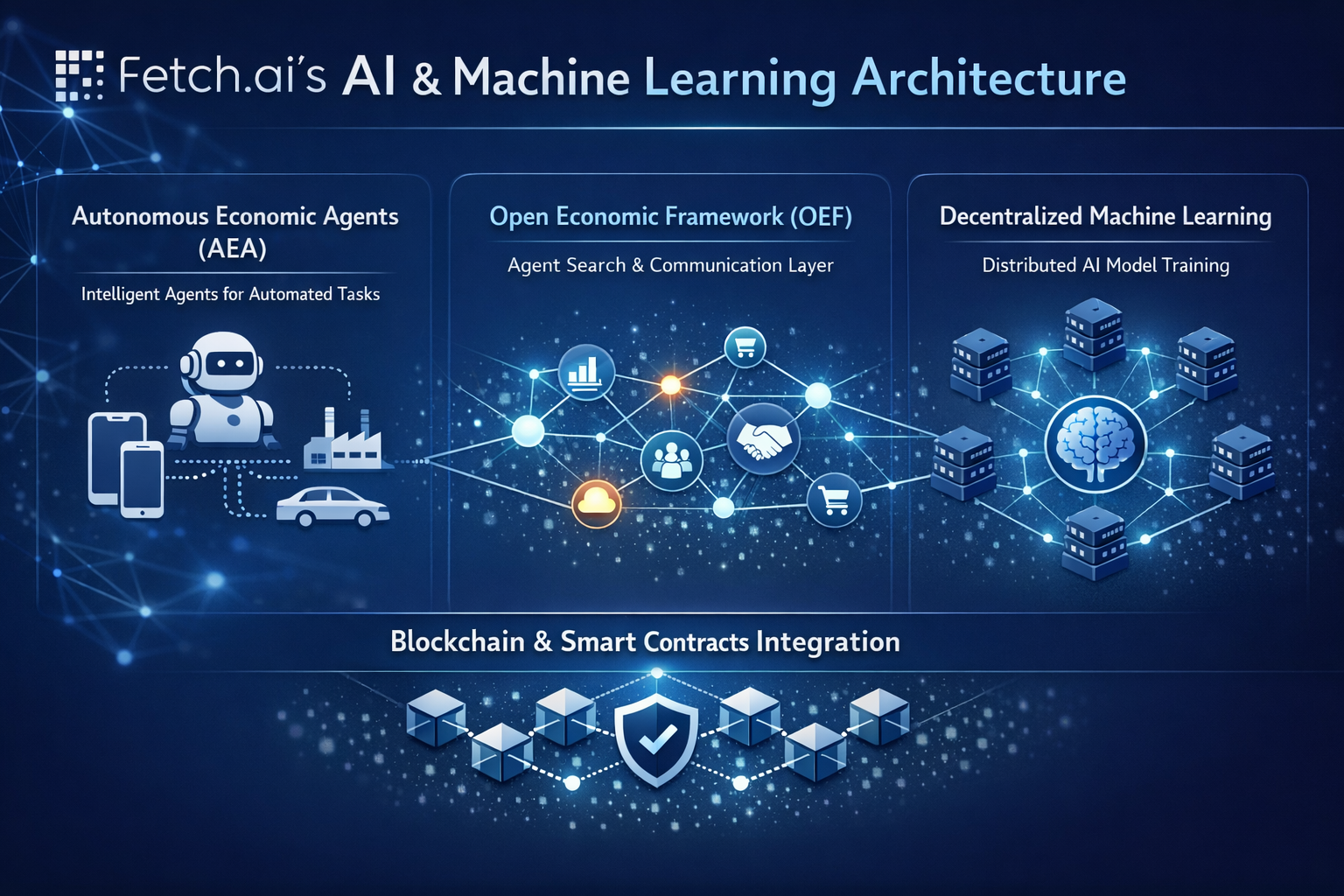
The core innovation of Fetch.ai lies in its architecture that combines autonomous agents with blockchain systems. Its technical framework includes several key components:
-
Autonomous Economic Agents (AEA): These agents act on behalf of users or devices to perform tasks such as resource booking, supply chain optimization, and data exchange.
-
Open Economic Framework (OEF): A discovery and search layer that connects agents, allowing them to find optimal counterparts for transactions and interactions.
-
Decentralized Machine Learning: AI models are trained across distributed networks, reducing reliance on centralized data sources and improving resilience.
The key implication of this architecture is that AI is no longer limited to being a passive tool. Instead, it becomes an active participant in economic activity, capable of making decisions, interacting with other agents, and generating value within a decentralized system.
Governance Mechanism Of Artificial Superintelligence Alliance
As competition in the AI sector intensifies, Fetch.ai has joined forces with multiple projects to form an alliance aimed at integrating resources and establishing shared standards. This collaborative structure reflects a shift toward coordinated development across AI ecosystems.
The governance mechanism of the alliance includes:
-
Multi project coordination with a structure similar to a DAO
-
Token based voting mechanisms for decision making
-
Shared access to technical resources such as models, data, and computing power
Within this framework, FET serves not only as a payment token but also plays a role in governance and incentives, strengthening its position within the broader ecosystem.
Fetch.ai Compared With Other AI Blockchain Projects
Within the AI and crypto landscape, Fetch.ai is often compared with several notable projects:
-
SingularityNET focuses on AI service marketplaces
-
Ocean Protocol emphasizes data exchange and data markets
-
Bittensor concentrates on decentralized model training
Compared to these approaches, Fetch.ai differentiates itself by focusing on the concept of an autonomous agent economy rather than a single layer of AI services. It embeds AI directly into transaction and execution processes while emphasizing automated decision making and machine autonomy. This positioning places Fetch.ai closer to an operating system for AI driven economic activity.
FET Tokenomics And Distribution Model
The design of the FET token centers on supporting network operations and aligning incentives across participants. Its primary functions include:
-
Paying transaction fees within the network
-
Incentivizing nodes and autonomous agents
-
Participating in governance decisions
-
Supporting access to AI powered services
In terms of distribution, FET typically includes allocations for the core team and early investors, ecosystem development funds, and rewards for the community and network participants.
At its core, the economic model transforms AI computation, data, and services into measurable on-chain resources, with the token acting as the medium for value exchange within the system.
Use Cases Of FET In The Decentralized Economy
FET is primarily applied in scenarios that combine machine automation with economic networks, where autonomous agents take on active roles in executing tasks and coordinating resources.
-
Smart transportation: Autonomous vehicles can use agents to optimize routes and coordinate resources in real time, improving efficiency across transport systems.
-
Energy networks: Power devices can automatically trade energy, enabling dynamic pricing and more efficient energy distribution.
-
Supply chain management: AI agents can match supply and demand automatically, reducing intermediaries and lowering operational costs.
-
DeFi and data markets: AI can participate in trading strategies and data pricing, improving market efficiency through automated decision making.
Across these scenarios, the common theme is reducing human intervention and enabling AI to act as a direct participant in economic activity.
Risks To Consider When Investing In FET
Despite strong technological narratives and positioning, FET carries several risks that should be carefully evaluated.
-
Technical risk: The integration of AI and blockchain is still at an early stage, with high complexity in real world implementation
-
Market competition: The AI and Web3 sector is highly competitive, with increasing overlap between projects
-
Regulatory uncertainty: Both AI and crypto fall under growing regulatory scrutiny, which may affect development and adoption
-
Narrative driven volatility: AI related narratives may lead to speculative cycles and significant price fluctuations
Investors should focus on actual technological progress and real world adoption rather than relying solely on market sentiment.
Future Outlook And Market Potential Of FET
The long term potential of FET depends on several key factors:
-
Progress in AI commercialization: If AI services become more standardized and modular, the demand for FET driven systems may increase
-
Maturity of Web3 infrastructure: Advancements in on-chain computation and data processing will directly impact system performance
-
Alliance level coordination: The effectiveness of the Artificial Superintelligence Alliance in integrating resources will be a critical factor
Under favorable conditions, FET could evolve into a foundational settlement layer within an AI driven economic system.
Conclusion
FET represents an effort to deeply integrate artificial intelligence with blockchain technology by building a decentralized economic system powered by autonomous agents. Its core value lies in transforming AI from a passive tool into an active economic participant, with token mechanisms enabling value exchange across the network.
Although the sector remains in its early stages, the continued convergence of AI and Web3 may position FET as an important component of future digital economies.
FAQs
Q1: What is the core technology behind Fetch.ai?
It includes autonomous agents (AEA), decentralized machine learning, and an economic framework protocol.
Q2: How is FET different from other AI projects?
It focuses on building a machine driven economy rather than a single AI service or data marketplace.
Q3: Is FET worth long term attention?
This depends on the progress of AI commercialization and the real world adoption of its ecosystem.
Q4: What are the main risks of FET?
Key risks include technical implementation challenges, market competition, and regulatory uncertainty.







