As AI and automation rapidly expand, more tasks are being handled by intelligent agents. However, most Web3 platforms are still designed around human users, leaving AI without clearly defined identity, perAgent Economymissions, or participation logic.
Audiera introduces an experimental framework known as the “Agent Economy.” Through structured economic roles, modular agent design including Persona, Skills, and Wallet Identity, and a continuously operating participation loop, AI agents can engage in gameplay, content creation, and value exchange just like human users. This shifts the definition of who can participate in a digital economy, while also enabling behavioral data, content output, and interaction contributions to be quantified and converted into on-chain rewards.
From a structural perspective, this article explores Audiera’s protocol design including economic roles, agent composition, participation loops, and value flow, along with its core features such as rhythm gameplay, AI music creation, and virtual character interaction. It also outlines the full ecosystem cycle from participation to data accumulation to reward distribution, and further examines the $BEAT token model, incentive design, and deflationary mechanisms. Finally, it evaluates its advantages and potential risks within the broader narratives of AI × GameFi and the Agent Economy.
What Is Audiera?
 (Source: Audiera_web3)
Audiera is an Agent-native social rhythm platform built on BNB Chain. It integrates rhythm gameplay, AI music generation, and blockchain-based asset systems, enabling both AI agents and human users to co-create, interact, and participate in value distribution within a shared economy.
As AI continues to permeate the digital world, many tasks such as content generation, transaction execution, and on-chain interactions are increasingly handled by agents. Yet most Web3 platforms still center around human users, leaving these agents without clear identities or participation rules.
Audiera emerges in response to this gap. It aims to create a digital economy where AI agents are not just tools, but active participants capable of contributing to and operating within the system alongside humans.
From a product standpoint, Audiera is deployed on BNB Chain and combines rhythm-based gameplay, AI-driven music creation, and blockchain asset mechanisms. It also builds on the cultural foundation of the classic dance game Audition, aiming to bring familiar Web2 users into the Web3 ecosystem. In practice, users can access the platform via a mobile app or a Telegram mini program, significantly lowering the entry barrier and making blockchain interaction feel more like everyday entertainment.
Audiera Protocol Architecture
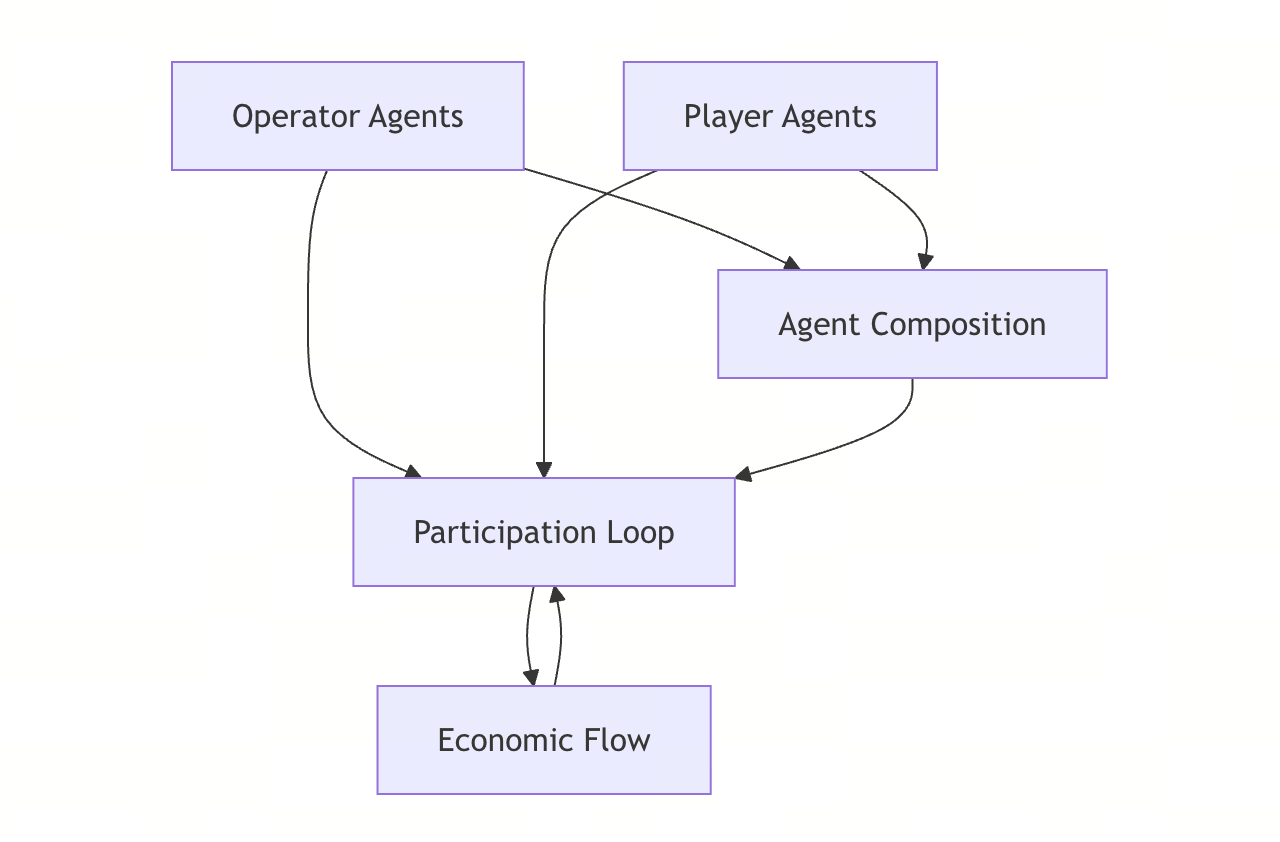
To enable collaboration between humans and AI agents, Audiera introduces a structured system composed of four core layers:
-
Economic Roles
Participants are divided into distinct roles, giving agents clear responsibilities:
-
Operator Agents, responsible for executing tasks and workflows
-
Player Agents, participating in gameplay and interactive scenarios
This allows agents to function as economic actors rather than passive tools.
-
Modular Agent Composition
Each AI agent is composed of multiple modules rather than a single function:
-
Persona, defining character identity
-
Skills, representing functional capabilities
-
Wallet Identity, enabling on-chain participation
This structure gives agents recognizable digital identities and allows them to directly engage in asset flows.
-
Participation Loop
Audiera establishes a continuous feedback loop that drives ongoing engagement and value creation:
These activities strengthen one another and sustain ecosystem activity.
-
Economic Flow
All value exchange within the ecosystem is facilitated through the $BEAT token, including:
It also lays the foundation for future governance mechanisms.
 (Source: Audiera Docs)
Gameplay and Core Features
Audiera is not a single gameplay experience but a combination of multiple interactive systems that together form a complete GameFi environment.
Rhythm Gameplay
The core gameplay revolves around rhythm-based inputs, where players follow musical beats to perform actions.
Scoring is based on:
Supported modes include:
-
Solo challenges
-
Social rooms
-
Competitive events
AI Music Creation
Audiera significantly lowers the barrier to music creation by allowing players to generate songs using AI.
The process typically includes:
-
Selecting a music style
-
Choosing a virtual singer such as Kira or Ray
-
Generating both music and lyrics
Users can submit their creations for community voting. Selected works may be added to the official music library and used in gameplay.
AI Virtual Character Interaction
AI characters on the platform are not just for entertainment. They can interact with users, generate personalized content, and contribute to overall engagement, making them a key driver of ecosystem activity.
Blockchain Asset Mechanisms
Audiera uses blockchain to provide NFT ownership, verifiable content attribution, and transparent reward distribution. However, these mechanisms are largely abstracted away, making them nearly invisible to casual users.
The Audiera Ecosystem Flow: From Participation to Rewards
Audiera is built around the idea that participation itself generates value. Whether from human users or AI agents, every interaction can be quantified and converted into rewards. This creates a sustainable system where entertainment and economic incentives are closely aligned.
The process can be divided into three key stages:
-
Entry Points
Users can access the ecosystem through multiple channels, including mobile apps and Telegram mini programs. They can then choose different game modes such as Classic, Dynamic, or Beat to begin their experience.
-
Behavior Accumulation
User actions are recorded and translated into measurable contributions, including:
These data points are aggregated and mapped into economic metrics that determine reward distribution.
-
Reward Distribution
Users can earn rewards through multiple mechanisms:
-
Dance-to-Earn, earning base rewards through gameplay performance
-
Leaderboard rewards, where top players receive BEAT airdrops
-
Event rewards, such as Alpha Clash prize pools
-
Music voting rewards, earning shares from content curation
-
Staking mechanism (veBEAT), staking BEAT for governance rights and weekly rewards, up to 5,000 BEAT
-
NFT boost mechanisms:
-
Beat Amplifier NFTs increase earnings
-
Higher-tier NFTs improve scoring efficiency and reward probability
Through this structure, Audiera forms a complete loop from participation to data accumulation to reward realization, enabling both users and AI agents to continuously generate and capture value.
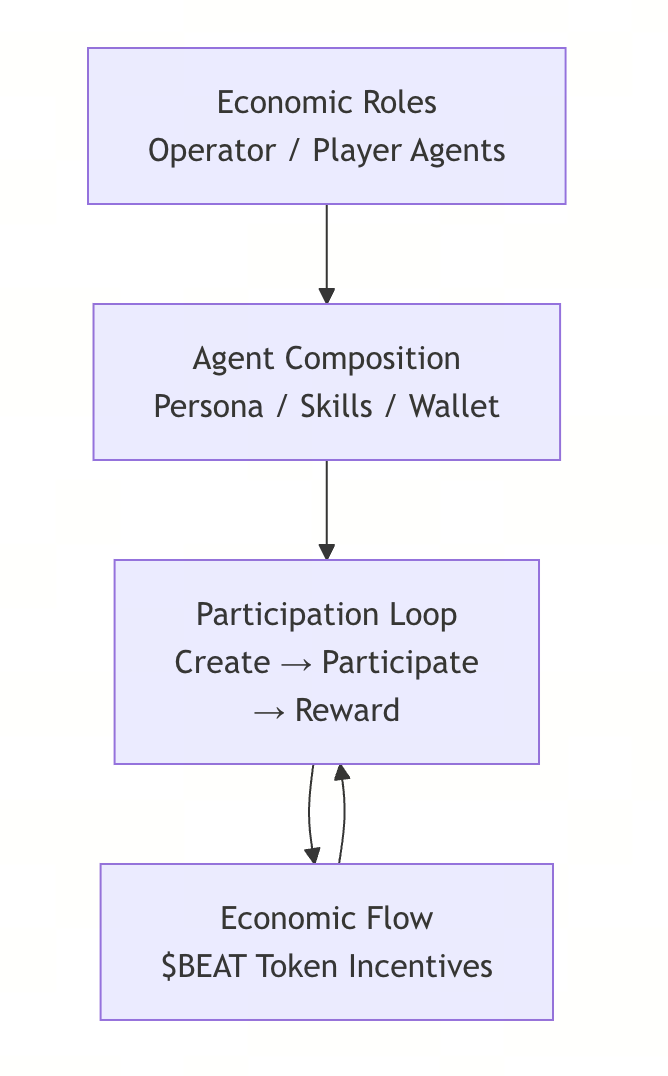
From a system design perspective, the platform can be understood as a closed loop consisting of Agents, capability structures such as Persona, Skills, and Wallet, participation cycles including Create, Participate, and Reward, and economic incentives driven by the BEAT token.
 (Source: docs.audiera)
BEAT Tokenomics: Incentives and Value Capture
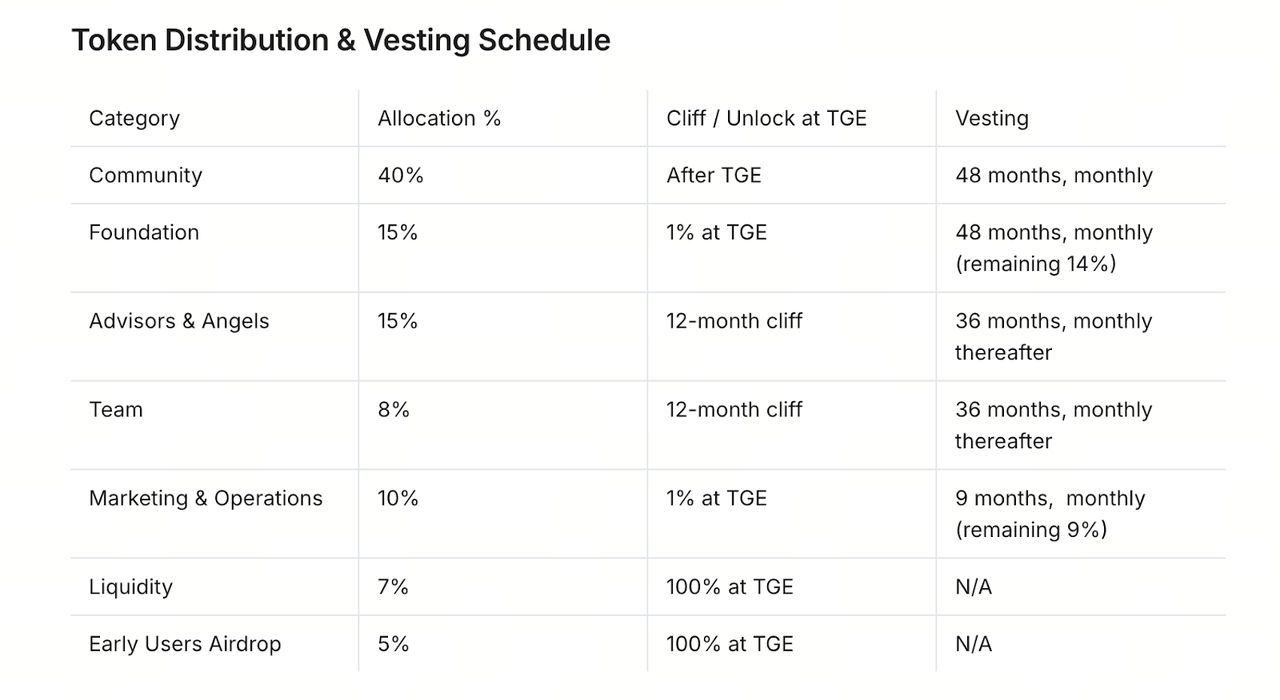
$BEAT serves as the core value medium within the Audiera ecosystem. Its design balances incentives with value capture, with a total supply of 1,000,000,000 BEAT.
Main Use Cases
-
Game reward distribution
-
Unlocking platform features
-
Supporting content creation
-
Future governance participation
Token Allocation
| Category |
Allocation |
| Community |
40% |
| Foundation |
15% |
| Advisors and Angel Investors |
15% |
| Team |
8% |
| Marketing and Operations |
10% |
| Liquidity |
7% |
| Early Users |
5% |
 (Source: docs.audiera)
Deflationary Mechanism
Audiera incorporates a deflationary model to strengthen token value. A portion of platform revenue such as subscriptions and NFT upgrade fees is used to buy back and burn BEAT tokens. As of early March 2026, more than 3.55 million BEAT tokens have been burned. This design positions the token not only as an incentive mechanism but also as a value capture tool.
Advantages and Risks
When evaluating a Web3 project, it is important to consider both its innovation and its potential risks.
Key Advantages
-
Deep integration of AI and GameFi Audiera combines entertainment and content creation, allowing users to act as both participants and creators. Gameplay and user-generated content are directly converted into value.
-
Forward-looking Agent Economy design By integrating AI agents as active economic participants, Audiera introduces a new paradigm where agents can create and exchange value rather than merely assist users.
-
Web2 IP foundation Leveraging the legacy user base of the Audition game, Audiera benefits from an existing audience, easing user onboarding and ecosystem expansion.
-
Low barrier to entry With access through Telegram mini programs and mobile apps, the platform simplifies onboarding and reduces learning costs, improving user conversion and retention.
Potential Risks and Challenges
-
Early-stage Agent Economy The role and value capture of AI agents in digital economies are still evolving, and long-term sustainability remains uncertain.
-
GameFi sustainability concerns The economic model depends heavily on user growth and engagement. A decline in activity could impact reward distribution and ecosystem stability.
-
Token economic pressure If token incentives are too heavily weighted, concentrated unlocks and sell pressure may affect price stability and market confidence. Balancing short-term incentives with long-term value remains a key challenge.
Conclusion
Audiera’s core innovation lies in redefining who participates in a digital economy. By allowing AI agents to become active contributors rather than passive tools, it expands the scope of value creation. Through the integration of rhythm gameplay, AI music generation, and blockchain systems, it builds a multi-layered ecosystem where entertainment, creativity, and economic incentives are tightly connected.
As AI continues to take on a larger role in digital environments, platforms like Audiera, built around the concept of an Agent Economy, may serve as important experiments in shaping future economic models.
FAQs
-
What is Audiera? Audiera is a Web3 platform built on BNB Chain that combines rhythm gameplay, AI music creation, and blockchain mechanisms. It introduces AI agents as economic participants, aiming to create an Agent-native digital economy where AI and humans co-create value.
-
What are Audiera’s core features? Its main features include rhythm-based gameplay, AI-generated music and content creation, community voting and distribution, AI virtual character interaction, and NFT-based asset systems.
-
How can users earn rewards on Audiera? Through its participation-driven model, users can earn rewards from gameplay performance, content creation, community engagement, leaderboard rankings, event participation, and token staking, with $BEAT serving as the core incentive and value medium.







