I. What Are Prediction Markets: Mechanisms and Information Pricing Logic
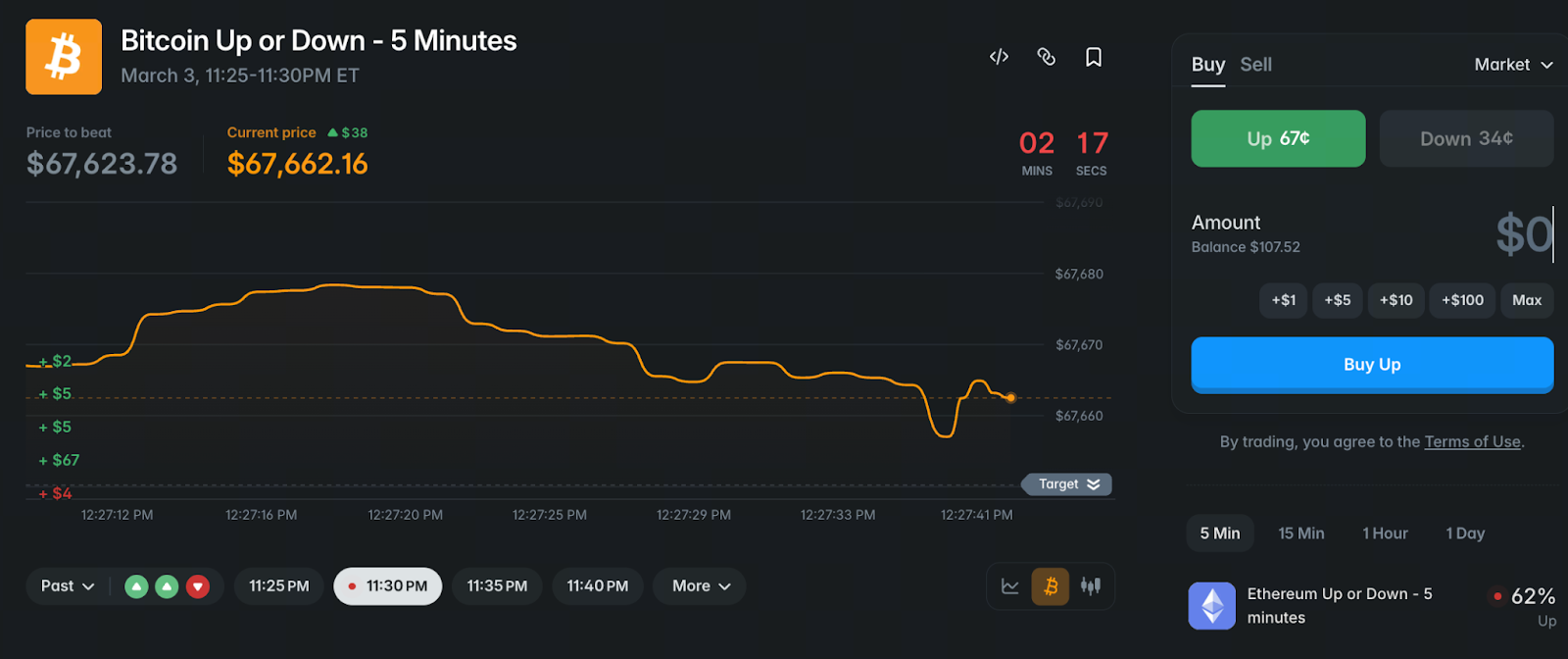
Source: Polymarket
Prediction markets are often mistaken for “betting platforms,” but from a financial perspective, they are actually systems that aggregate information and price probabilities through economic incentives.
The mechanism is simple: every contract price reflects the market’s real-time estimate of the probability that a future event will happen.
For example:
- YES contract price = 0.72 USDC
- This signals the market believes there is roughly a 72% chance the event will occur.
This mechanism defines prediction markets as a unique asset class—Probability Assets.
1. From Odds to Market Pricing
In traditional gambling, bookmakers set the odds to ensure long-term profits through commissions. Participants merely accept the pricing. Prediction markets, however, mark a critical shift: pricing power moves from the platform to the participants themselves.
Prices are formed through:
- Order books
- Automated Market Makers (AMM)
- Hybrid liquidity models
Participants trade based on their own information, research, and judgment. Ultimately, the price becomes a dynamic equilibrium of collective insight.
2. Why Prediction Markets Are Known as the “Truth Machine”
Academia has long considered prediction markets to be highly efficient information mechanisms because participants must bear financial consequences for their opinions—skin in the game.
Comparison:
| Information Mechanism | Cost | Information Quality |
|---|
| Polling | Near zero | Easily swayed by sentiment |
| Social Media | Zero cost | Extremely noisy |
| Expert Commentary | Reputational cost | Slow to update |
| Prediction Market | Real capital at risk | High information density |
When poor judgment leads to financial loss, participants are more likely to reveal their true beliefs rather than simply state a position.
As a result, prediction market prices often reflect trend shifts sooner than public opinion does.
II. The Underlying Logic Behind the Prediction Market Boom in 2026
The exponential growth of prediction markets in 2026 is not the result of a single technological breakthrough, but rather the convergence of three structural forces.
1. The Global Uncertainty “Super Cycle”
Demand for prediction markets fundamentally arises from uncertainty. In 2026, several macro variables converge:
- Federal Reserve monetary policy shift window
- Diverging global inflation paths
- Global events like the World Cup
- Major election cycles in multiple countries
In traditional finance, hedging these events typically requires complex derivatives. Prediction markets provide a more direct approach: investors can buy into the event itself.
For example:
- Will interest rates be cut?
- Will a specific policy pass?
- Will an index reach a certain range?
This shift is turning prediction markets from entertainment tools into macro risk trading instruments.
2. Capital Efficiency Revolution: From Locked Funds to Yield-Bearing Assets
Historically, slow growth in prediction markets was largely due to low capital efficiency. User funds were locked until the event concluded and could not earn returns. In 2026, new protocols (like Predict.fun) introduce Yield-Bearing Collateral.
Mechanisms include:
- Collateral automatically enters RWA yield pools
- Or connects to DeFi lending protocols
- Users earn both prediction and interest returns
Prediction markets now shift from “cost behavior” to “yield behavior.”
This change is critical—it enables prediction markets to compete with DeFi yield protocols for capital.
3. Compliance Breakthrough: Gray Markets Enter Mainstream Finance
Regulation has always been the biggest barrier for prediction markets. In 2026, a pivotal moment comes from the US:
- Kalshi’s landmark legal victory
- CFTC’s increasingly clear regulatory path for event contracts
This leads to two immediate outcomes:
- Institutional capital starts entering
- Prediction markets are recognized as legitimate financial derivatives
Prediction markets are now included in TradFi asset allocation discussions for the first time.
III. Core Prediction Market Platforms in 2026
The industry now shows a clear layered structure.
Polymarket — On-Chain Liquidity Gravity Center
Polymarket has become the “de facto standard” for Web3 prediction markets.
Key features:
- Built on Polygon network
- USDC settlement
- Largest global on-chain event market liquidity
Its price data is widely referenced by media, research institutions, and traders—serving as a real-time probability terminal for Web3.
2026 Insight: Despite compliance challenges, its permissionless nature enables rapid listing of long-tail and breaking events, a competitive advantage that compliant platforms struggle to match.
Participation value: Though no token has been issued yet, there’s broad expectation of an airdrop, and user activity is rising.
Kalshi — TradFi’s Compliance Bridge
Kalshi is currently one of the only prediction markets fully regulated by the US CFTC.
Features:
- Fiat deposits
- Strict KYC
- Compliant event contracts
Its user base is notably different:
- Hedge funds
- Macro traders
- Professional investment institutions
For macro events like:
- Non-farm payroll data
- Interest rate decisions
- Stock index events
Kalshi has become the primary tool for institutions.
- Advantages: Extremely high legal certainty
- Limitations: Geographic and product scope restrictions
Predict.fun — DeFi-Driven Efficiency Pioneer
Predict.fun represents the DeFi direction for prediction markets.
Core design includes:
- Prediction mining (Predict Points)
- Liquidity incentives
- Order book + AMM hybrid model
It solves the toughest challenge for new platforms: building liquidity during the cold start phase. With a points system and yield stacking, high-frequency traders and airdrop hunters quickly join the ecosystem.
Opinion Labs — Modular Prediction Infrastructure
Opinion Labs positions itself as a “prediction market layer.”
Developers can embed prediction features directly:
- Binary predictions
- Scalar predictions
- Multi-outcome combination markets
This enables prediction features to enter:
- Social platforms
- Content communities
- DAO governance
- Gaming applications
Prediction markets are evolving from single apps to native internet components.
IV. 2026 Investment Trends and Capital Structure Changes
The industry’s capital structure is shifting noticeably.
1. From Application Investment to Protocol Investment
Capital is now favoring:
- Liquidity infrastructure
- Cross-chain settlement layers
- Modular prediction protocols
Projects such as Azuro and Opinion are attracting more attention.
2. Diverging Valuation Logic
Different approaches yield different pricing models:
| Type | Valuation Anchor |
|---|
| Compliant Platform | Exchange-like PE model |
| Web3 Platform | TVL + user activity |
| Protocol Layer | Network effects and integration count |
Prediction markets now feature a multi-layered valuation system similar to DeFi for the first time.
3. AI Agent Entry
A major change in 2026 is that over 30% of trades are executed by AI Agents.
AI excels at:
- Real-time news parsing
- Automated trade execution
- Cross-platform arbitrage
Prediction markets are becoming one of the most suitable financial environments for AI, since outcomes are clearly verifiable.
V. Advanced: Participation and Strategy Selection
Each user type is suited to a different path.
Platform Selection
- Security / Large capital → Kalshi
- Hot trades / Airdrop expectations → Polymarket
- Capital efficiency / Incentive returns → Predict.fun
Cross-Platform Arbitrage Opportunities (Arbitrage)
Because participant groups differ:
- Web3 users focus on sentiment and narrative
- TradFi users focus on data and modeling
The same event often shows a 3%–5% price difference across platforms. Professional traders can hedge across platforms for low-risk returns.
Information Advantage Strategies
Success in prediction markets depends not on guessing, but on:
- Faster access to information
- Better probability assessment
- Stricter capital management
At its core, prediction market participation is closer to quantitative trading than gambling.
VI. Risk Warnings
1. Information Manipulation Risk
In low-liquidity markets, large capital can move prices and steer public opinion, creating feedback loops.
2. Oracle and Settlement Disputes
Complex events (such as policy interpretation) can still result in arbitration disagreements, a long-standing challenge prediction markets must address.
3. Regulatory Uncertainty
Legal definitions of “prediction” and “gambling” continue to change across countries, potentially affecting platform accessibility.
Conclusion
By 2026, prediction markets have made a critical leap—from niche experiments in geek communities to global probability pricing infrastructure. Their real value lies not in betting outcomes, but in transforming dispersed information into tradable prices. In an era of information overload, prediction markets offer a new way to form consensus: not by who speaks loudest, but by who is willing to pay for their judgment.
Understanding the information structure behind prices often delivers more lasting value than predicting outcomes themselves.







