Background and Timeline of the Sale
This sale was not a spontaneous decision. In late January 2026, Vitalik Buterin publicly announced that he had allocated 16,384 ETH from his personal holdings as a dedicated fund reserve. He intends to gradually invest these assets over the next few years in privacy technologies, open-source hardware, and verifiable security software systems. Based on the average ETH price at the time of sale (around $2,000), this portion of assets is valued at approximately $34.96 million, representing a well-defined, long-term capital arrangement.
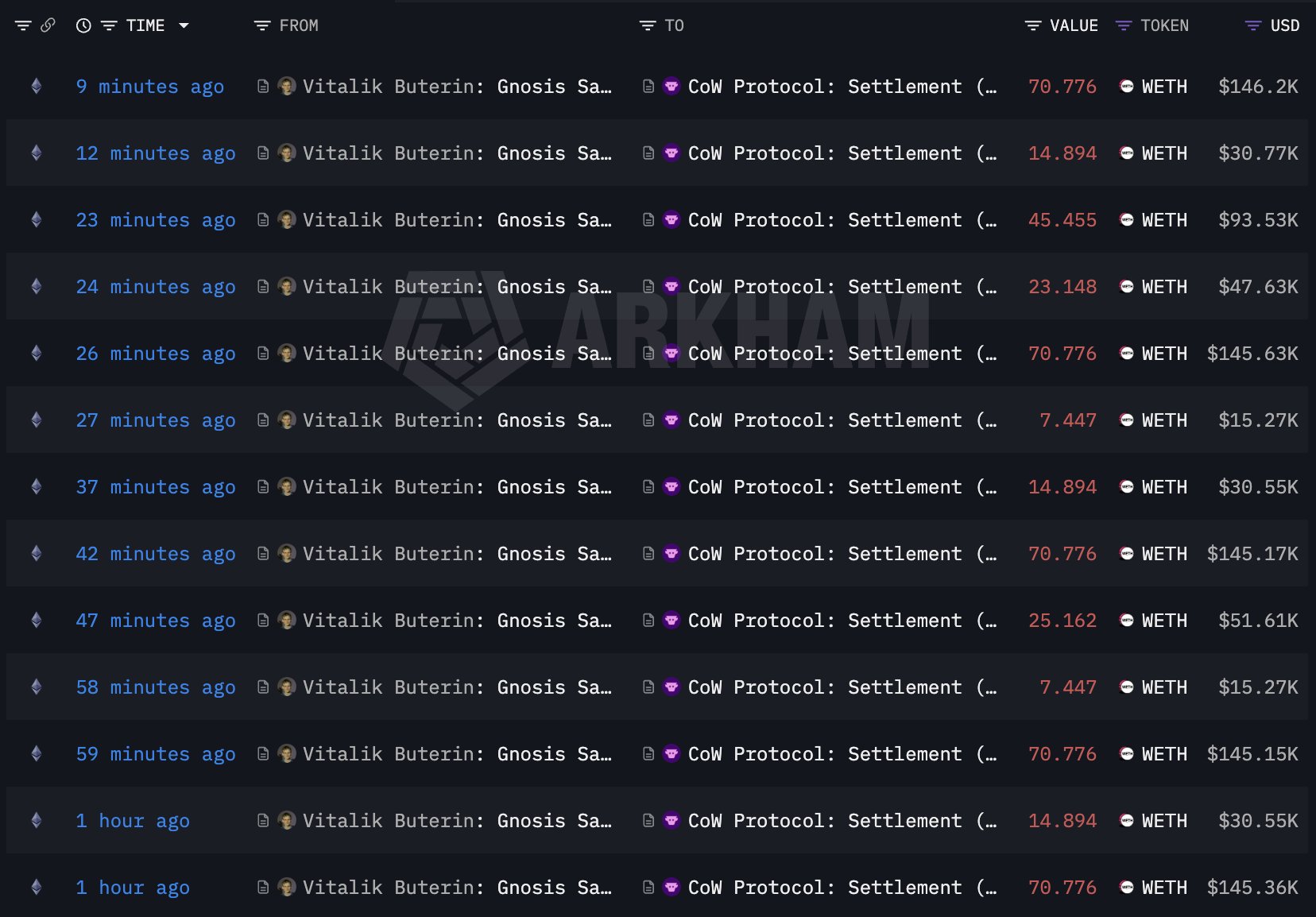
Starting in February, the related on-chain addresses began to show ongoing ETH outflows. This was not a one-time sale but was carried out in batches, with small amounts spread over several days. Data shows the first batch was transferred in early February, with the cumulative amount increasing through mid-month and nearing the planned total by late February. On February 26 at 12:32 (UTC+8), on-chain monitoring indicated cumulative sales reached 17,196 ETH, slightly exceeding the originally disclosed 16,384 ETH. The overall pace was more akin to a planned fund release than a sentiment-driven reduction.
Evolution of Historical Holdings and Current Scale Comparison
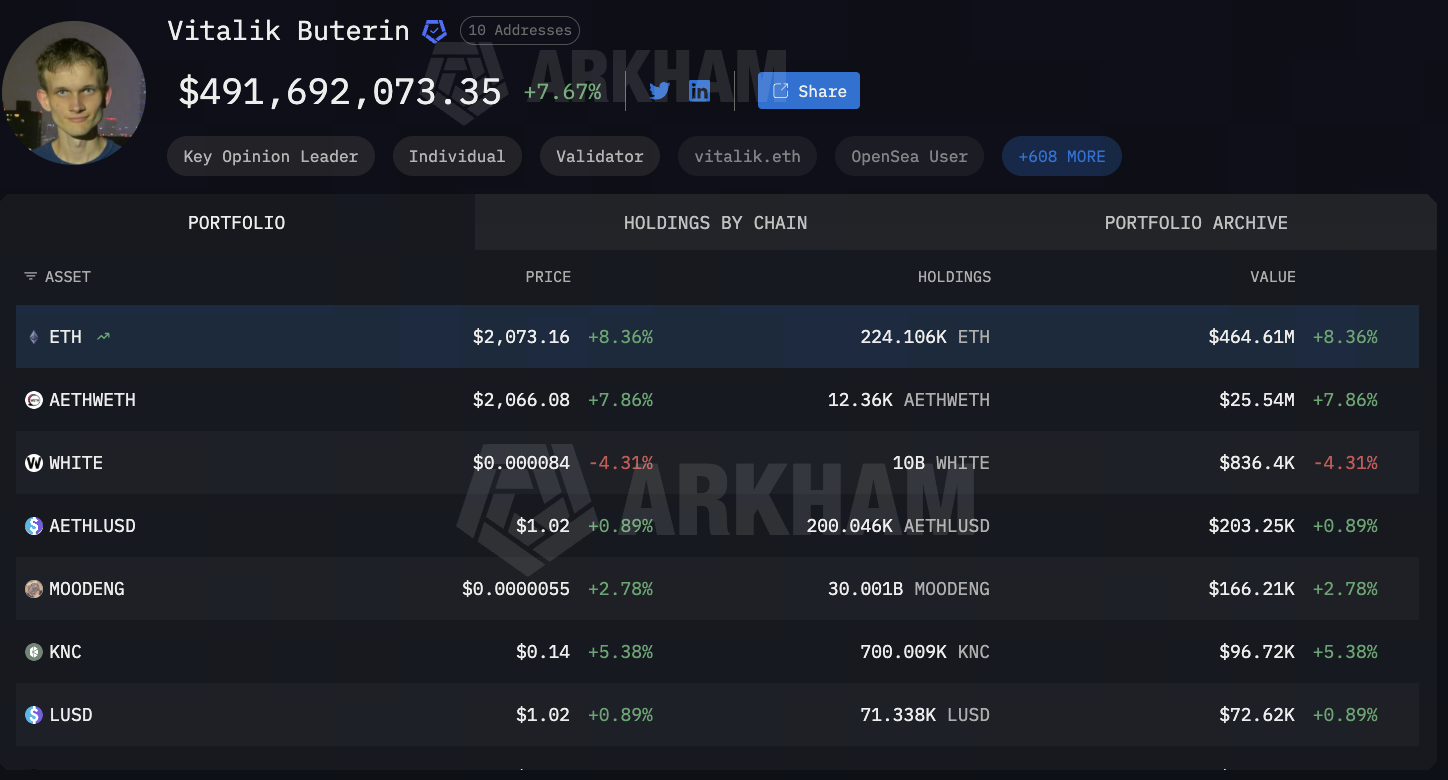
Chart: https://intel.arkm.com/explorer/entity/vitalik-buterin
According to Arkham Intelligence’s historical address tracking, by the end of 2015, addresses associated with Vitalik Buterin held roughly 660,000–700,000 ETH. Using 680,000 ETH as a median estimate and comparing it to the current traceable balance of about 220,000–240,000 ETH (including around 12,000 WETH), his holdings have decreased by approximately 440,000–460,000 ETH over ten years—a decline of over 60% from the peak.
The 17,196 ETH sold in this round represents about 7% of his current holdings; compared to the historical peak, it accounts for about 2–3%; relative to the total network supply, it is less than 0.02%.
In terms of quantity, this represents a periodic adjustment within the context of his long-term holdings evolution.
Historical ETH Sales Overview
Below is a summary of major sales or transfers compiled from public on-chain data and multiple analytics platforms:
| Date | Amount (ETH) | Type | Description |
|---|
| End of 2015 | 660,000–700,000 | Holdings Peak | Arkham address tracking data |
| 2021 | ~70,000 (estimate) | Reduction + Donation | Multiple sales and charitable donations during the bull market |
| 2023 | Several hundred | Small-scale sales | Transferred in batches on-chain |
| August 2024 | ~3,000 | Transfer | Capital structure adjustment |
| December 2024 | ~4,521 | Sale | Completed in batches |
| February 2026 | 17,196 | Sale | Cumulative sales in this round |
Important Notes:
- Some historical figures may vary slightly due to differences in statistical methodology.
- Transfers to multi-signature or fund addresses do not necessarily indicate market sales.
- There is no record of large-scale, one-off sell-offs.
Why Did Market Sentiment Amplify So Rapidly?
Founder actions naturally carry symbolic significance.
When the market is in a volatile phase, any movement by large holders is easily interpreted as a “trend signal.” Currently, there are three main perspectives in the market:
- This is a periodic cash-out.
- This is a structural adjustment with a clear use of funds.
- The market is amplifying a long-standing routine behavior.
The key issue is that historical data does not support the linear logic of “founder reduction = trend reversal.” During the 2021 bull market, Vitalik also made large donations and sales, but market trends were more influenced by macro liquidity and risk appetite.
As a result, public sentiment often exaggerates the symbolic meaning of such actions, overlooking the proportion of holdings and long-term trajectory.
The Gap Between Narrative and Reality
On-chain data is factual, but narratives do not always reflect reality. This round of sales has several key characteristics:
- Purpose of funds disclosed in advance
- Dispersed execution sized over time
- No abnormal single-day selling pressure
- The reduction is relatively limited compared to overall holdings
Viewed in isolation, “17,196 ETH” appears significant; but in the context of a nearly 700,000 ETH historical peak and a decade-long holding evolution, it is just one stage in a longer process.
The market is more inclined to spread the narrative of “the founder is bearish” than to discuss the rationale of asset rebalancing.
Real Industry Impact
From an industry perspective, the impact of this sale on the Ethereum ecosystem is more about sentiment than fundamentals.
Ethereum’s current supply and demand structure is mainly determined by the following factors:
- Network activity
- Staking ratio
- Layer 2 ecosystem expansion
- Institutional capital flows
- Macro liquidity conditions
A single individual’s reduction in holdings is unlikely to shift the overall supply-demand curve.
More importantly, if the funds are indeed used for privacy and open-source infrastructure development, the long-term effect could be positive for the ecosystem.
Future Direction Still Depends on Market Sentiment
If market sentiment stabilizes, this reduction will likely be seen as routine asset management.
If prices continue to weaken, the narrative may reinforce the idea that “the founder is exiting early,” even if the data does not fully support this claim.
If future disclosures clarify fund flows, public opinion may shift toward a neutral or even positive view.
Ultimately, the true driver of price remains macro capital flows and on-chain fundamentals, not a single reduction event.
Conclusion: Reduction Confirmed, Structural Logic Unchanged
As of February 26, 2026, Vitalik has cumulatively sold 17,196 ETH. From a historical high of 660,000–700,000 ETH to the current 220,000–240,000 ETH, the evolution of his asset structure has been underway for years. This round of sales represents a small share of his current holdings and an even smaller share of the total circulating supply. Rather than viewing this as a simple “bearish signal,” it is more accurate to see it as another step in a long-term asset rebalancing process.
Market sentiment can shift quickly, but on-chain structure and long-term trends are typically more stable.







