Vitalik Buterin Proposes Unified Node Architecture to Simplify Ethereum Infrastructure

2026-03-16 07:24:47
Beginner
Quick Reads
Ethereum co-founder Vitalik Buterin has recently put forward a new technical proposal to unify Ethereum nodes’ currently separate consensus and execution layer architectures, making node operation simpler. The proposal aims to reduce technical barriers so that more individual users can operate their own nodes, further advancing the network’s decentralization.

Vitalik Introduces New Node Architecture Proposal

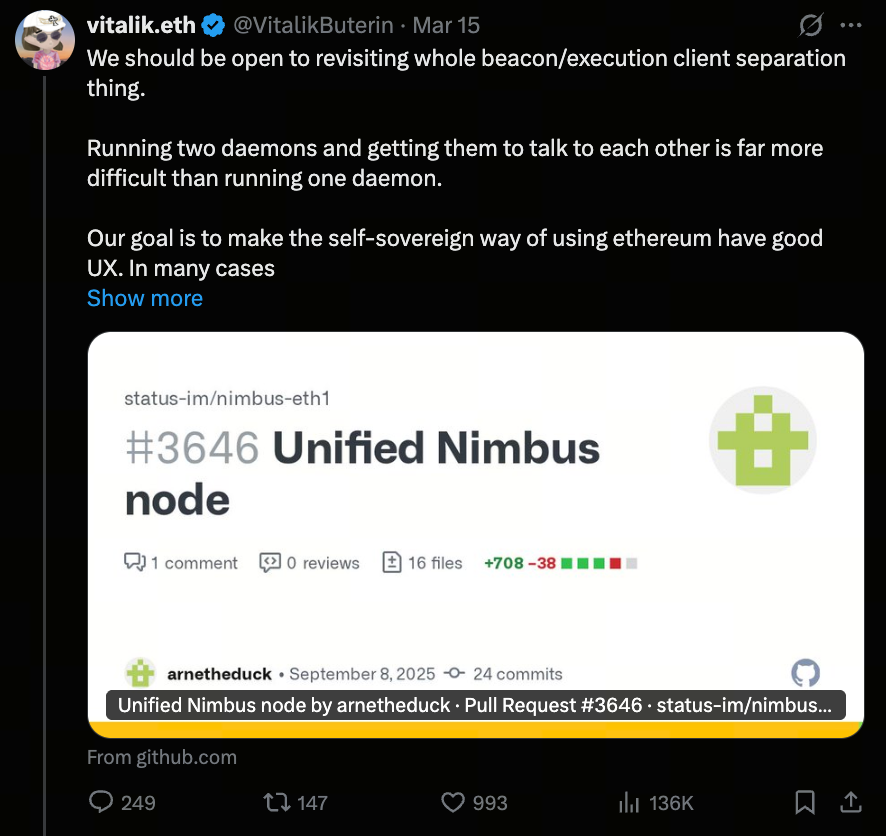
Vitalik Buterin recently unveiled a new technical proposal aimed at simplifying Ethereum node operations. Published as a Pull Request, the proposal centers on merging the two core programs currently run separately into a unified backend architecture, making node deployment more straightforward.

At present, Ethereum nodes must run:

  • Consensus layer program

  • Execution layer program

Vitalik Introduces New Node Architecture Proposal (Source: VitalikButerin)

These two systems must operate in sync and exchange data to keep the network running.

Complexity of the Current Node Architecture

Under the current design, node operators (also known as validators) must deploy two separate systems:

  • Consensus Layer: Responsible for blockchain consensus mechanisms and staking, primarily managed through the Beacon Chain.

  • Execution Layer: Handles transaction processing and smart contract execution.

Both programs require configuration, synchronization, and data transfer, making node operation relatively complex.

For many average users, this technical barrier makes running a node independently challenging.

Node Operation Barriers Affect Decentralization

Buterin argues that the current node architecture has inadvertently turned node operation into a specialized technical task. He points out that many believe node operation must be handled by professional DevOps teams, but this mindset actually hinders blockchain decentralization.

His position is:

  • Individuals and households should be able to run nodes easily

  • Nodes should not be considered highly specialized infrastructure

If node deployment remains too complex, most users will rely on third-party services, which could weaken the network’s decentralization.

Time and Technical Barriers Remain Key Challenges

Buterin also notes that even users with adequate hardware and technical skills may lack the time to maintain a node.

He therefore stresses a core principle: node operation should be simpler. Only when node deployment becomes more accessible will more individuals participate in network infrastructure.

Partially Stateless Node Concept

Beyond simplifying node architecture, Buterin also proposed another design concept in May 2025: Partially Stateless Nodes.

These nodes differ from traditional ones in that:
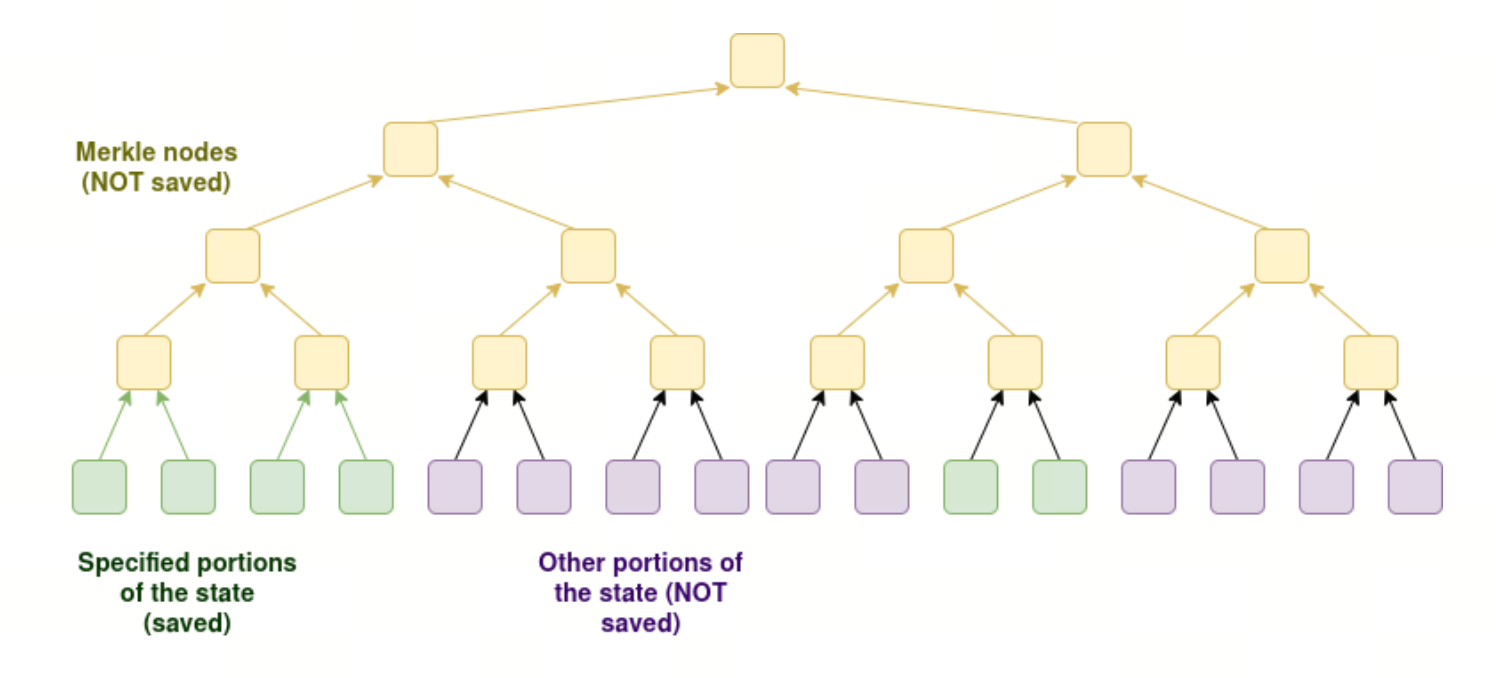
  • They do not need to store the entire blockchain history

  • They only retain the data necessary for node operation

Partially Stateless Node Concept (Source: Vbuterin)

This design can significantly reduce the resources required to run a node.

Lowering Hardware and Storage Costs

For many node operators, the main technical constraint is often disk storage. Blockchain networks—especially smart contract platforms—generate large volumes of data. As the Ethereum network expands through DeFi, NFTs, and various decentralized applications, on-chain data continues to grow.

This results in:

  • Nodes requiring greater storage capacity

  • Increasing operating costs

The Partially Stateless Node concept is designed to address this challenge.

Risks of RPC Infrastructure Centralization

Buterin also warns of another potential issue in blockchain infrastructure: RPC service centralization. If most users depend on a handful of RPC service providers to access the blockchain, several risks could arise:

  • Service providers may restrict certain users

  • Some regions may be blocked

  • Users may face censorship or deplatforming

Thus, enabling more people to run their own nodes is essential for maintaining an open network.

Vitalik’s Personal Funding Supports Technical Development

In addition to technical proposals, Buterin recently announced that he has allocated 16,384 Ether from his personal holdings, valued at approximately $45 million.

This funding will support a range of technical developments, including:

  • Privacy protection technologies

  • Open-source hardware

  • Verifiable and secure software systems

Buterin stated that these funds will be gradually invested in related research and development over the coming years.

Meanwhile, the Ethereum Foundation is entering a more restrained spending phase but will continue advancing Ethereum’s technical roadmap.

Conclusion

Vitalik Buterin’s proposals for node architecture optimization and the Partially Stateless Node concept highlight the Ethereum community’s ongoing commitment to infrastructure decentralization. By reducing the technical and hardware barriers to node operation, more individual users may participate directly in network operations rather than relying on a few large service providers. As these technologies evolve, these improvements could enhance network accessibility and further strengthen Ethereum’s long-term resilience as an open blockchain infrastructure.

Author:  Allen
Disclaimer
* The information is not intended to be and does not constitute financial advice or any other recommendation of any sort offered or endorsed by Gate.
* This article may not be reproduced, transmitted or copied without referencing Gate. Contravention is an infringement of Copyright Act and may be subject to legal action.

Share

Crypto Calendar
Tokenların Kilidini Aç
Wormhole, 3 Nisan'da 1.280.000.000 W token açacak ve bu, mevcut dolaşımdaki arzın yaklaşık %28,39'unu oluşturacak.
W
-7.32%
2026-04-02
Tokenların Kilidini Aç
Pyth Network, 19 May'da 2.130.000.000 PYTH tokenini serbest bırakacak ve bu, mevcut dolaşım arzının yaklaşık %36,96'sını oluşturacak.
PYTH
2.25%
2026-05-18
Tokenların Kilidini Aç
Pump.fun, 12 Temmuz'da 82,500,000,000 PUMP token'ı kilidini açacak ve bu, mevcut dolaşımdaki arzın yaklaşık %23,31'ini oluşturacak.
PUMP
-3.37%
2026-07-11
Token Kilidi Açma
Succinct, 5 Ağustos'ta mevcut dolaşımdaki arzın yaklaşık %104,17'sini oluşturan 208,330,000 PROVE token'ını serbest bırakacak.
PROVE
2026-08-04
sign up guide logosign up guide logo
sign up guide content imgsign up guide content img
Sign Up

Related Articles

What is Fartcoin? All You Need to Know About FARTCOIN
Intermediate

What is Fartcoin? All You Need to Know About FARTCOIN

Fartcoin (FARTCOIN) is a representative meme coin within the Solana ecosystem based on an AI-driven narrative. Its core concept originated from an experiment aimed at exploring the "boundaries between AI Agents and humor." More than just a digital asset with social attributes, the project deeply couples absurd humor culture with on-chain financial logic by integrating autonomous AI interaction models.
2026-03-04 05:38:51
Gold Price Forecast for the Next Five Years: 2026–2030 Trend Outlook and Investment Implications, Could It Reach $6,000?
Beginner

Gold Price Forecast for the Next Five Years: 2026–2030 Trend Outlook and Investment Implications, Could It Reach $6,000?

Analyze current gold price trends alongside authoritative five-year forecasts, integrating an evaluation of market risks and opportunities. This gives investors insight into the potential trajectory of gold prices and the main drivers expected to shape the market over the next five years.
2026-01-26 03:33:33
2026 Silver Price Forecast: Bull Market Continuation or High-Level Pullback? In-Depth Analysis of Silver Candlestick Chart
Beginner

2026 Silver Price Forecast: Bull Market Continuation or High-Level Pullback? In-Depth Analysis of Silver Candlestick Chart

2026 Silver Price Forecast: Latest Outlook This article integrates current market trends, silver candlestick chart analysis, and momentum factors to assess the potential key support and resistance levels, upside targets, and pullback risks for silver prices. The goal is to help investors make informed, rational decisions.
2026-01-28 08:36:39
Crypto Future Profit Calculator: How to Calculate Your Potential Gains
Beginner

Crypto Future Profit Calculator: How to Calculate Your Potential Gains

Crypto Future Profit Calculator helps traders estimate potential earnings from futures contracts by considering entry price, leverage, fees, and market movement.
2025-02-09 17:28:28
What is Oasis Network (ROSE)?
Beginner

What is Oasis Network (ROSE)?

The Oasis Network is driving the development of Web3 and AI through smart privacy technology. With its privacy protection, high scalability, and cross-chain interoperability, the Oasis Network is providing new possibilities for the future development of decentralized applications.
2025-05-20 09:41:15
Crypto Futures Calculator: Easily Estimate Your Profits & Risks
Beginner

Crypto Futures Calculator: Easily Estimate Your Profits & Risks

Use a crypto futures calculator to estimate profits, risks, and liquidation prices. Optimize your trading strategy with accurate calculations.
2025-02-11 02:25:44