Squads Users Alert: Understanding Address Poisoning Attacks and How to Stay Safe

Last Updated 2026-04-15 08:52:17
Reading Time: 3m
Recently, an address contamination attack has targeted Squads multi-signature Wallet users. While no Assets have been lost, the attack could mislead users through interface manipulation and prompt incorrect actions.

What Is an Address Poisoning Attack?

In the blockchain space, an address is fundamentally a publicly visible string, which means anyone can observe and leverage this information to design attacks.

The recent incident targeting Squads users is a classic example of address poisoning. Attackers create fake addresses that closely resemble your account, using visual deception to prompt mistaken actions. This type of attack does not compromise the system directly—it exploits human error in judgment.

How Does the Attack Occur?
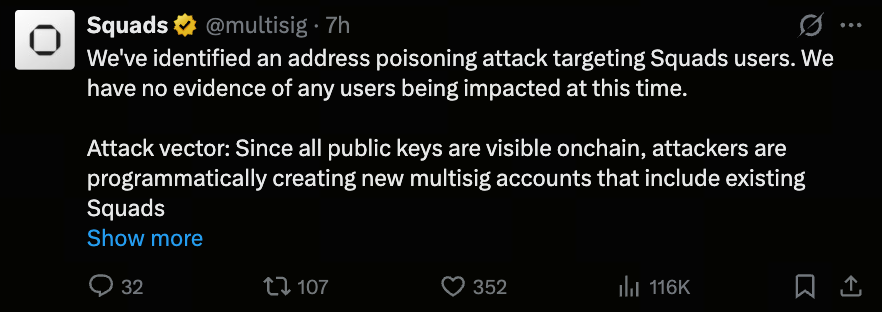
(Source: multisig)

This event primarily unfolded through two methods:

  1. Forging Multisig Accounts

Attackers set up new multisig wallets and add the victim’s public key to the member list, causing these accounts to appear in the user interface. Because the system displays accounts associated with your address, these fake accounts blend into your list.

  1. Imitating Address Formats

Attackers intentionally generate addresses with beginnings and endings similar to legitimate ones. For example:

  • Real address: ABCD...XYZ

  • Fake address: ABCF...XYA

If you only check the first and last few characters, it’s easy to misjudge.

What Is the Purpose of the Attack?

The main objective of this attack isn’t to hack systems, but to trick you into making mistakes.

Common goals include:

  • Accidentally transferring funds to a fake address

  • Signing transactions you did not initiate

  • Mistaking fake accounts for team accounts

The errors stem from user actions, not system vulnerabilities.

Is Fund Security Affected?

Currently, the key takeaway is that there have been no known fund losses, and the protocol itself remains uncompromised.

Attackers cannot:

  • Access your assets

  • Modify your multisig settings

  • Force transactions to execute

As long as you avoid operational mistakes, your assets remain secure.

Official Upcoming Security Updates

(Source: multisig)

To further mitigate risk, the Squads team has planned a series of UI enhancements:

  1. Short Term (Immediate)
  • Display security warning banners

  • Mark multisig accounts that have never interacted before

  1. Mid-Term (Within a Few Days)
  • New accounts will default to a pending confirmation status

  • Users must manually add accounts to their list (whitelist mechanism)

The core objective of these features is to reduce the likelihood of mistaking addresses.

How Should Users Protect Themselves?

To mitigate potential attack risks, it’s essential to develop sound operational habits. Always remain vigilant with unfamiliar multisig accounts—only interact with accounts you created or those explicitly verified by your team. Avoid engaging with suspicious addresses, and never rely solely on the first or last few characters to verify authenticity. The best practice is to compare the full address or confirm through internal records and whitelists to minimize errors.

In addition, since multisig environments typically involve multiple collaborators, any uncertain transaction should be confirmed with the team before proceeding to prevent asset loss due to miscommunication. It’s also recommended to pin frequently used and trusted accounts to the top of your list—this not only boosts efficiency but also reduces the risk of accidental clicks or mistakes.

Summary

Address poisoning attacks are fundamentally a form of social engineering that exploits human nature, not technical flaws. The Squads case is a strong reminder that blockchain security relies not just on protocol design, but also on user behavior. In the on-chain world, consistently verifying addresses and carefully signing transactions are the most important defenses for protecting your assets.

Author:  Allen
Disclaimer
* The information is not intended to be and does not constitute financial advice or any other recommendation of any sort offered or endorsed by Gate.
* This article may not be reproduced, transmitted or copied without referencing Gate. Contravention is an infringement of Copyright Act and may be subject to legal action.

Related Articles

The Future of Cross-Chain Bridges: Full-Chain Interoperability Becomes Inevitable, Liquidity Bridges Will Decline
Beginner

The Future of Cross-Chain Bridges: Full-Chain Interoperability Becomes Inevitable, Liquidity Bridges Will Decline

This article explores the development trends, applications, and prospects of cross-chain bridges.
2026-04-08 17:11:27
Solana Need L2s And Appchains?
Advanced

Solana Need L2s And Appchains?

Solana faces both opportunities and challenges in its development. Recently, severe network congestion has led to a high transaction failure rate and increased fees. Consequently, some have suggested using Layer 2 and appchain technologies to address this issue. This article explores the feasibility of this strategy.
2026-04-06 23:31:03
Sui: How are users leveraging its speed, security, & scalability?
Intermediate

Sui: How are users leveraging its speed, security, & scalability?

Sui is a PoS L1 blockchain with a novel architecture whose object-centric model enables parallelization of transactions through verifier level scaling. In this research paper the unique features of the Sui blockchain will be introduced, the economic prospects of SUI tokens will be presented, and it will be explained how investors can learn about which dApps are driving the use of the chain through the Sui application campaign.
2026-04-07 01:11:45
Navigating the Zero Knowledge Landscape
Advanced

Navigating the Zero Knowledge Landscape

This article introduces the technical principles, framework, and applications of Zero-Knowledge (ZK) technology, covering aspects from privacy, identity (ID), decentralized exchanges (DEX), to oracles.
2026-04-08 15:08:18
What is Tronscan and How Can You Use it in 2025?
Beginner

What is Tronscan and How Can You Use it in 2025?

Tronscan is a blockchain explorer that goes beyond the basics, offering wallet management, token tracking, smart contract insights, and governance participation. By 2025, it has evolved with enhanced security features, expanded analytics, cross-chain integration, and improved mobile experience. The platform now includes advanced biometric authentication, real-time transaction monitoring, and a comprehensive DeFi dashboard. Developers benefit from AI-powered smart contract analysis and improved testing environments, while users enjoy a unified multi-chain portfolio view and gesture-based navigation on mobile devices.
2026-03-24 11:52:42
What Is Ethereum 2.0? Understanding The Merge
Intermediate

What Is Ethereum 2.0? Understanding The Merge

A change in one of the top cryptocurrencies that might impact the whole ecosystem
2026-04-09 09:17:06





