Rapid Market Recovery: Risk Assets Rally Across the Board
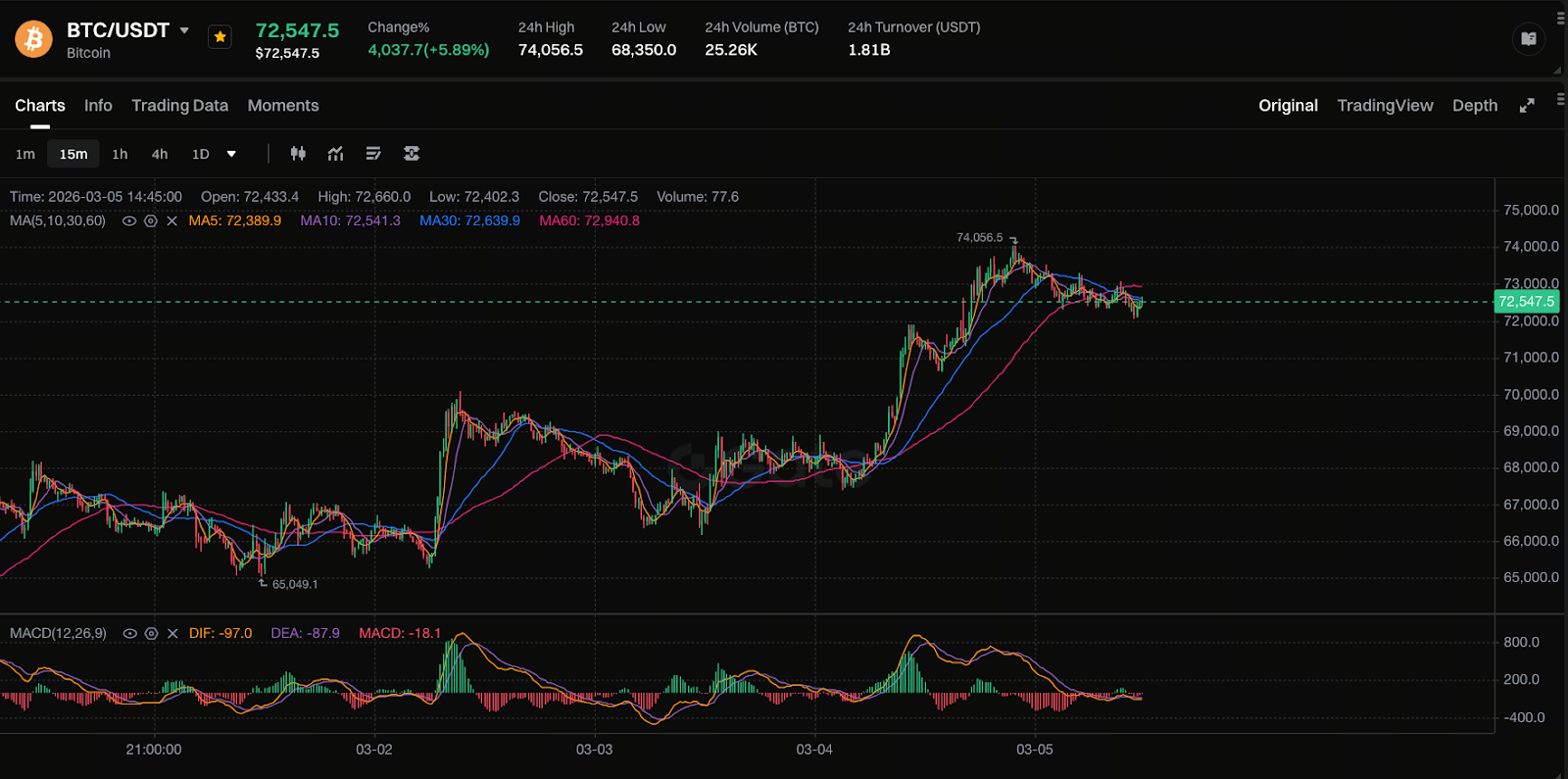
Image source: Gate
In the early hours of March 5, the crypto market staged a notable rebound. Bitcoin briefly surged to $74,050, its highest level since February 5, lifting the total crypto market capitalization back above $2.538 trillion.
This upswing was not an isolated event—it resonated in tandem with traditional financial markets. US equities saw crypto-related stocks post strong gains:
- MicroStrategy (MSTR) climbed 10.37%
- Coinbase (COIN) jumped 14.57%
- Circle Internet Group (CRCL) rose 5.63%
At the same time, Asian markets showed a clear return to risk appetite. Korea’s KOSPI Composite Index opened over 11% higher, and Japan’s Nikkei 225 advanced more than 4%.
This simultaneous rally across assets and regions typically signals that the market is reassessing the broader macro environment, rather than just responding to sector-specific trends.
Macro Variables: Market Is Repricing Federal Reserve Policy
This risk asset recovery was triggered in part by shifts in US political and monetary policy expectations.
The White House submitted Kevin Warsh’s nomination as Federal Reserve Chair to the Senate. Warsh, a former Fed Governor, is seen as relatively market-friendly by investors.
Currently, the two most sensitive variables for monetary policy are:
- Whether rate cuts will be brought forward
- Whether financial stability will take precedence over inflation control
If the Fed shifts toward prioritizing financial market stability, high-volatility assets—including crypto—typically receive stronger liquidity support.
As a result, the market interprets this nomination as a potential “policy shift signal.”
Geopolitical Variables: Risk Premiums Temporarily Decline
Another key development comes from the US Congress. The Senate did not pass a vote to halt actions against Iran, signaling that short-term geopolitical risk has not escalated.
Over the past few weeks, the Middle East situation has been a major variable for global markets:
- Oil price volatility
- Safe-haven assets rising
- Risk assets under pressure
When conflict does not escalate, markets tend to quickly reverse prior risk discounts. This explains why the rebound appeared not only in crypto, but also in equities.
A Key Phenomenon: BTC Reconnects With Traditional Markets
Since 2025, crypto markets had shown “independent price action.” But this rebound marks a clear shift: Bitcoin has reestablished its linkage with traditional risk assets.
This is evident in:
- BTC rising
- Crypto stocks rising
- Asian equities rising
- Risk assets rallying overall
This pattern usually suggests a deeper change: the global liquidity environment is improving at the margin.
In other words, the market is trading the macro liquidity cycle—not just a single asset.
Institutional Forces Still Dominating Bitcoin’s Price Action
One of the key beneficiaries of Bitcoin’s breakout is corporate holding institutions. The standout example is MicroStrategy, led by Michael Saylor. MicroStrategy holds hundreds of thousands of BTC, and its stock has become a high-leverage proxy for Bitcoin.
When BTC rises:
- MSTR typically sees even larger gains
- Traditional capital markets can indirectly allocate BTC via equities
This further strengthens the trend of Bitcoin being integrated into global asset allocation.
The Real Structure of Market Sentiment: Rebound or New Trend?
Although market sentiment has clearly warmed, structurally this is more likely a liquidity-driven, short-term rebound.
There are three main reasons for this.
First: Macro Uncertainty Remains
US monetary policy remains in a high-rate environment. While rate cut expectations exist, they have not yet materialized.
Second: Geopolitical Risks Have Not Fully Subsided
The Middle East situation remains uncertain. If conflict escalates, risk assets may quickly correct.
Third: Market Leverage Is Rising Rapidly
After BTC broke through key price levels:
- Leverage increased
- Futures open interest rose
- Short-term volatility may be amplified
This suggests sharp fluctuations may accompany the upward movement.
Future Market Development Paths
Looking ahead over the next few months, three scenarios are likely for the market.
1. Liquidity Improvement Drives a New Uptrend
If the following occur:
- Rate cut expectations strengthen
- ETF inflows continue
- Macro risks ease
Bitcoin could retest historic highs.
In this scenario, the market target range could move to $80,000–$90,000.
2. Choppy Uptrend
A more realistic scenario might be:
- BTC fluctuates repeatedly in the $70,000–$80,000 range
- Macro data continuously influences sentiment
- Institutional funds gradually position
This pattern aligns with a classic mid-stage bull market structure.
3. Risk Events Trigger a Pullback
If the following occur:
- Middle East conflict escalates
- US financial market volatility
- ETF outflows
BTC may pull back to the $65,000–$70,000 range. However, under the current structure, the probability of a sharp break below the long-term trend remains low.
Long-term trend: Bitcoin is becoming a macro asset
Over a longer cycle, Bitcoin’s market role is evolving.
Over the past decade, Bitcoin was primarily viewed as:
- Technical experiment
- Speculative asset
Now, it is gradually becoming part of global macro assets. This means BTC’s price is no longer driven solely by the crypto industry, but is closely tied to:
- Global liquidity
- Interest rate cycles
- Geopolitics
- Institutional asset allocation
In other words, Bitcoin is gradually entering the global asset pricing system.
Conclusion: What Is the Market Trading Right Now?
On the surface, this rally looks like a risk asset rebound. But the deeper logic is that the market is repricing the future liquidity environment.
When investors expect more accommodative policy ahead, high-volatility assets tend to lead the gains. Thus, the real core question is not how high Bitcoin has climbed, but whether the global financial system is entering a new liquidity cycle.
If the answer is yes, then this rebound may just mark the beginning of a larger trend.







