In traditional Web2 architectures, internet services are highly centralized, with data and value flows controlled by platforms. The AEA framework introduced by Fetch.ai proposes a different approach by combining distributed ledger technology with multi-agent systems to create a decentralized digital economy, where individuals and organizations can parFetch.aiticipate as autonomous agents in market interactions and coordination.a decentralized digital economy
From both a technical and economic perspective, FET is not merely a payment token. It functions as a core pricing mechanism embedded within an agent, protocol, and settlement layer architecture. Through this structure, FET facilitates interactions, transactions, and value distribution among AI agents, forming an on-chain economic system driven by machine-based participation.
Core Functions And Use Cases Of The FET Token
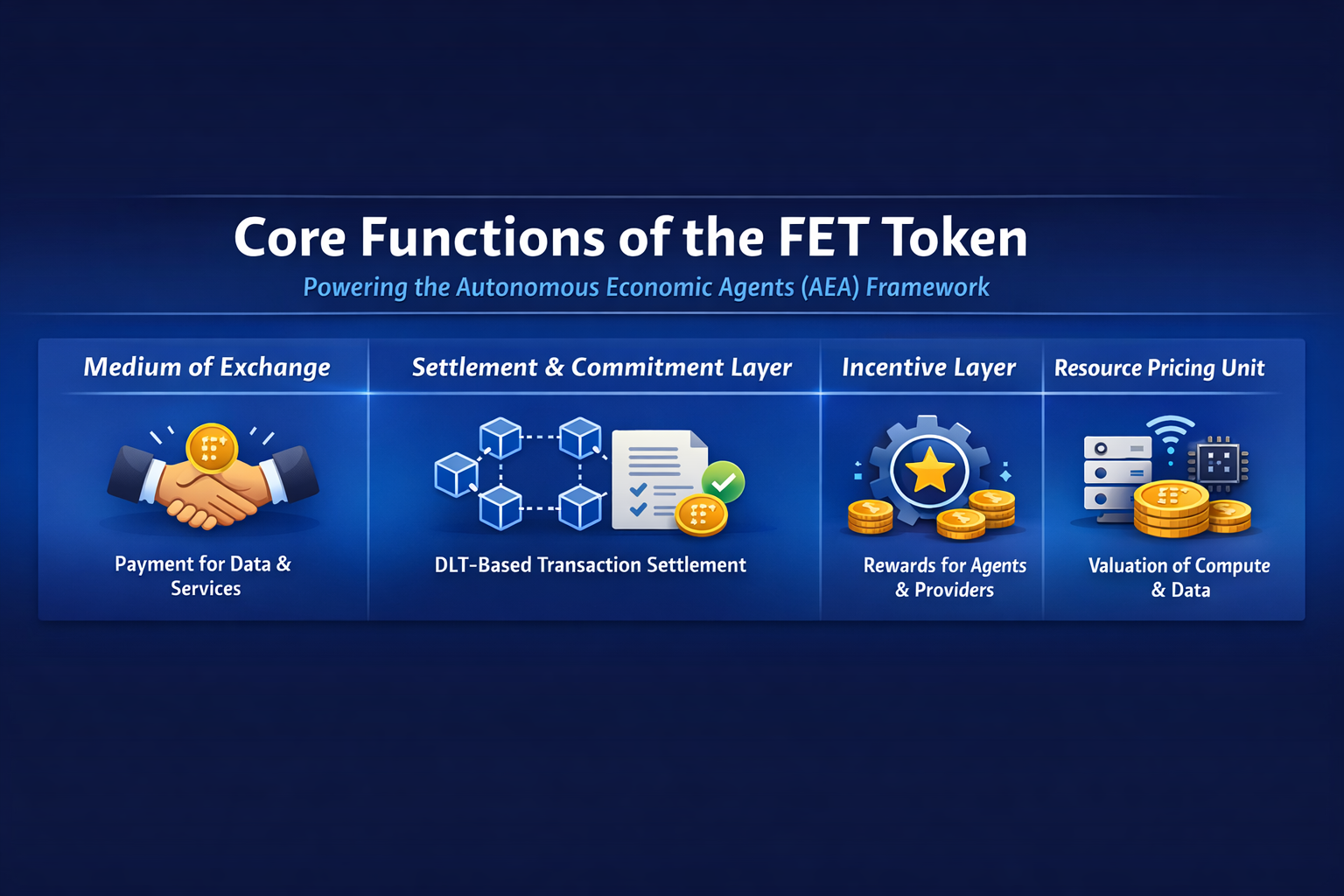
Within the AEA framework, the role of FET can be understood as an economic coordination layer. Each Autonomous Economic Agent operates with several key capabilities:
-
Autonomous decision making driven by AI or predefined rules
-
A wallet with an on-chain identity
-
The ability to transact and sign actions as part of economic activity
FET serves as the foundational medium enabling these behaviors:
-
Medium of exchange Agents interact through protocols for tasks such as data purchasing, service execution, or resource allocation, with FET used for payment and settlement
-
Settlement and commitment layer Distributed ledger technology enables trustless value exchange and contract execution, with FET acting as the unit of value within this layer
-
Incentive mechanism Agents providing data, computation, or services receive FET rewards, sustaining network activity and participation
-
Pricing unit for agent operations Communication, computation, and data access within the agent network can all be priced, with FET serving as the standardized unit
In essence, FET is not simply an AI related token but a settlement asset within a machine driven economy.
Token Distribution And Incentive Mechanism
Participants within the AEA ecosystem include:
The incentive structure of FET follows a contribution based model:
-
Service rewards: Agents that provide data or services receive FET in return
-
Network operation incentives: Nodes that maintain communication, discovery, and settlement layers are rewarded
-
Ecosystem growth incentives: Developers who build new agents or protocols can receive subsidies or market driven revenue
Through distributed ledger technology, the multi agent system gains both economic incentives and coordination capabilities, enabling large scale deployment. As a result, FET distribution is not static but dynamically adjusts based on real economic activity within the network.
Role Of FET In Decentralized Finance
Autonomous Economic Agents can already be applied in several scenarios:
This gives FET a distinct position within DeFi:
-
Agent driven trading markets Agents can execute asset trades autonomously rather than relying on manual user actions
-
Bilateral negotiation mechanisms Agents can negotiate prices through protocols, similar to automated over the counter interactions
-
On-chain settlement assurance All transactions are settled through distributed ledger technology, ensuring transparency and trust
The key difference from traditional DeFi is that FET enables Agent to Agent Finance rather than User to Protocol interactions.
Governance And Decision Making With FET
Within the AEA architecture, a critical component is the DecisionMaker module.
-
The DecisionMaker is the only component that can access the wallet
-
It determines whether a transaction should be executed
-
It represents the agent’s preferences and objective functions
This creates two layers of governance:
Agent level governance: Each agent makes decisions based on its own strategy, such as maximizing returns or optimizing efficiency
Protocol level governance: FET holders can participate in protocol upgrades and parameter adjustments through on-chain governance
The key distinction is that traditional DAOs rely on human voting, while the Fetch.ai system combines both agent driven decisions and human participation.
Market Value And Long Term Potential Of FET
The long term value of FET depends on several structural factors:
-
Network usage and agent activity: More agents and transactions increase demand for FET
-
Dependence on on-chain settlement: All economic interactions ultimately rely on distributed ledger settlement
-
Adoption of AI agents: If autonomous agents become a mainstream software paradigm, FET could serve as a foundational asset
-
Scaling of multi agent systems: The broader goal is to enable large scale deployment across multiple participants and agents
In the long run, the upper bound of FET’s value is tied to whether machines evolve into active participants in economic systems rather than passive tools.
Investment Analysis Of FET Returns And Risks
When evaluating the investment value of FET, it is not sufficient to focus on token price or short term market sentiment. The core question lies in whether the agent-based economy, built on Autonomous Economic Agents, can be realized and scaled in practice. In essence, investing in FET is a bet on the viability of this new economic paradigm.
Potential Upside
-
Narrative driven growth from the convergence of AI and Web3
-
Innovative agent based economic model with new value creation logic
-
Real world applicability of multi agent systems across industries
-
Increasing network usage leading to higher demand for FET
Key Risks
-
High technical complexity: The AEA architecture combines AI, distributed systems, and economic coordination, making implementation challenging
-
High adoption barrier: Developers need to understand and build within the agent framework, which may slow ecosystem growth
-
Uncertain commercialization: It remains unclear whether enterprises will adopt multi agent systems at scale
-
Competition from centralized AI: Large scale AI platforms may dominate the market and limit the adoption of decentralized alternatives
At its core, the primary risk is not simply related to the token itself, but whether the agent driven economy can truly function and gain widespread adoption.
Conclusion
The economic model of FET can be understood as a token system that provides settlement, incentives, and coordination for Autonomous Economic Agents. Its focus is not on AI itself, but on enabling AI to participate in economic activity as an active entity. By transforming AI agents into participants capable of making decisions and executing transactions, and by leveraging distributed ledger technology to enable coordination without intermediaries, FET functions as a central value layer within a multi agent system. If Web3 is designed to facilitate value exchange between individuals, Fetch.ai extends this concept toward enabling value exchange between machines. Within this framework, FET serves as the foundational currency that connects and coordinates interactions across a machine driven economy.







