On the Internet Computer network, users not only pay for computational resources but also participate in governance through token holdings. This means ICP is not just for transactions or value storage—its full functionality is critical to understanding how the network operates.
ICP’s essential role in the Dfinity ecosystem spans three core aspects: the fee system, governance framework, and token supply and demand. Together, these define ICP’s significance in the network.
What Is the ICP Token and Its Role in the Dfinity Network
ICP is the native token powering the Internet Computer, integrating computational resource allocation with decentralized governance.
Functionally, ICP converts to Cycles for paying computational fees and can also be staked to participate in governance. This dual role lets the token cover both resource consumption and decision-making.
At the protocol layer, ICP sits at the network’s core—linking developers and users with the governance system and node incentives.
This structure ensures that computation and governance both rely on a unified token model.
How ICP Is Used for Computational Costs and Resource Consumption
One of ICP’s primary functions is to pay for computational resources on the network.
ICP is converted into Cycles, which pay for the compute and storage resources that Canisters (smart contracts) consume. Cycles act as fuel, enabling application execution.
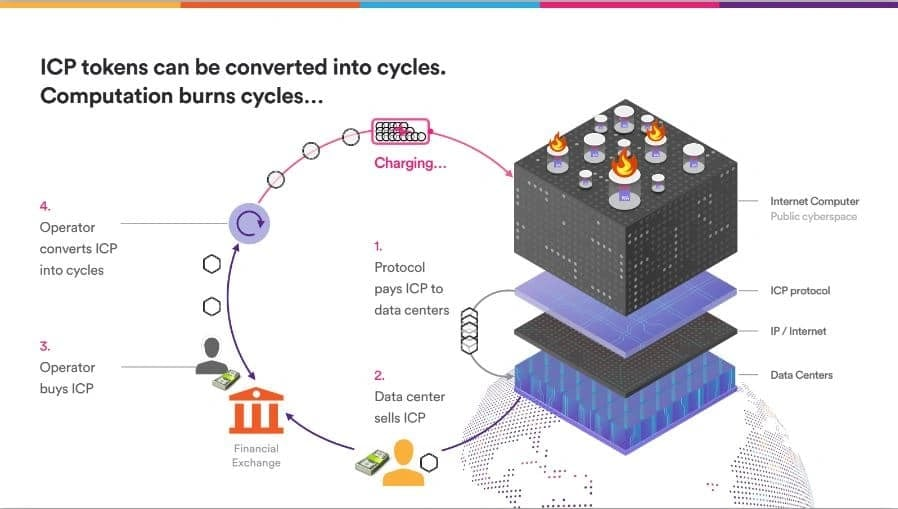
The ICP–Cycles model separates value (ICP) from spendable units (Cycles), insulating resource usage from market price swings.
This design means developers can run applications with predictable costs, while ICP retains its market-driven properties.
How ICP Powers Network Governance
ICP holders have the right to participate in the network’s decentralized governance.
Users stake ICP to create Neurons, which grant voting rights in protocol upgrades and parameter changes.
The governance framework is built on proposal submission, voting, and execution, with ICP holders actively involved via Neurons throughout the process.
This decentralized mechanism enables the network to evolve without centralized oversight.
How Neurons Define Voting Power
Neurons are the heart of ICP’s governance, determining each participant’s voting weight.
When users stake ICP, they generate Neurons. Voting power is based on both the amount staked and the duration of the lock-up—longer commitments equal more influence.
Neurons link token ownership to governance rights and incentivize long-term participation, strengthening the system’s stability and reliability.
How ICP’s Supply and Issuance Mechanisms Work
ICP launched with an initial supply of 469,213,710 tokens. Its supply is dynamic, adjusted through governance rewards and token burning tied to resource usage.
There’s no fixed cap: supply fluctuates through “minting and burning.” Governance participation mints new ICP, while converting ICP to Cycles (for resource consumption) burns tokens.
The supply framework includes initial allocation, governance minting, and burning from usage. The starting distribution sets the baseline, with ongoing supply shaped by network activity and governance engagement.
ICP Initial Distribution
| Category |
Percentage |
Description |
| Community & Governance |
50% |
For NNS governance, airdrops, and community incentives |
| Team & Early Contributors |
20% |
Supporting core development and protocol building |
| Early Investors |
25% |
Multiple funding round participants |
| Foundation & Ecosystem Support |
5% |
Ecosystem growth and long-term development |
This distribution prioritizes community and governance, ensuring most tokens drive participation and network incentives.
ICP’s Dynamic Supply Model
| Mechanism |
Trigger |
Supply Impact |
| Governance Rewards (Minting) |
Staking ICP and voting |
Increases supply |
| Cycles Conversion (Burning) |
Using ICP for computational resources |
Decreases supply |
ICP’s supply flexibly adapts to network demand—burning when usage rises, minting when governance activity grows—striking a dynamic balance.
This avoids the pitfalls of fixed inflation or deflation and keeps token economics responsive to real network activity.
ICP’s Ecosystem Use Cases
ICP supports a range of ecosystem applications.
It enables payment of computational costs, governance participation, and application support. Developers and users interact with network resources directly through ICP.
ICP spans the application, protocol, and governance layers, fostering seamless collaboration across all participants.
This comprehensive role ensures a robust, self-sustaining ecosystem.
How ICP’s Functionality Impacts Network Security
ICP’s tokenomics are tightly linked to network security.
Staking and lock-up mechanisms require governance participants to commit value, deterring malicious actions. The resource payment model ensures fair use of compute power.
ICP’s design ties economic incentives directly to network safety, raising the cost of attacks and increasing overall stability.
Summary
ICP unifies computational resource payments, governance participation, and supply dynamics—creating a token-centric architecture that allows the Internet Computer to operate sustainably in a decentralized environment.
FAQ
What are ICP’s main uses?
Paying for computational fees, participating in governance, and supporting network operations.
What’s the difference between ICP and Cycles?
ICP is the native token; Cycles are the units spent for computational resources.
How do you participate in ICP governance?
Stake ICP to create Neurons and vote on proposals.
Is ICP burned?
Yes, ICP is burned when converted to Cycles.
Does ICP’s function affect network security?
Yes, by aligning economic incentives and restrictions, ICP enhances network security.







